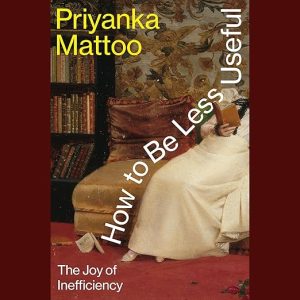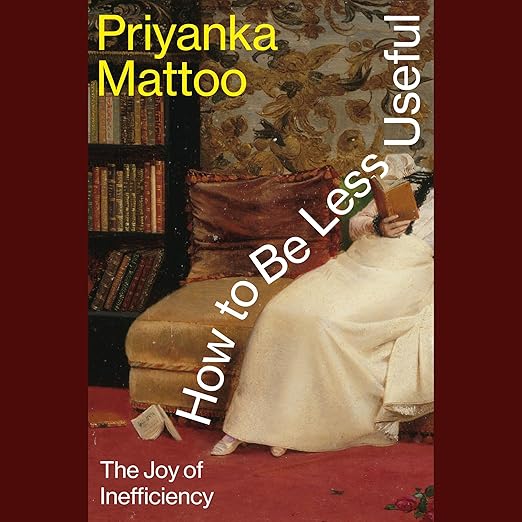
Somewhere around the third week of my annual attempt to cook every meal from scratch while also maintaining a running log and answering emails faster than they arrived, I came across Priyanka Mattoo's central argument in this audiobook: that the relentless drive toward efficiency and usefulness is not a virtue but a kind of self-inflicted diminishment. How to Be Less Useful is a book about reclaiming the activities that get systematically eliminated in middle life because they cannot be justified in the language of productivity. It is a book I needed to listen to while walking without a destination, which is either a coincidence or exactly the kind of thing Mattoo would appreciate.
A Closer Look at How to Be Less Useful
Mattoo writes from a specific vantage point: she has done the optimization. The career, the parenting, the responsible exercise regimen, the algorithmically curated television consumption that somehow leaves her feeling like she has watched a lot of content and enjoyed very little of it. Her opening provocation, that she has done everything right and missed everything, is the kind of sentence that lands differently depending on whether you have already had that thought yourself. For anyone who has, the book functions as both recognition and permission. The particular texture of that recognition is part of what makes the book work: Mattoo is not diagnosing a problem she observed from outside but one she has been living from the inside.
The targets of Mattoo's critique are not new. The optimization culture of American professional life has a substantial library of critics at this point, from Oliver Burkeman's writing on time to Jenny Odell's work on attention and doing nothing. What Mattoo brings is a wrier, more personal voice, and a willingness to locate the problem not in abstract systemic forces but in the specific daily choices that add up to a life where solo travel, dessert, and pointless hangs with friends have been quietly exiled from the calendar.
What Makes How to Be Less Useful Worth Hearing
The audiobook format is a good fit for a book whose argument is fundamentally about reclaiming non-instrumental time. Listening while doing something ostensibly unproductive feels appropriate, and Mattoo's voice in prose is conversational enough that the audio version should carry that quality well. The writing has the rhythm of someone who has thought carefully about what she is saying and then deliberately made it sound casual, which is a specific craft skill and one that suits audio adaptation particularly well. The seven-hour runtime gives Mattoo enough space to develop her argument through personal essays rather than listicles, which is the right choice for this material.
Things to Know Before Starting How to Be Less Useful
The central argument is counterintuitive in a way that requires sustained treatment to convince, and seven hours is long enough to do that work if the essay structure holds. The risk with books built around a single organizing premise is that the premise becomes repetitive before the end. Mattoo's challenge is to keep finding new angles on the same essential observation without the listener feeling that the argument has been made and is now being padded. The description suggests she takes on cooking, travel, social media, restaurants, and interpersonal bandwidth as separate case studies, which is a sound structural choice that should prevent the book from wearing out its welcome.
Listeners looking for a prescriptive program with specific exercises or action items will not find that here. How to Be Less Useful is more interested in shifting the reader's relationship to pleasure and purposelessness than in providing a schedule for doing so. Whether that feels liberating or frustrating depends on what you brought to the book in the first place. Readers who want a step-by-step recovery plan for over-optimization will need to look elsewhere. Readers who want to feel understood and then given permission to stop being so useful will find exactly that.
The book's treatment of cooking is one of its most recognizable passages for anyone who has experienced the transformation of something pleasurable into a performance of domestic virtue. Mattoo tracks how cooking can move from genuine pleasure through the exhausting terrain of Instagram presentation, dietary optimization, and the pressure to source ingredients at the correct level of ethical consciousness, until the original pleasure is barely visible underneath the obligations that have accumulated around it. The argument is not that cooking is bad but that the optimization of cooking is the thing that makes it bad, which is the same structure she applies to exercise, travel, and friendship throughout the book.
Who Priyanka Mattoo Is Writing For
This audiobook is for people in the decade between thirty and forty who have noticed that the activities that used to feel restorative have slowly been optimized out of their lives. It is for people who recognize the specific exhaustion Mattoo identifies: not burnout in the clinical sense but the flatter, quieter sensation of having made yourself very efficient at a life that is not actually what you wanted. Listeners who are content with high productivity and find the premise unconvincing are unlikely to be persuaded. But for anyone who has looked at a perfectly organized calendar and felt a vague sense of loss, Mattoo offers something valuable: the argument that being less useful is the correct response, and that the people who figured that out earlier than you have been having a better time.
Key Details
- Themes: Reclaiming pleasure in mid-life, the costs of optimization culture, humor as coping mechanism
- Mood: Wry and self-aware, with enough genuine feeling underneath the comedy to keep it from floating away
- Verdict: A well-timed audiobook for anyone in the thick of efficiency culture who suspects something important has been sacrificed in the name of usefulness.
Is this audiobook a self-help guide or more of a personal essay collection?
It blends both. Mattoo uses personal essays and memoir to investigate the optimization culture rather than offering a prescriptive program. The book has more in common with Oliver Burkeman or Jenny Odell than with a traditional self-help audiobook. If you want specific exercises or action plans, this may not be what you are looking for.
What is the tone of this audiobook?
Self-deprecating and funny without being preachy. Mattoo is honest about her own complicity in the optimization culture she is critiquing, which keeps the book from taking on a lecturing quality. The humor is consistent and serves the argument rather than distracting from it.
Does this audiobook cover travel as a specific topic?
Yes. Solo travel is one of the pleasures Mattoo identifies as systematically excluded from the optimized adult life, and the book addresses it alongside other activities like cooking, socializing, and watching television for enjoyment rather than cultural currency.
Is the narrator confirmed for this audiobook?
It is not confirmed whether Priyanka Mattoo narrates this audiobook herself or whether a professional narrator handles it. The listening experience may differ significantly depending on which is the case, so it is worth checking before purchasing if the narration matters to you.