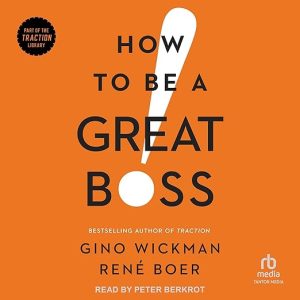
Gino Wickman shares this book's cover with a second name that never made it into the byline field. The description credits Gino Wickman and Rene Boer as co-authors; the record credits Wickman alone. Worth saying up front, because the book is explicitly a two-person collaboration built on shared consulting work, and the audiobook is being sold under a single name. Peter Berkrot handles the Tantor Audio recording, which runs three hours and thirty-seven minutes, making this one of the shorter management titles you will find carrying this much operational detail.
Their premise fits in a sentence and the book declines to complicate it: most employees are disengaged, and the variable that moves that number most is the person they report to. Wickman and Boer claim their tools have been used by more than thirty thousand bosses, a figure that means everything or nothing depending on how you count a user. What it does signal is that this is practitioner material. Nothing here derives from a study. It derives from a consulting practice that has run the same interventions across a lot of companies and kept what worked.
First, the Big Picture
By far the most substantive response on the record, a four-star entry from a reader who describes themselves as a tough rater, praises the simplicity of the message and points at the useful forms, the helpful lists, and the exercises. That is exactly where an audio edition runs into trouble. Forms do not narrate. Lists meant to be filled in become lists read aloud at you, and exercises turn into descriptions of exercises. Nothing on this listing mentions an accompanying PDF, so the practical apparatus those print readers are praising may simply not be inside the file you buy.
That same entry identifies the audience precisely: entrepreneurs who want to lead and manage well and have no HR professional on staff to ask. That is the gap this fills. Managers in large companies already have a performance framework imposed on them, complete with paperwork somebody else designed. Owner-operators have nothing, and they usually discover this during the week a good employee becomes a problem employee. Three and a half hours buys a starting structure, and even an unoriginal one is worth having.
Why How to Be a Great Boss Works as an Audiobook
What the book actually demands turns up in a February 2026 response: build systems and processes, then use them consistently. Consistency is where most first-time managers fail, and the book is unsentimental about it. Quarterly conversations only work if they happen quarterly. Expectations only work if somebody stated them before the failure instead of after it. None of this is novel and the book does not pretend it is. The value lies in having someone specify the cadence so you are not inventing management rhythm while also doing your actual job.
The runtime suits the content. Three hours and thirty-seven minutes is short enough to hear twice, which prescriptive books benefit from more than narrative ones do. Peter Berkrot is the only credited reader on the Tantor Audio edition, released in September 2016 and still the version on offer. Listeners who use audio for repeat exposure instead of first exposure will get more from the second pass, once the framework names have stopped being new and the sequencing underneath them becomes audible.
A Few Reservations
The numbers on this record do not survive checking. The display shows a 4.6 average drawn from a single rating, and a single rating can only be a whole number of stars, so that average has no arithmetic route to it. Five written responses sit underneath a counter that says one. Two of those five are worth very little as evidence in any case: one is a two-word product comment, and another was written by someone who bought the book for their daughter and is reporting her reaction instead of their own.
That gift purchase remains informative in one respect. It reports that the recipient, a working manager, was already doing most of what the book recommends, and found the material on difficult employees the part that added something. That is a fair description of the ceiling here. If you have managed people for five years, most of this will be confirmation, and the return concentrates in the chapters about conversations you have been avoiding. The book has nothing to say to an experienced manager about strategy, hiring markets, or organizational design.
Should You Listen to How to Be a Great Boss?
A five-star response from March 2025 recommends it for startups and businesses of any size, which is generous but points the right way. The natural listener is someone who has just acquired direct reports and holds no framework at all: the founder whose company grew past the point where everyone reported to them personally, the technician promoted to supervisor, the family business owner who inherited a staff along with the building. For that listener, three and a half hours of specified practice beats a longer book with a bigger idea.
Look elsewhere if you want evidence instead of practice. No study is cited, no counterargument is entertained, and the thirty-thousand-boss claim is a volume statistic rather than a result. Look elsewhere too if you already speak the Entrepreneurial Operating System vocabulary, since this is that system pointed at people management and the shape will be immediately familiar. What you get for the money is a short, specific operating manual with a co-author the byline forgot, delivered by one voice in a single sitting. On those terms it holds up.