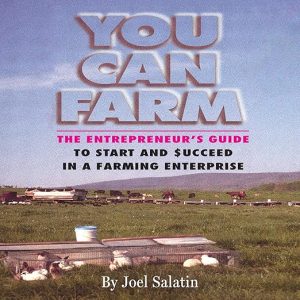
Joel Salatin reads his own book aloud for fourteen hours and nine minutes, and the description says so in a sentence that also tells you he co-owns Polyface Farm in Swoope, Virginia with his family. That combination is the whole proposition of this audiobook. The person explaining how a family can make a living from land is the person doing it, and the voice arrives with the calluses attached. Whether that is an advantage depends entirely on how you feel about being argued with by somebody who has already won the argument on his own acreage.
Honesty is the opening move, in a way farming books rarely manage. Before making any case, the copy concedes the objections: the farm population keeps shrinking, the capital needed to start is punishing, the pay is poor, and the working conditions are dusty, smelly and noisy. All true, it says, for most farmers. The pivot is that farm entrepreneurs are not most farmers, and that an aging farm population is opening gaps that somebody willing to work differently can move into.
A five-star from March 2004 gives the clearest account of the contents anywhere on the page, describing a high-level overview of a family-scale pastured beef, poultry and pork operation, with a substantial dose of why alongside the how. It picks out two arguments in particular: that a family-friendly farm beats a commercial commodity farm for a household with children, and that pricing your products ethically means pricing them high enough to actually live on. That second point is the one most enthusiasts skip and the one that decides whether a farm survives.
The book's stated target is not the working farmer. The copy names the wannabes, the people who entertain notions of living and learning on a piece of land, and says the burning question it addresses is whether it is really possible for you. Fourteen hours is a long time to spend on that question, and the length is justified because the answer keeps turning into arithmetic.
What Works
Voice is the argument for this edition. The description itself vouches for the performance, calling the reading by the author wonderful, and that is the only endorsement of the recording anywhere on the page, which is worth noting because it comes from the seller. What can be said independently is that a five-star from December 2011 describes an engaging writer who works dry humor through the material and is never afraid to be insightful about uncomfortable things. Dry humor read by the person who wrote it usually survives the trip into audio better than jokes read by a hired voice.
The scope is wider than a how-to. A December 2025 five-star argues the book matters to anyone interested in food quality, not only to prospective farmers, and points to its treatment of the roles played by the FDA and university agricultural extensions in small-scale regenerative farming. The same entry frames the payoff in two directions at once: a plan for becoming a farmer, and a plan for becoming a neighbor and a citizen who stores carbon in the soil while producing decent food.
For a fourteen-hour listen the structure holds up because the topics are modular. Enterprise selection, capital, marketing, pricing and the daily reality of livestock each get their own stretch, and none of it requires holding a diagram in your head. This is one of the rare practical books that loses almost nothing away from the printed page.
What to Watch For in You Can Farm
Dates on the responses tell you what you are actually reading. This recording went on sale in April 2020, and a pair of entries in the visible column date from 2004 and 2011, one of them sixteen years before the file existed. They are graded reactions to a printed book, and one of the most recent entries states plainly that the reader has not finished it yet. Treat the whole column as commentary on a text that long predates this edition.
Now the badge, which cannot be right. The page displays 4.8 with a counter of one rating beneath it, and a single vote can only be a whole number of stars. Look at the column and the contradiction deepens, because every visible entry gives it top marks, so no arithmetic over what you can see produces 4.8 either. Three fields on this record disagree, and the only one with any evidence behind it is the column.
Content-wise, the important caveat comes from a five-star filed in the United Kingdom in March 2011, which calls the book an outstanding step-by-step guide while warning that it was written by an American about the United States, and that the regulatory differences elsewhere need to be worked out by the listener. That entry also credits it as the first book it had seen that engages seriously with the revenue and expenses of farming, again with American figures. Take the framework, expect to rebuild the numbers.
Who It's For
People with the dream and no plan are exactly who this was written for, and the fourteen hours are best spent by someone who wants the fantasy tested, not flattered. Anyone weighing a career change onto land, anyone inheriting acreage and wondering what to do with it, and anyone interested in how small food producers actually make money will get their money's worth. It shelves under business on this listing, and that is the more accurate label for it than agriculture.
Give it a miss if you want technical husbandry, breed selection or crop science, or if you need a neutral survey of farming models, because the book has a position and holds it throughout. Listeners outside the United States should also be ready to translate regulation, market structure and price levels themselves, since the whole financial case is built on American conditions.
- Performance: Written and read by the farmer who lives the argument, which gives fourteen hours of practical instruction a first-hand authority no hired voice could supply.
- What it covers: Farm entrepreneurship, pastured livestock, pricing and profitability, food quality and regeneration.
- Feel: Plainspoken, opinionated and quietly evangelical.
- Our call: The most useful reality check available for anyone who has seriously considered making a living from land.
Common Questions
How long is the You Can Farm audiobook and who reads it?
Fourteen hours and nine minutes, with the author at the microphone. The description makes a point of the arrangement, noting that the same person part-owns and works the Virginia farm these methods come from, so the instruction and the voice arrive from one operation.
Does the audiobook work for listeners outside the United States?
The framework travels and the specifics do not. An American wrote it for an American readership, and the money chapters run on American prices and American rules, so anyone farming elsewhere will have to rebuild the figures and check local regulation themselves.