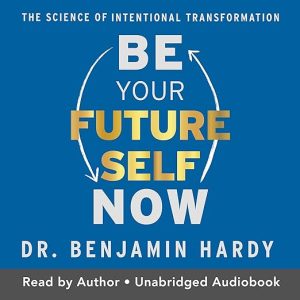
Self-authored audiobooks occupy a complicated position in the personal development genre. Benjamin Hardy narrating his own audiobook Be Your Future Self Now means you are hearing the psychologist make the argument in his own voice, which removes a layer of mediation but also removes the interpretive distance a professional narrator might provide. I started this one during a long flight, which turned out to be the right context. The core concept, that your present decisions are shaped by how vividly you can imagine your future self, is worth sitting with quietly. It is the kind of idea that benefits from space to breathe rather than from constant interruption.
Hardy's central claim is both psychologically grounded and practically oriented. He argues that the Future Self is not merely a motivational construct but a distinct person with different goals, habits, and perspectives. Understanding this, he contends, changes how you evaluate current choices. The question is not 'do I feel like doing this now?' but 'is this consistent with who my Future Self needs to be?' The framework is genuinely useful, and the material in this updated edition builds on the original with additional supporting content.
Is Be Your Future Self Now Worth Your Time?
Hardy's self-narration is confident and practiced. He speaks with the rhythm of someone who has given many talks and knows how to pace an argument for an audience that is not reading along. The delivery is warm without being performative, and the sections where he draws on personal experience are convincingly grounded. What it lacks is the precision of timing that a seasoned audiobook narrator develops specifically for the format. Hardy is a good speaker, but good speaking and good narrating are related skills with meaningful differences. The occasional flatness in transitions reflects that distinction.
Reviewers have been enthusiastic. One reader described the book as reshaping 'how I approach my choices, my goals, and even my daily habits.' Another noted that for listeners already familiar with the self-improvement genre, the book 'repeats wisdom from other popular books, but many more insights are waiting' to discover. That is an honest and useful calibration. Hardy draws on established psychological research and connects it to frameworks readers of Atomic Habits or The Gap and the Gain will recognize. He is synthesizing and deepening, not inventing from scratch, and that is a legitimate and valuable contribution.
The Best Parts of Be Your Future Self Now
The audiobook's particular strength is its treatment of identity as the lever of behavior change. Hardy argues convincingly that motivation-based approaches to habit formation are inherently unstable because motivation fluctuates. Identity-based approaches, anchored to a clear and specific Future Self, are more durable because they do not depend on how you feel on any given day. The stories and examples Hardy uses to illustrate this are accessible and drawn from enough varied contexts, athletic, professional, relational, to reach listeners across different life situations.
The PDF of supporting material included with this audio product is a genuine addition. Hardy integrates references to the supplementary content naturally rather than using it as a tacked-on promotional gesture. For listeners who want to do the reflective exercises the book recommends, the material provides a structured framework that extends the audiobook's value beyond the runtime.
Before You Commit to Be Your Future Self Now
Listeners already deep in the personal development genre may find the early chapters covering well-trodden ground. The concept of identity-driven behavior change is not new. James Clear articulates a version of it in Atomic Habits. Hardy's contribution is the specific Future Self framing and the psychological scaffolding he builds around temporal self-continuity, but getting to those original contributions requires patience through more familiar material.
The book also runs at a relatively high concept density for an audiobook. Hardy is a psychologist presenting research-informed ideas, and the listening experience rewards attention. This is not background listening. Passages about how clearly imagined Future Selves reduce impulsivity or how disconnection from the future self correlates with poor decision-making are worth pausing to absorb, which is not always easy in audio form without the ability to underline or annotate.
The companion PDF deserves a separate note. Hardy references specific exercises throughout the narration, and the PDF provides the structured prompts that make those exercises actionable. The most valuable of these is the Future Self letter, in which you write to your present self from the perspective of who you want to be in five or ten years. It sounds simple and is in fact harder than most people expect. The act of writing out what your Future Self has done, how they think, what habits they have built and which ones they left behind, forces a specificity that vague goal-setting never achieves. Hardy's framing gives the exercise its psychological weight: you are not imagining a wish; you are constructing a person whose decisions you are now obligated to begin enacting.
Should You Listen to Be Your Future Self Now?
Listeners in the middle of a genuine transition, career change, relationship reassessment, health pivot, will find this audiobook most useful. The framework is designed for people who already know change is necessary but lack a stable way to connect daily choices to long-term goals. Hardy gives you a scaffold for that connection, and his self-narration means the voice you are hearing is the same voice that built the argument.
Listeners who have already read and absorbed Hardy's earlier work, including The Gap and the Gain or Personality Isn't Permanent, will find familiar territory here alongside new material. New listeners to Hardy's ideas will likely find this a strong entry point. Expect a rigorous, well-structured audiobook that rewards attention, not a quick motivational lift.
The Short Version
- Narration: Benjamin Hardy narrates his own work with the confidence of an experienced speaker; warm and paced well, though without the precise timing of a dedicated audiobook narrator.
- Themes: Future self as identity anchor, identity-driven behavior change, psychological self-continuity
- Mood: Reflective and structured, demanding attention rather than offering passive inspiration
- Verdict: A psychologically grounded take on identity and behavior change that rewards listeners willing to engage actively rather than listen passively.
Good to Know
Does Benjamin Hardy narrating his own audiobook add to or detract from the listening experience?
It adds authenticity and the sense of hearing the argument from its architect. What it lacks is the precise timing and vocal modulation that professional audiobook narrators develop specifically for the format. Overall it works, with occasional flatness in transitions.
Is this audiobook suitable for listeners already familiar with James Clear or similar personal development writers?
Yes, though the early chapters will cover familiar ground. Hardy's specific contribution, the Future Self framing and its psychological underpinnings, is distinct enough to offer new material even for experienced genre readers.
What is the PDF supplementary material included with this audiobook?
Hardy provides a downloadable PDF with exercises and frameworks that extend the audiobook's reflective work. It is referenced naturally within the narration and is worth downloading if you plan to engage with the material actively.
Is this audiobook suitable for passive background listening?
Not really. The concept density is high for the personal development genre, and key ideas benefit from active attention. It works best in a focused environment where you can pause and reflect, rather than as commute or exercise background audio.