Quick Take
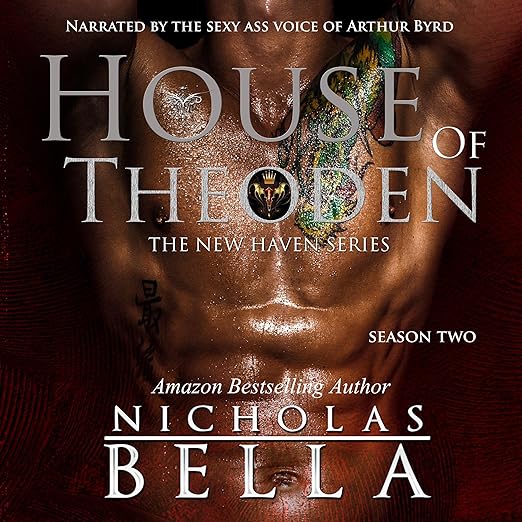
- Narration: Arthur Byrd brings the right register to Nicholas Bella’s dark paranormal world, commanding and unhurried, which suits a story built around power dynamics.
- Themes: Domination and submission hierarchies, transformation under duress, loyalty within brutal systems
- Mood: Dark, intense, and deliberately transgressive, the author’s content warnings are serious and should be taken at face value
- Verdict: House of Theoden delivers on its explicit promises of darkness and heat, with more character depth and narrative architecture than the content warning alone might suggest, but the warnings exist for good reason.
I want to be straightforward about what this review is and is not. House of Theoden is the first book in Nicholas Bella’s New Haven Series, an LGBTQ+ dark paranormal fantasy with explicit adult content that the author warns readers about at length and without apology. If you are the target audience for this kind of fiction, the audiobook delivers on its premise. If you are not, this review will tell you that clearly so you can move on without wasting your time.
The 2017 publication has built a reader base that returns for rereads, one reviewer mentioned a third read, which tells you something meaningful about the world-building and character investment underneath the explicit content. At over thirteen hours, this is not a quick listen, and the runtime is occupied by more than the promised scenes between powerful, sexy men.
Our Take on House of Theoden
The premise is structured around two simultaneous stories of submission and power navigation. Lord Theoden receives orders from King Ara that conflict with his own desires, a tension that the book explores through the friction between institutional hierarchy and personal will. Noel, a newer character figuring out his role as an enforcer under the sadistic Marco’s training, provides the reader’s primary point of entry into the New Haven world. His evolution across the series is consistently cited by readers as one of the main draws, one reviewer noted watching Noel evolve and come into his own from his first book appearance as a particular pleasure.
Bella’s world-building is deliberately revisionist toward familiar paranormal creatures. The author makes clear that the vampires are not misunderstood romantics, the werewolves are not cuddly, and the dragons are not the childhood variety. That commitment to a genuinely dark supernatural register distinguishes the series from paranormal romance that uses dark aesthetics as window dressing while maintaining fundamentally safe emotional structures. House of Theoden does not maintain safe emotional structures.
Why Listen to This Rather Than Read It
Arthur Byrd’s narration suits the material well. The world Bella has constructed runs on authority and control, and Byrd’s voice carries the appropriate gravity without becoming one-dimensional. The character differentiation is handled well enough that the complex power hierarchies, Ara, Theoden, Marco, Noel operating at different levels of the same system, remain navigable across thirteen hours.
One reviewer with experience of Bella’s earlier series noted they were initially hesitant, having found the first series too dominated by explicit content at the expense of plot. House of Theoden represented, in their view, a better balance, more storyline and character building. That comparative context is useful for listeners already familiar with the author’s work.
What to Watch For in the Power Architecture
The series rewards reading in order, and this is specifically noted by reviewers. The world’s rules around vampires, werewolves, and the enforcer hierarchy are established in earlier books, and House of Theoden assumes some familiarity with those structures. First-time readers to the New Haven universe may want to verify they are starting at the appropriate entry point for this particular volume’s placement in the series.
The order and discipline themes that structure Theoden’s house are more than aesthetic choices, they organize the character relationships and drive the plot tensions in ways that become clearer across multiple volumes. Bella is building something with architectural intent, even if individual scenes are designed for immediate rather than cumulative impact.
Who Should Listen to This Recording
Listeners who enjoy dark paranormal fiction with explicit LGBTQ+ content and who want more narrative substance than pure erotica provides will find this satisfying. Those who have read Bella’s earlier work and found it too sex-heavy are worth noting, multiple reviewers suggest this entry represents better plot-to-content balance. This is emphatically not for sensitive readers: the content warnings in the synopsis are genuine, not performative. Anyone for whom dark, non-romantic power dynamics in an explicit context is a hard boundary should simply look elsewhere.
Frequently Asked Questions
Is House of Theoden the first book in the New Haven Series, or do I need to read prior books first?
House of Theoden is listed as Book 1 of the New Haven Series, but Nicholas Bella has published earlier works set in the same world. Reviewers specifically recommend reading in order for the best experience, so it is worth checking whether earlier series in the New Haven universe precede this volume and whether they are intended as prerequisites.
How does Arthur Byrd’s narration handle the multiple dominant characters in Bella’s power hierarchy?
Byrd maintains vocal authority throughout and differentiates the key characters, Ara, Theoden, Marco, Noel, sufficiently to navigate the hierarchy. The performance is deliberate rather than theatrical, which suits a world built on control and order rather than emotional volatility.
Is there enough plot and character development to sustain 13-plus hours, or is this primarily explicit content?
Reviewers are consistent in noting that House of Theoden offers more narrative substance and character development than Bella’s earlier series. Noel’s evolution from his first appearance is frequently cited as a genuine character arc. The explicit content is prominent but exists alongside enough world-building and relationship tension to justify the runtime for readers committed to the genre.
How graphic is the content, and does it affect the listening experience in ways that audio specifically amplifies?
The content is explicitly graphic, the author’s own synopsis warns of raunchy and steamy scenes. Audio narration does amplify explicit content relative to reading silently, which is worth considering when choosing your listening environment. The book is not suitable for public or shared listening spaces.