Quick Take
- Narration: Imani Jade Powers brings warmth and emotional precision to Saika’s grief-laden interiority, making the cozy-fantasy register feel grounded rather than twee.
- Themes: Grief and avoidance, found family, magical belonging and identity
- Mood: Quietly heartbreaking and warm, like a rainy afternoon in a house full of people who understand you
- Verdict: A fantasy that earns its emotional weight without ever overreaching it.
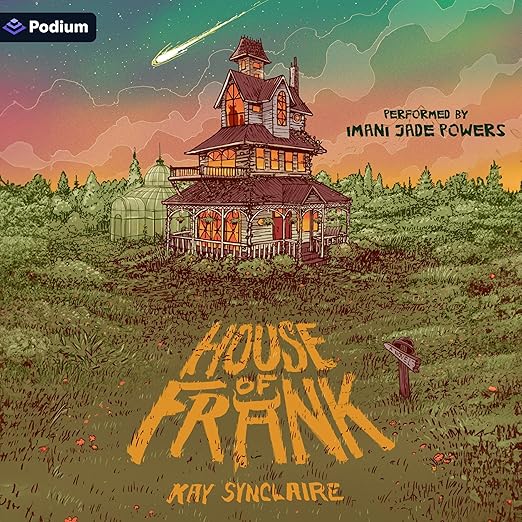
I listened to most of House of Frank on a Sunday afternoon when I had specifically planned to do nothing. I had picked it at random from a pile of unreviewed titles, knowing almost nothing about it except that it was LGBTQ+ fantasy from Podium Audio and that the cover featured what appeared to be a large, cardigan-wearing creature. By the time evening arrived I had not moved from my chair, and I had quietly cried at least twice without quite being able to explain why.
That, it turns out, is exactly what this book is designed to do. Kay Synclaire has written something that is technically a cozy fantasy and technically a grief narrative, but what it actually feels like is a book about the specific way human beings avoid the things that most need doing. Saika, a witch who has lost her power along with her sister, arrives at the Ash Gardens to fulfill a final request she cannot bear to fulfill. She takes a job. She makes excuses. She hides her powerlessness behind a shard of fallen star. She keeps moving so she does not have to feel the thing that is waiting to be felt. Most of us have done some version of this. Very few fantasy novels have made me feel it with this much precision.
The Cast That Holds Ash Gardens Together
Frank himself, the enormous knit-cardiganed mythical beast who owns and tends the sanctuary, is one of the stranger and more affecting creations I have encountered in fantasy this year. He is not played for comedy, though he has moments of genuine humor. He is played for kindness, which is harder to write and rarer to find. Around him Synclaire assembles a motley staff of bickering twin cherubs, a mute ghost, a cantankerous elf, and a half-witch who irritates Saika in ways that eventually make sense. Each of them is grieving something. Each of them has found a way to keep functioning inside that grief. The ensemble dynamic is the heart of the book, and Synclaire manages it without tipping into the forced-quirky character parade that sinks a lot of found-family fantasy.
One reviewer described the book as examining grief through many different characters, all grieving in their own healthy and unhealthy ways. That is accurate. The variety matters. Saika’s avoidance is not presented as the only shape grief takes, and the other characters illuminate different corners of the same territory without the narrative becoming a grief taxonomy. The emotional restraint another reviewer praised is real: Synclaire trusts her readers to feel what is happening without having it explained to them. That trust is evident from very early on and it never wavers.
What Imani Jade Powers Adds
Imani Jade Powers is exactly right for this material. Her performance for Saika carries a kind of careful steadiness in the early sections that gives way, gradually and convincingly, to something softer and more open. She handles the ensemble of supporting characters cleanly, keeping each voice distinct without the kind of exaggerated differentiation that often breaks cozy fantasy narration. The audio was described by one reviewer as fantastic, and I would agree. Powers does not push the emotional beats. She arrives at them at exactly the pace Synclaire’s prose sets, and the effect is that the moments that hit you hit you on the book’s timeline rather than the narrator’s.
The eleven-hour runtime sits comfortably for the story being told. There are sequences that move slowly, which is a deliberate choice, since the pace of Saika’s life at the sanctuary is itself a form of avoidance, and Synclaire needs the listener to feel the passage of time as something both comforting and procrastinating. Listeners who want plot-driven momentum will find themselves adjusting to a different rhythm. Those who make that adjustment will find it rewards them.
The Worldbuilding That Earns Its Space
The magic system in House of Frank is worth discussing because it does real thematic work. The idea that witchcraft is like schooling, that you choose an area to specialize in and build your power through that specialization, means that Saika’s disconnect from her magic is also a disconnect from the identity she built during her years with her sister. The magic is not decorative. It is the externalized form of what she has lost. The Ash Gardens themselves, a stormy sanctuary where people bring the remains of loved ones to be planted, carry the same metaphoric weight without ever feeling heavy-handed. The worldbuilding is inventive and specific enough to feel fully realized, but it never crowds out the emotional narrative.
A minority of reviewers found the book less cozy than they were hoping, and one noted that Saika could be annoying in her avoidance behaviors. Both of these responses are understandable. This is not a comfort-read in the unchallenging sense. It asks you to sit with someone who is hurting herself by refusing to grieve, and that can be uncomfortable. But the discomfort is earned and purposeful, and the ending, which multiple reviewers described as hopeful, pays off the difficulty honestly.
Who Should Follow Saika to the Ash Gardens
Readers who respond to Becky Chambers’ found-family science fiction, or to T. Kingfisher’s ability to blend the whimsical with the genuinely affecting, will likely find a lot to love here. Listeners who have experienced grief and felt the specific pull toward busyness as a defense mechanism will find themselves recognized in ways that sneak up on you. Those looking for plot-driven fantasy with active antagonists and clear stakes should look elsewhere. House of Frank is a quiet book about a quiet kind of courage, and it is exactly as good as that sounds.
Frequently Asked Questions
Is House of Frank part of a series, or does it stand alone?
Based on all available information it is a standalone novel. The story reaches a complete emotional conclusion and does not end on a cliffhanger.
How explicit is the LGBTQ+ content in House of Frank?
The LGBTQ+ elements are present in character relationships and identity, but the book’s primary focus is grief and found family. The tone is warm and wholesome rather than explicit.
Is the slow pacing deliberate, and does it pay off?
Yes. The slower tempo mirrors Saika’s deliberate avoidance of her grief, and the book earns the pacing choice by making the emotional resolution feel genuinely arrived at rather than imposed. Reviewers who adjusted to the rhythm found it deeply affecting.
Does Imani Jade Powers handle the ensemble cast of unusual creatures effectively?
Yes. Powers differentiates the bickering cherubs, the mute ghost, the cantankerous elf, and the half-witch without resorting to cartoonish voices. Each character remains distinct while the narration maintains the warm, melancholic register the material requires.