In Brief
- Voice: Elizabeth Evans handles the tonal range of Crescent City's third book with the authority of a narrator who has inhabited these characters across nearly 80 combined hours of series listening; her Bryce remains sharp and her Hunt registers desperation credibly.
- Big ideas: Multiverse crossover, resistance against authoritarian systems, the cost of chosen loyalty
- Atmosphere: Relentlessly propulsive with reveals that compound rather than resolve
- Worth it?: Sarah J. Maas delivers a third installment that honors the series' scale and justifies the investment of the first two books while opening a wider universe than readers originally bargained for.
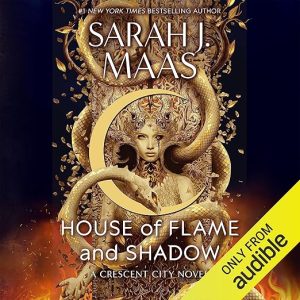
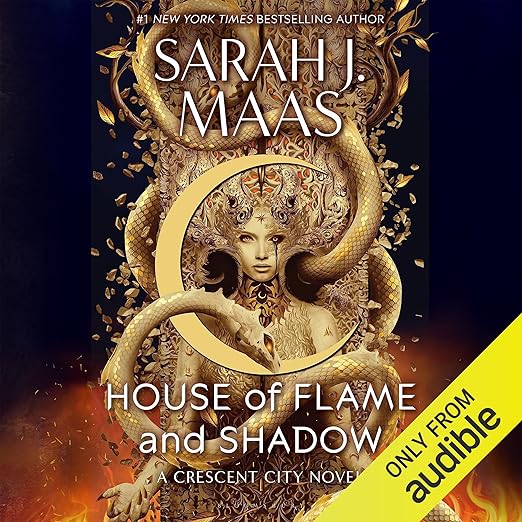
Bryce Quinlan in a world that is not Midgard, and Hunt Athalar in the Asteri's dungeons again: House of Flame and Shadow opens with its two leads separated and at their lowest points simultaneously. Sarah J. Maas's third Crescent City audiobook, narrated by Elizabeth Evans across twenty-nine hours and forty-two minutes, wastes no time establishing that the escalation promised at the end of House of Sky and Breath is not gradual. The book runs at a sprint from its first scenes, and the multiverse crossover elements that had been seeded across the series are no longer suggestions. For listeners who have been in this series from the beginning, the payoff structure this volume delivers is significant in scale and scope.
For listeners arriving at this audiobook having completed the previous two Crescent City installments, what follows will feel appropriate to the investment made. Bryce's cross-world displacement forces her into alliances with figures whose significance readers of Maas's other series will recognize immediately. For Crescent City-only listeners, those same elements land as mysterious but not unintelligible: Maas writes them with enough in-scene exposition to function without prior knowledge of her other fictional universes, even as the connections clearly carry additional weight for those who have that background.
Bryce's Momentum, Hunt's Weight, One Long Book
The novel's central structural achievement is maintaining two equally urgent narrative threads across its considerable length. Bryce's chapters, set in a world of different rules and different power structures, carry the plot's forward momentum and the series' larger questions about what the Asteri actually are and what defeating them would require. Hunt's chapters, set in captivity, are more constrained in action but carry more emotional weight. His desperation to know Bryce's fate and his powerlessness to act on it give the dungeon sequences a credibility that could easily have deflated into passive waiting. Evans captures that distinction in her delivery across the long runtime.
Reviewers cite the mind-bending reveals as a consistent highlight, and mind-bending is not overstatement here. Maas is operating at the intersection of several long-running plotlines, multiple magical systems, and a multiverse whose rules she has been establishing across half a dozen books in different series. The payoffs arrive in clusters rather than evenly distributed, which makes certain stretches feel like setup and others feel almost overwhelming in their density of consequences. At thirty hours, that uneven distribution is a pacing reality: the book would need to be substantially shorter to avoid it, and shorter would mean sacrificing either the plot's complexity or its emotional development. Neither sacrifice would serve the series.
Evans' Eighty Hours Give Bryce a History
Elizabeth Evans has narrated all three Crescent City books, and continuity at this scale matters. By the third installment, her Bryce has a history: specific vocal textures that connote specific emotional states, a relationship with the cadence of Maas's action sequences that has been calibrated over nearly eighty hours of combined series listening. Newcomers to the audiobook format in this series should start at the beginning. But for listeners who have been in Evans's hands through House of Earth and Blood and House of Sky and Breath, the third book benefits from accumulated trust in a narrator who has earned it through sustained performance across enormous runtimes.
The multiverse crossover component is the series' most ambitious narrative move and the element that most divided readers of the print edition. In audio, at thirty hours, the gradual revelation of what the crossover means for Bryce and Hunt's world feels proportionate. The audiobook's length allows Maas to develop the implications of each revelation before deploying the next, which gives the plot room to breathe in ways that rapid print reading might compress. The sequence of reveals lands differently when you cannot flip ahead to see what is coming.
Asteri Reveals Reward Careful Cross-Book Attention
The Asteri's true nature is the mystery this book resolves most completely, and tracking the evidence Maas has laid across the first two installments makes the reveal more satisfying. Bryce's cross-world encounters are not just plot mechanics: they recontextualize what Crescent City has been about from the beginning, and that recontextualization is the book's most sustained intellectual pleasure. It rewards listeners who have been paying careful attention to detail across all three volumes rather than simply following the romantic thriller surface.
Hunt's arc in the dungeons moves toward a different kind of resolution than readers expecting action-hero rescue will anticipate. His chapters ask questions about what captivity does to someone whose identity is built around power and freedom, and Maas answers those questions in ways that connect back to his arc in the first book with more coherence than the surface genre framing suggests. The emotional development here earns the runtime it occupies and serves the series' larger argument about what these characters are actually willing to risk for each other.
Not a Viable Entry Point for This Trilogy
Series listeners who have completed both prior Crescent City audiobooks: this is not a viable entry point and the narrative simply does not function without that context. Fans of Maas's other series will find the crossover elements rewarding rather than confusing. Listeners who found the second book's ending frustrating in its ambiguity will find this installment considerably more resolving. Those fatigued by long fantasy audiobooks with dense world-building should know the runtime is the real commitment here: at thirty hours, this is an investment that pays off for those already inside the series and is inadvisable for those who are not.
Common Questions
Can House of Flame and Shadow work as a standalone audiobook, or is it essential to listen to the first two Crescent City books first?
Not a viable standalone. The audiobook picks up directly from events in House of Sky and Breath, and the multiverse crossover elements require familiarity with Bryce and Hunt's established history. Start with House of Earth and Blood.
Do you need to have listened to Sarah J. Maas's other series audiobooks to follow the crossover in House of Flame and Shadow?
Maas writes the crossover elements with sufficient in-scene context for Crescent City-only listeners to follow the plot. The connections carry additional meaning for readers of her other series, but the book does not require that prior knowledge.
How does Elizabeth Evans's narration hold up across a nearly 30-hour audiobook?
Consistently strong throughout. Evans maintains the tonal distinctions between Bryce and Hunt's narrative perspectives and handles the emotional escalation of the final act without losing the vocal textures she established in the earlier installments.
Is House of Flame and Shadow a satisfying series conclusion, or does it end on another major cliffhanger?
It resolves the Asteri storyline and the central questions of Bryce and Hunt's arc more fully than the second book did, while leaving the wider multiverse implications open. Most readers describe it as genuinely satisfying rather than truncated.