The Short Version
- Performance: Sarah Maslin Nir narrates her own book with the authority of someone who has reported and lived this story, and the self-narration gives the personal passages a vulnerability that a hired narrator could not replicate.
- What it covers: Obsession as identity, the hidden worlds within a city, the Holocaust's long shadow on a daughter's life
- Feel: Warm but substantive, part love letter and part investigation, the kind of memoir that keeps expanding its scope
- Our call: A richer book than the premise suggests, reaching well beyond horse content into questions of heritage, belonging, and how an animal becomes the organizing principle of a life.
I expected to enjoy this one in a specific and limited way. A New York Times reporter writes about horses. There would be good prose, interesting access, a few revelatory profiles. I was not expecting the sections about Nir's father surviving the Holocaust, or the description of her childhood as deeply lonely despite being spent at the center of Manhattan's most elite social circles, or the image of a young girl pressing her nose to the window of a stable hidden inside a townhouse, convinced she had found the only world that fit her. Horse Crazy turned out to be a more serious book than I anticipated, and it is better for that.
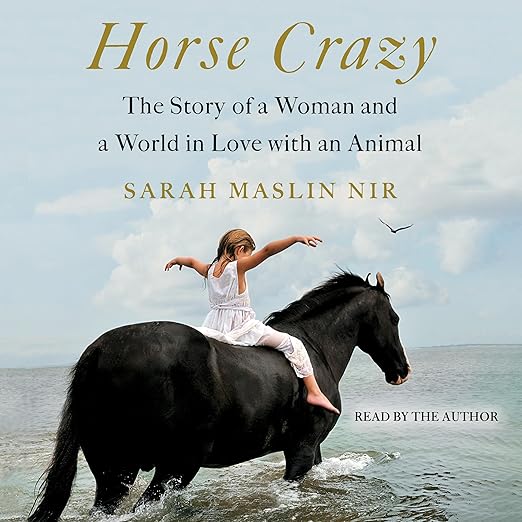
Sarah Maslin Nir is a Pulitzer Prize finalist and longtime New York Times reporter whose equestrian life began at age two. She narrates her own audiobook, which was released through Simon and Schuster Audio in 2020 and runs just over eight hours. This is also a free audiobook available through Audible membership. The combination of reporter's instincts and personal stake gives the book an unusual dual structure: chapters that profile figures in the horse world alternate with chapters drawn from Nir's own life, and each chapter is named after a horse she has loved, which is exactly the kind of organizing device that sounds sentimental until you understand how much weight each of those names carries.
Monty Roberts, the Blairs, and a Marwari Rescue
Nir's access as a journalist produces the kinds of stories that horse enthusiasts already in the world might know but that most listeners will not. Monty Roberts, the California trainer known as the man who listens to horses, appears with a pet deer in tow. George and Ann Blair run a riding academy on a tiny island in Harlem River, where they are working to recover the erased history of the Black cowboy, a story that Nir treats with the specificity it deserves. Francesca Kelly's life's mission to protect an endangered Indian horse breed, the Marwari, and bring them to America, is rendered with the texture of genuine reporting rather than the glossed-over summary that travel memoirs often offer when they borrow from professional journalism.
These profiles do something structural for the book: they make the world around Nir's personal obsession feel large and genuinely complex. The horse world is not monolithic. It contains elites and outsiders, tradition and innovation, conservation work and competitive performance, the kind of contradictions that reward a journalist's eye. One reviewer noted that Nir's writing produces a powerful feeling of place, that they were alongside her in the cargo hold of a 747 with three Warmbloods, or galloping on a Marwari stallion. That specificity of scene comes from the reporting habit, and it translates well to audio.
Her Father's Holocaust Survival, and a Lonely Childhood
The book is a memoir as much as it is a reported work, and the personal sections are where it reaches toward something more difficult than enthusiasm for horses. Nir describes her father's Holocaust survival with the weight that material requires. She is honest about growing up wealthy and socially connected but deeply lonely, finding in horses the family she didn't feel she had in human form. She describes chasing down truants as an auxiliary mounted patrol officer in Central Park, which is the kind of New York detail that belongs in a piece of urban mythology. And she speaks about using horses to move through heartbreak in ways that are candid without being self-pitying.
One reviewer described the book as coming-of-age memoir alongside first-rate reporting, and that is accurate. But it is worth noting that the coming-of-age element does not have a tidy arc. Nir is not offering a story of how horses saved her in a simple sense. She is offering a more honest account of how an obsession that starts before you can articulate it becomes woven into every subsequent experience, and how that is both a gift and a constraint.
Sarah Maslin Nir Narrates Her Own Reporting
Nir reading her own book is the right call for this material. The personal passages, particularly the ones involving her father, carry an emotional register that would be difficult for any other narrator to access. Nir knows exactly how much weight to put on each word in those sections. The reported profiles, which require a different gear, also benefit from her delivery: she has a journalist's instinct for what is important in a story, and that judgment shapes her reading of her own research in useful ways.
The self-narration does mean the production has the slight informality that author readings sometimes produce compared to professional audio work. But for a book this personally rooted, that informality reads as authenticity rather than technical limitation. Several reviewers placed Nir in the company of Malcolm Gladwell and called her one of the great storytellers working now. That may be generous, but it points accurately to the quality of her prose and her ear for a telling detail.
For Horse Lovers, and Anyone Drawn to Belonging
Listen if you have any relationship with horses, either current or historical, or if you are drawn to books that use a specific passion or subculture as a lens for examining larger questions about identity and belonging. The book is well-made enough that it works for readers with no horse knowledge or interest, particularly if they are drawn to New York memoir, immigrant family stories, or the specific kind of journalism that takes niche communities seriously.
Skip if you want a straightforward how-to or historical account of horse culture without the memoir elements. The personal narrative is woven throughout the book and cannot be separated from the reported sections. Also skip if Holocaust family narrative is something you need to be in the right headspace for before committing, because those sections are handled with care but genuine weight.
Good to Know
Do you need to know anything about horses or riding to appreciate this book?
No. Reviewers who identified themselves as lifelong horse lovers praised the book highly, but so did readers with no particular background in equestrian culture. The horse world functions as Nir's subject, but the book's real concerns, identity, belonging, family history, are universally accessible.
How much of the book is personal memoir versus journalistic reporting?
The two are interwoven throughout rather than separated into distinct sections. Chapters alternate between Nir's personal story and profiles of figures in the horse world, but the reporting and the memoir inform each other. The book reads as a unified work rather than two separate books bound together.
The synopsis mentions Nir's father's Holocaust survival. How prominent is that material in the overall book?
It is significant rather than peripheral. The sections about her father's history are handled with care and serve to contextualize Nir's childhood and her relationship to loneliness and belonging. Listeners should know this material is present and given serious weight.
Does Sarah Maslin Nir's self-narration add to or detract from the listening experience?
For most listeners, it adds considerably. The emotional authority she brings to the personal passages, particularly those involving her father and her childhood, is difficult to replicate in a hired narration. One reviewer placed her among the great storytellers of her generation, and her self-narration reflects that confidence.