
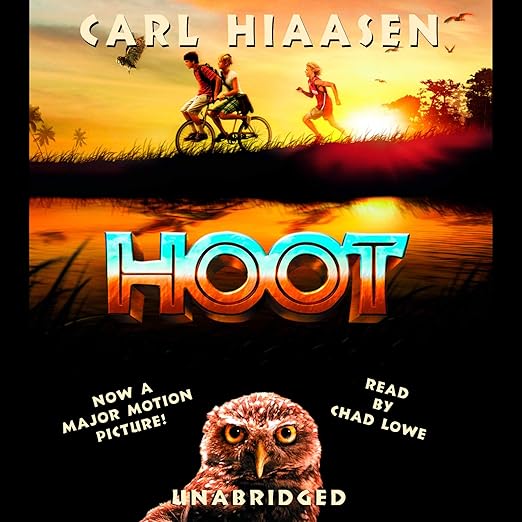
How do you get a middle schooler to care about burrowing owls? Carl Hiaasen's answer is to bury them under a pancake franchise and let a renegade eco-avenger declare war on the construction site. Hoot carries a Newbery Honor and a number one bestseller tag, it runs six hours and twenty-five minutes as an audiobook, and it remains one of the very few children's novels where the antagonists are permits, paperwork and a corporate schedule.
The score on this page points the wrong way. Six ratings produce a posted 4.5, while the five written responses underneath carry one four-star and four fives, averaging 4.8. The readable column therefore sits above the badge rather than below it, and the unread votes are the ones dragging the figure down. That is the opposite of the usual pattern, and it means a browser scanning averages will undervalue a book whose visible readers were more enthusiastic than the number admits.
Composition muddies it further. The newest five-star on the page has no review text at all: its entire content is a headline praising the quality and the easy-to-carry size of the item, decorated with emoji. Somebody graded a physical object. On a listing selling a six-hour recording, a rating awarded for portability is not merely useless, it is actively misleading, and it currently sits at the top of the column as the most recent word on the book.
What Works
An October 2020 four-star gives the clearest account of what the book actually does. Hiaasen, that reader says, may be the funniest person ever to write a book, and he wrote this one for middle school readers and collected a Newbery honor for the trouble. Then comes the summary that matters: young Roy arrives in Florida from out west, finds himself the odd one out at a new school, makes friends where he can, and ends up entangled in a criminal effort to break the endangered species protections. That is the whole engine, and it is a genuinely unusual one for a kids' novel.
The comedy holds up because Hiaasen refuses to make the adults harmless. Everybody loves Mother Paula's pancakes except the owls living on the building site, and the joke is that the owls have the law on their side and no way to invoke it. Children in this book are the only characters willing to act on information the adults already have. Add alligators, poisonous snakes and a new kid's bully, and you get a comic thriller for eleven-year-olds that never once talks down about consequences.
Spoken aloud, the difficulty is tone. Hiaasen's humor is dry, and dry humor for a young audience is the hardest register in the business, because the temptation to signal the jokes is enormous and signaling them kills them. Chad Lowe is the credited reader, and everything here depends on whether the Florida eccentrics land as people rather than as cartoons. A children's comedy that mugs is unbearable in the car; one that trusts the writing is the reason families finish audiobooks together.
The description reads like an ingredient list, and that is not an accident: a new kid, his new bully, alligators, burrowing owls, a renegade eco-avenger and several extremely poisonous snakes. Hiaasen writes to that inventory on purpose, dropping every element in early and then letting them collide, which is why the middle never sags. For a young listener the effect is that a fresh complication keeps arriving before the previous one has settled. For an adult it is the pleasure of watching a professional thriller writer work at half scale without putting down any of his tools.
Things to Know Before Starting Hoot
The oldest response on the page is not a customer review at all. Dated October 3, 2002, it is a syndicated critic's column, headed with the columnist's own branding, written while the author of it sat on convention center carpeting waiting in line for a Jean Auel signing at six fifteen in the morning. It is warm, it is well written, and it describes finishing the book with damp eyes. It also predates this recording by more than a year, which places it firmly among the print verdicts.
That matters because the column is the longest and most persuasive text on the listing, and a browser reading top to bottom will take it as the considered opinion of a reader who chose this edition. The description compounds the impression with awards: a Newbery Honor, a number one bestseller line, an all-time best kids book citation from a national magazine. Every one of those honors belongs to the novel. None of them belongs to the six hours and twenty-five minutes you would be buying.
The date spread on this page is a curiosity in itself. A recording published on October 31, 2003 is still gathering responses in January 2026, and the five written entries run across more than twenty-three years, from a convention floor in 2002 to a single line posted last winter. Longevity like that is a compliment to the book. It also means the average aggregates two decades of buyers who owned very different objects, with nothing in the display separating a paperback bought for a classroom from a download bought for a family trip.
Who It's For
A January 24 five-star gives the most practical recommendation available: an eleven-year-old has just started on these books, loves them, and finds them genuinely interesting. That is a parent reporting, not a reader, and it is still the best available signal on the target age. Eleven is about right. Roy is a new kid navigating a new school, the stakes are legal rather than violent, and the environmental argument is delivered through a construction schedule rather than through a lecture.
Families with readers between about nine and thirteen are the core audience, and adults who like Hiaasen's grown-up Florida novels will recognize the machinery in miniature. One four-word response from earlier that month sums up the consensus about as efficiently as it can be summed up: great author, cute story. Set it aside if you want a nature book, because the owls are a plot device rather than a subject. Set it aside too if your listener needs a protagonist with more edge than a decent kid from out of state. What you get instead is six and a half hours of comic civil disobedience, which is a rarer thing to hand a child.
Before You Listen
Is this audiobook too intense for younger listeners?
Not really. The threat comes from bullying, trespassing and a corporation cutting corners rather than from violence, and the alligators and snakes are played for comedy. Nervous listeners should know the owls are in genuine danger, which is the emotional weight the book is built around.
Does a six-hour-and-twenty-five-minute audiobook work as a family listen?
It is close to ideal for one. The length fits a couple of car journeys, the plot keeps introducing complications rather than dwelling on any of them, and the comedy is pitched so that adults get their own layer. Expect questions about endangered species law afterward.







