Quick Take
- Narration: Donna Allen brings an animated, classroom-energy delivery that suits the book’s myth-busting tone without tipping into condescension for older listeners.
- Themes: Historical myth-busting, civic identity, untold perspectives in the Revolution
- Mood: Lively and irreverent, like a teacher who knows the textbook got it wrong
- Verdict: Kate Messner’s sharp, well-researched debunking of Revolutionary War myths lands particularly well in audio, where Allen’s energy keeps the corrections feeling like discoveries.
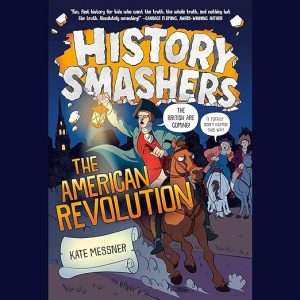
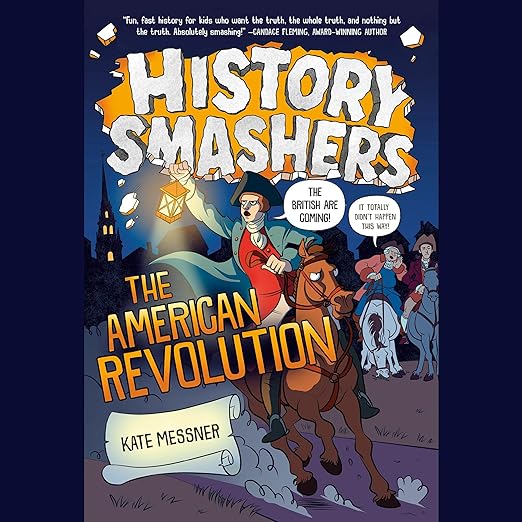
I have a particular fondness for history books that open with a wrong answer. Messner starts with Paul Revere’s midnight ride, the version every American child has drilled into them from roughly second grade onward, and within the first few minutes dismantles it so cleanly that I actually paused the playback to confirm what I thought I remembered. Samuel Prescott was the one who made it to Concord. Revere was captured before completing his mission. I finished this one during a late afternoon walk and kept stopping to send texts to my sister, who teaches fifth grade, citing one corrected fact after another.
History Smashers: The American Revolution is part of a series that includes volumes on the Mayflower, Women’s Right to Vote, Pearl Harbor, and the Titanic. The series premise is explicit: history as commonly taught is riddled with myths, oversimplifications, and calculated erasures, and children deserve the more complicated, more interesting truth. Messner is not the first writer to take this approach, but she is among the clearest, and at 2 hours and 43 minutes, this entry in the series is paced precisely for the attention span it is targeting.
What Got Left Out of the Textbook
The Paul Revere correction is the hook, but it is not the whole argument. Messner works through the Revolution’s standard narrative with consistent pressure, interrogating which voices got preserved and which got ignored, who the Patriots actually were in terms of class and race, and what the phrase “all men are created equal” meant in practical terms in 1776. She handles these complications with age-appropriate directness rather than evasion. The book does not pretend the Revolution was simple or uncomplicated; it trusts young listeners to handle the ambiguity.
This is the quality that separates History Smashers from comparable children’s nonfiction: Messner consistently chooses to complicate rather than simplify. That is a harder editorial call than it sounds, because the temptation in children’s nonfiction is always to sand down the uncomfortable edges. She resists it throughout, and the result is a book that genuinely teaches critical thinking about historical sources, not just historical facts.
Donna Allen and the Audio Advantage
Donna Allen’s narration is worth discussing because it does something specific that serves this material. She delivers Messner’s myth-busting corrections with genuine performative energy, the kind of voice that registers surprise and indignation on behalf of the listener. When she reaches the moments where the standard story collapses, her delivery communicates that something important just happened. For a 9-year-old in the back seat who has been told the Revere story since kindergarten, that performative response is a cue that they should care about the correction.
Allen does not play it broadly or cartoonishly. The energy is controlled. She varies her pace well, slowing for passages that require careful listening and picking up speed for narrative momentum. Reviewers note that one listener’s daughter, normally devoted exclusively to graphic novels, called Messner “so good” after hearing this series. Allen’s narration is a significant part of why the oral format works as well as it does here.
The Myth-Busting Structure and Its Limits
At under three hours, the book necessarily covers a lot of ground quickly. This means that some corrections get less development than they deserve. The discussion of enslaved people and what the Revolution meant, or did not mean, for them is handled honestly but briefly. Messner gestures toward the contradiction without fully excavating it. That is partly a function of length, partly of audience, and partly of the series format, which prioritizes accessibility over depth.
Adult listeners who have already read academic historiography of the Revolution may find the debunking familiar rather than revelatory. But the audience here is children who have only ever encountered the mythologized version, and for that audience, the corrections carry real force. The secondary audience is teachers and parents who want to have better-informed conversations with children about how history gets constructed and who gets left out of the official story.
Who Should Listen, Who Should Skip
Ideal for: children ages 8 through 13 who have had the standard American Revolution curriculum but not yet encountered its complications, teachers looking for a read-aloud that models historical thinking, and parents who want to supplement school history with more honest material.
Probably not the right fit for: adult listeners seeking a comprehensive revisionist history of the Revolution; for those, Woody Holton or Gary Nash’s work covers similar territory in much greater depth. Also, given the brevity, motivated older readers may find themselves wanting significantly more than the runtime provides.
Frequently Asked Questions
What specific myths about Paul Revere does Kate Messner correct in this audiobook?
Messner establishes that Revere never completed his famous ride: he was captured by the British before reaching Concord. It was Samuel Prescott who successfully warned Concord, and dozens of other riders were out that night as well. The narrative of a single heroic midnight ride is a later invention.
Is History Smashers: The American Revolution appropriate for classroom use at the elementary level?
Yes, and reviewer evidence aligns with a roughly 5th through 9th grade range for classroom use. A teacher specifically recommends it for grades 5 through 9 as an independent or supplementary read. The content handles race and class honestly but accessibly.
Does this audiobook cover lesser-known participants in the Revolution, or does it focus on the founders?
Messner deliberately expands beyond the standard founding-fathers narrative. The book examines who was actually riding that night, who the Patriots were in terms of class, and how enslaved people and other marginalized groups relate to the Revolution’s stated ideals. It is explicitly structured to surface voices the standard curriculum omits.
How does this entry in the History Smashers series compare to the other volumes on the Mayflower or Pearl Harbor?
The series follows the same structural premise across all volumes: identify a widely taught myth, research what actually happened, and present the correction with primary source support. The Revolution volume is among the more conceptually ambitious because the myth is not just a single factual error but a whole framing of the war’s meaning and participants. Listeners who respond to this volume are likely to find the others similarly rewarding.