- Voice: Adam Lazarre-White brings Clayton's grief and determination to life with emotional precision, finding the blues rhythm in Williams-Garcia's prose and making the New York City subway sequences feel genuinely propulsive.
- Big ideas: Grief and family rupture, the blues as inheritance and identity, a child's search for belonging after loss
- Atmosphere: Tender and searching, with genuine emotional weight beneath the adventure surface
- Worth it?: A children's novel that earns every one of its five starred reviews, with a narration that matches the musical heart of the story.
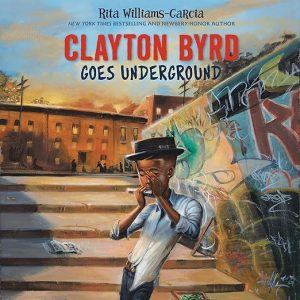
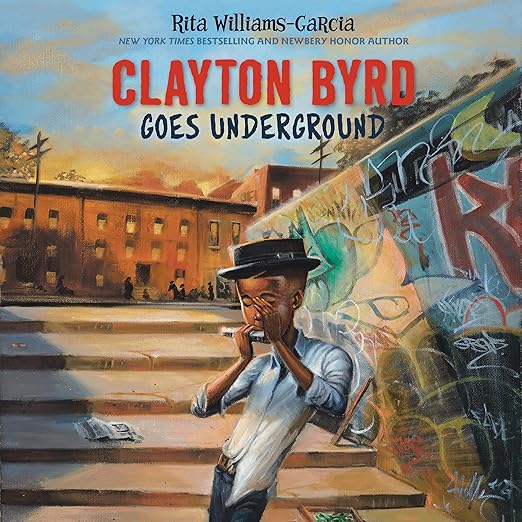
Clayton Byrd Goes Underground arrives in this audiobook as one of those children's novels that reads differently depending on what you bring to it. As a story about an eleven-year-old boy who runs away to find his grandfather's Bluesmen after Cool Papa Byrd dies and Clayton's mother forbids him from playing the blues, it is a compact, beautifully paced adventure through the New York City subway and Washington Square Park. As a novel about grief, family fracture, and how music carries what words cannot, it is something considerably more demanding. Rita Williams-Garcia, a three-time Coretta Scott King Award winner and Newbery Honor recipient, has written a book that functions simultaneously as both, and Adam Lazarre-White's narration makes the listening experience the ideal way to encounter it.
The setup carries its own mythology. Cool Papa Byrd is described as the emotional center of Clayton's world, the grandfather who connected him to the Bluesmen and gave him the harmonica and the porkpie hat that become the book's physical talismans of inheritance. When Cool Papa Byrd dies and Clayton's mother tries to sever that connection, the book frames her grief as a form of protectiveness that Clayton cannot yet understand. Williams-Garcia is careful about this: the mother is not a villain. She is a woman who lost her father and is trying to manage her son's grief in a way that makes sense from her position. Clayton is wrong about some of what he believes about her. That complexity is what separates this from a simpler story about a kid versus an unreasonable adult.
Five Starred Reviews Call the Blues a Character
Five starred reviews from Publishers Weekly, School Library Journal, Kirkus Reviews, The Horn Book, and Booklist place this among the most unanimously praised middle grade novels of its year. That consensus is not accidental. Williams-Garcia manages to make the blues itself a character in the book, not just a musical genre but a way of processing what cannot be said directly. Kirkus called it a complex tale of family and forgiveness with heart; School Library Journal noted the tale's heart; Publishers Weekly wrote that it strikes a strong chord; Horn Book described the story's elegant turns of phrase. Each critic is responding to something different but pointing toward the same accomplishment: a book that works at multiple levels simultaneously and does not sacrifice emotional honesty for accessibility.
Clayton's quest to find the Bluesmen leads him through the subway, which Williams-Garcia treats as its own terrain of discovery rather than merely a transit mechanism. Washington Square Park, where the Bluesmen perform, is rendered with enough specificity to feel like a real destination rather than a generic setting. The journey teaches Clayton things that surprise him, as the synopsis notes, and those surprises are the book's mechanism for delivering what he has not been able to hear from his mother directly.
Adam Lazarre-White Carries Grief Like the Blues
The audiobook format amplifies what Williams-Garcia has already built into the prose. Adam Lazarre-White has a natural musicality in his delivery that mirrors the blues sensibility at the book's center. The sound of grief in this narration is not performed; it is carried. The blues, as Lazarre-White renders it through Williams-Garcia's language, is not decorative but structural: the rhythm of loss and response that gives the whole narrative its emotional shape. One listener bought the book for a friend who is a working blues musician and his grandson specifically, which suggests how directly the book speaks to people who already live inside that tradition. Lazarre-White makes it speak just as clearly to listeners who encounter the blues primarily through this story.
At three hours and forty-four minutes, the audiobook is the right length for a middle grade listener who can be driven to school, or for an adult who wants a complete emotional experience in a single evening sitting. The pacing does not drag; Williams-Garcia's prose is economical without being thin, and Lazarre-White honors that economy by not adding theatrical weight the text does not require.
This Grief Novel Doesn't Rush Toward Resolution
The emotional content of this book is more demanding than the adventure framing suggests. Grief in children's literature is often softened toward resolution, but Williams-Garcia keeps the rawness of Clayton's loss present throughout the narrative. Younger children who have not experienced a significant loss may find some of the emotional register harder to follow. The NAACP Image Award for Youth/Teens is relevant context here: the book is written for young readers who are ready to meet emotional complexity without having it resolved for them too quickly.
Listeners who approach this as a purely adventure-driven story will find the internal emotional landscape richer than the external plot momentum, which is not a complaint but an accurate description of where Williams-Garcia places her attention. The book's pleasures are in its language, its characterization, and its emotional intelligence rather than in plot twists or pace escalation.
Fans of Jason Reynolds Will Feel at Home
Middle grade listeners who are ready for emotional depth alongside adventure, fans of Jason Reynolds and Kwame Alexander who want to move into Williams-Garcia's catalog, and young readers who have experienced loss and want to encounter it in fiction will all find what they need here. Educators and parents building diverse reading lists will find a book that carries genuine literary weight rather than simply checking demographic boxes.
Adults who read children's literature are equally welcome in this audience. The NAACP Image Award winner has the kind of cross-age resonance that the best children's fiction often achieves, and Lazarre-White's narration performs for adult ears as convincingly as for children's. Skip this one only if you want action-forward pacing and minimal emotional interiority.