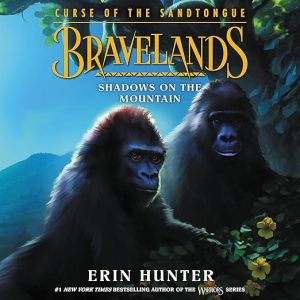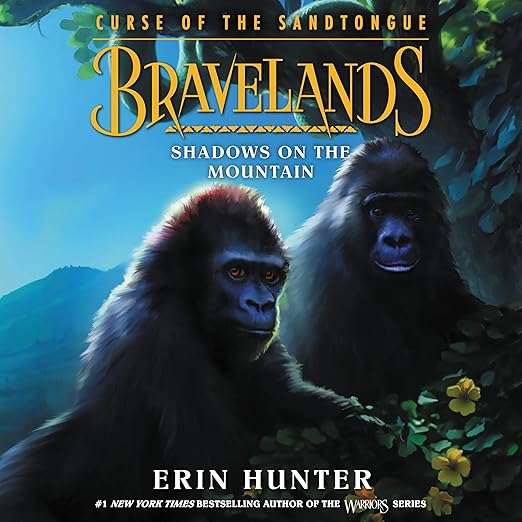
Can an animal fantasy audiobook carry three distinct protagonists, a society-threatening secret, and a generational code of honor in its opening volume and still feel genuinely accessible to young listeners arriving at the series for the first time? Bravelands: Curse of the Sandtongue #1: Shadows on the Mountain answers that question with the confidence of a franchise that has spent years building toward exactly this kind of narrative expansion. James Fouhey narrates, and his performance manages the multi-protagonist structure with the clarity that middle-grade audiobooks require, giving young listeners a reliable guide through seven-and-a-half hours of animal adventure with real stakes and real loss.
The Verdict, Briefly
Erin Hunter opens this new Bravelands arc with three distinct animal perspectives: a gorilla carrying a deadly secret within a troop that has lived in peaceful seclusion high above the Great Herd, a leopard struck by personal tragedy at the worst possible moment, and a gazelle cast out of her herd with nowhere established to return to. The Silverback gorilla troop's foundational rule, "blood pools on the plains," establishes a code with both practical and philosophical weight, and the arrival of a new and terrifying evil that forces every animal to venture beyond their established territory is handled with the epic framing that Hunter's franchise has made its signature. What distinguishes Bravelands from lighter animal fantasy is the moral seriousness extended to its non-human characters. The gorilla's secret is not merely a plot device but a genuine burden with consequences that reverberate through the troop. The leopard's grief is an active force shaping every decision she makes rather than background detail. The gazelle's exile is a displacement that defines her position in every interaction she has with the other protagonists. Together, the three perspectives create multiple emotional entry points into the same central crisis, which means listeners who connect most strongly with one character will still be carried forward by investment in the others, building the kind of ensemble attachment that sustains long-running series over multiple volumes.
The Best Parts of Bravelands
Fouhey brings genuine vocal differentiation to the ensemble demands of Hunter's structure, maintaining distinguishable qualities for the gorilla, leopard, and gazelle perspectives that help young listeners track whose consciousness they're inhabiting without needing to consciously remind themselves of every character name. This matters significantly in the opening volume of a series with a cast that will clearly grow across subsequent installments. The ability to orient by voice before a character name fully sticks is one of the underappreciated skills in middle-grade audiobook narration, and Fouhey delivers it reliably throughout the runtime. The 4.7 rating from 237 listeners reflects a book that functions both as an accessible new entry point and as a satisfying continuation for established Bravelands fans. Reviewer reports of children reading through the volume immediately on receipt speak directly to the pacing: seven-and-a-half hours that don't overstay their welcome or sacrifice momentum for backstory.
Points to Consider
This is the beginning of a new arc rather than a standalone story, and the opening volume establishes character, world, and central conflict without resolving the threat that drives it. Young listeners who prefer their audiobooks to conclude completely within a single installment should be prepared for a serial structure rather than an episodic one. That said, each character's individual arc within this volume reaches a meaningful development point, so the listening experience doesn't end on a pure unresolved cliffhanger. Listeners coming to this without prior Bravelands experience will find it accessible: the Curse of the Sandtongue arc is designed to be entered here. Those with deep knowledge of the original Bravelands series will recognize the world-building infrastructure but meet new protagonists rather than continuing with established characters. The series comparisons to Spirit Animals and Wings of Fire in the marketing are accurate in terms of ensemble adventure structure and the moral weight given to animal characters across both.
Fouhey also handles the tonal shifts between action sequences and quieter character moments well, which matters in a book that needs to establish three separate emotional worlds before bringing them into productive conflict. The gorilla troop's seclusion has a different quality from the leopard's isolated grief and the gazelle's enforced movement through unfamiliar territory. Each has its own emotional register, and Fouhey finds a vocal approach for each that feels consistent with the character rather than arbitrarily assigned. For young listeners new to ensemble animal fantasy, this kind of consistent vocal differentiation makes the multi-protagonist structure accessible rather than confusing during the opening chapters.
The Right Listener for Bravelands
Young listeners in the eight-to-twelve range who enjoy animal-centered adventure fantasy with genuine stakes will find this an excellent choice for independent listening or family audio time. The audiobook works particularly well for long car journeys and reading routines where sustained engagement across multiple sessions is the goal. Established fans of Wings of Fire, Spirit Animals, or the original Bravelands series will adapt to the new arc quickly. Adults listening alongside younger children will find the thematic complexity and prose quality rewarding rather than condescending. Skip it if you're looking for a complete, self-contained story resolved in a single volume; this is the opening move of a series, and the best response to finishing it is to queue up the next installment rather than evaluate it as a standalone.
Quick Take
- Narration: James Fouhey handles the three-protagonist ensemble with clear vocal differentiation, reliable for young listeners tracking multiple animal perspectives across a new arc
- Themes: Community protection, exile and belonging, secrets with catastrophic consequences
- Mood: Epic and propulsive, with the confident adventure energy of a franchise operating at full capacity
- Verdict: A strong opening to a new Bravelands arc, accessible to newcomers while rewarding established fans with the series' familiar combination of moral weight and adventure momentum
Do I need to have listened to the original Bravelands audiobooks before starting this new arc?
No. Bravelands: Curse of the Sandtongue #1 is specifically designed as a new arc entry point with new protagonists. Prior Bravelands knowledge adds depth to the world-building, but the audiobook introduces the gorilla, leopard, and gazelle characters from the beginning without requiring familiarity with earlier series characters.
What age range is this audiobook best suited for, and is it appropriate for family listening?
The Bravelands series targets readers aged 8 to 12 and works well for family listening with younger children. Themes of loss, exile, and protecting a community are handled with gravity appropriate to middle-grade rather than being sanitized. Animal death and danger are treated as real consequences rather than consequence-free events.
How does James Fouhey handle the three-protagonist structure in this audiobook?
Fouhey maintains distinguishable vocal qualities for the gorilla, leopard, and gazelle perspectives, helping young listeners track perspective shifts without needing to consciously remember character names during early chapters. The ensemble structure adds to the experience rather than creating confusion, which is a meaningful achievement in a first-series-installment audiobook.
Is this audiobook a good entry point for children who already love Wings of Fire or Spirit Animals?
Yes. The multi-species ensemble structure, moral complexity given to animal characters, and epic adventure framing make this a natural fit for fans of both series. Erin Hunter's longer track record with the Warriors and original Bravelands franchises means the storytelling craft is well established rather than experimental.