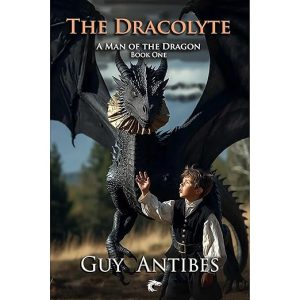
Guy Antibes opens this audiobook on a piece of worldbuilding that most fantasy would spend three chapters explaining and gets through in a paragraph: magicians, long ago, made two kinds of human-dragon hybrid. One kind came out mostly human and mostly harmless. The other, the Dracolytes, came out with powers that frighten ordinary people and frighten the dracolians almost as much. Spark Tomson is fourteen, undersized, and about to find out which one he is, in a kingdom whose royal government has already decided how it feels about the answer.
Our Take on The Dracolyte
Rev Carol L. reduced the opening situation to a single accurate sentence in March 2026: an undersized fourteen-year-old with a secret he is not aware of but others are, and they are not nice people. That is the engine. Spark's ignorance about himself is not a mystery the book keeps from the reader for effect; it is a vulnerability, because everyone who might hurt him has better information than he does, and the academy he is sent to is full of them.
Antibes is working in the familiar magic-school shape and not pretending otherwise. What he does with it is narrower and more interesting than the template. Spark is not the chosen prodigy who arrives and outclasses everyone. He arrives small, poorly informed, and legally suspect, and the education he needs most is about his own biology. The result is a school story where the lessons matter to the plot rather than decorating it, and where the danger comes from classmates and policy rather than a dark lord. Spark's classmates are not obstacles arranged for him to overcome; several of them would prefer he did not survive the term.
Eleven hours is generous for a series opener aimed this young, and the pacing shows it. The first third moves slowly while the family situation and the political ground are laid out, and the back half accelerates hard once the academy stops being a refuge. Listeners who bail early will miss the part the responses are actually excited about. The reading is credited to Virtual Voice rather than to a named performer, which is a synthetic production and worth knowing before you commit to a book this length.
Why Listen to The Dracolyte
Van, who has followed Antibes for years, liked this enough in January 2026 to go through it twice, and singled out the same thing twice over: the dragons here are not the normal fantasy dragons, and the humans carrying dragon traits are treated as a population rather than a plot device. That distinction is the book's best asset. Hatred and distrust of people with dragon-like characteristics is the political weather of the story, not a twist waiting at the end of it.
That gives the coming-of-age material somewhere to go. Spark is not learning to be powerful; he is learning what he is in a place that has already legislated against it, and the adolescent embarrassment of a changing body carries a second, sharper meaning when the change is the thing the crown is watching for. Antibes never spells the parallel out, which is why it works on the age group it is written for. Adolescence as a metaphor for being watched is well-worn ground, and it holds here because the politics stay concrete.
Invented vocabulary rewards attention too. Dracolyte and dracolian sound close enough to blur on a first hearing, and the whole political structure rests on the difference between them. A print reader can flip back. A listener has to catch it in the first hour, and the book is generous enough to restate the distinction a few times before it starts mattering.
What to Watch For in The Dracolyte
A February 2026 five-star described the school section plainly: enemies from Spark's past and new ones he makes on arrival try to bully him, harm him, and eventually kill him. That is a fair summary and it sits oddly against the shelf this title has been placed on. The page files it under children's audiobooks as well as teen, and attempted murder by classmates, a government hostile to a whole category of person, and a family in genuine peril belong on the older end of that range.
The response pool needs the same caution. All five visible entries are five stars while the headline average sits at 4.6 across 238 ratings, so whatever is pulling that number down is not in view. One of the five runs to two sentences and spends both of them on the author's back catalog. Read the two long ones and ignore the arithmetic. Nothing in the description prepares a parent for how much of the book is spent under direct threat.
The other thing to weigh is the series commitment. This is the first volume of A Man of the Dragon, and it ends the way first volumes end, with the situation altered and the argument unresolved. Two of the responses close by asking for the next book. If unresolved endings irritate you, wait until more of the series exists before starting an eleven-hour investment in it.
Recommended For
mas232 called it a definite inspiration of dragon lore in March 2026 and noted that it is both similar to and different from Antibes' earlier work: a coming-of-age character and a hero in the making, arranged around a new premise. That is the audience. Readers who already trust this author will find the familiar architecture with an unfamiliar creature at the center. Newcomers get a self-contained entry point that assumes no prior reading at all. The book asks for no familiarity with the author's other series, which matters given how many other books sit under the same author name.
It suits confident middle-grade listeners and teens who want dragons treated as heredity rather than spectacle, and it suits adults who read this shelf for comfort. Skip it if you need a named human reader, since the synthetic credit will be the first thing you notice. Pass as well if you want dragons on the wing and cities burning, because the dragon content here is mostly inside people and mostly political.
Spark spends the book being underestimated by everyone including himself, and Antibes is patient enough to let that pay off slowly rather than in one triumphant scene. That patience is the reason to start the series here rather than waiting for the reviews to pile up.
Good to Know
Is the audiobook read by a person or by a synthetic voice?
The page credits Virtual Voice rather than a named performer, which means a synthetic reading rather than a studio recording. For an eleven-hour fantasy that is a real consideration, so sample it before buying if you have not listened to a synthetic production at this length before.
How young is too young for this audiobook?
The page lists it under children's titles as well as teen, but the plot involves classmates trying to kill the fourteen-year-old lead and a state hostile to his kind. Confident ten-year-olds who handle peril will manage; younger listeners are better served elsewhere on the same shelf.