Quick Take
- Narration: Virtual Voice handles this survey efficiently enough at four hours. The synthetic delivery is a limitation, but the short runtime and overview format make it more tolerable than it would be for a longer or denser title.
- Themes: Imperial continuity and political transformation, Japan’s forced opening and accelerated modernization, the role of cultural identity in national resilience
- Mood: Brisk and survey-level, covering enormous historical ground with accessible language and a pace that occasionally sacrifices depth for momentum
- Verdict: A functional entry point for listeners with no prior exposure to Japanese history, best understood as a foundation for further reading rather than a complete treatment.
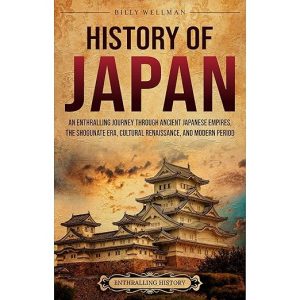
I want to be honest about what this book is and what it is not, because the distinction matters more for a broad survey of Japanese history than it might for a more focused work. History of Japan by Billy Wellman is four hours long and covers approximately fifteen thousand years of recorded and prehistoric human activity in the Japanese archipelago. That mathematics tells you something essential about the register: this is orientation, not analysis. It is a map for listeners who do not yet have one, and within those constraints, it largely succeeds at its limited mission.
The book opens with the Jomon people – the pre-agricultural inhabitants of Japan whose culture predates rice farming by thousands of years – and arrives at Japan’s current status as a technological and economic power by the end. In between, it covers the Yamato clan and the early imperial system, the three great unifiers of the Sengoku period, the Tokugawa shogunate and its centuries of enforced isolation, the Meiji Restoration, the militarist period and WWII, and the postwar economic miracle. That is genuinely a lot of ground, and Wellman covers it with a consistency of clarity that is not as easy to achieve as it sounds.
The Jomon to the Shogunate: Ancient Japan in Compressed Form
The early chapters on Japan’s pre-modern history are the strongest in the book. Wellman is particularly good at explaining why the imperial line’s continuity – Japan’s monarchy is the oldest in the world by conventional reckoning – coexisted with centuries of effective governance by warlords and shoguns who held real power while emperors retained symbolic authority. This dual-sovereignty structure is genuinely difficult to explain without making it sound either paradoxical or like a simple puppet arrangement, and Wellman navigates it clearly enough for a first-time listener to grasp the distinction.
The section on the Sengoku period – the era of warring states that preceded the Tokugawa unification – is appropriately dramatic and handles the three great unifiers (Oda Nobunaga, Toyotomi Hideyoshi, and Tokugawa Ieyasu) with enough character differentiation to make them feel like distinct historical figures rather than a sequence of names. One reviewer noted that the coverage of the Ashikaga period and the Imperial Golden Age is the weakest section, and that observation is fair. The middle medieval period gets compressed in a way that makes it feel like a transition rather than a subject with its own character, which is an inherent limitation of the four-hour format.
Meiji, Militarism, and the Modern Miracle
The final quarter of the book covers Japan’s transformation from isolated feudal society to industrial power to militarist empire to devastated occupied nation to economic superpower with the same brisk efficiency as the earlier sections. For listeners who already know this period, the coverage will feel thin; for those approaching it for the first time, the key events and their sequence are clearly laid out. The treatment of WWII is appropriately serious about Japan’s responsibility for the conflicts it initiated while remaining focused on consequences rather than dwelling in the atrocities – a choice that keeps the book accessible but will frustrate listeners who want more moral reckoning.
One reviewer noted that the book covers Japanese history through 2025 and flagged the recent emergence of Japan’s first female LDP leader as the only material gap, which is a fair calibration of the book’s currency. This is genuinely up-to-date popular history, which distinguishes it from many short-form surveys in this genre that stop at the postwar economic miracle and treat everything after as contemporary affairs rather than history.
Virtual Voice and the Four-Hour Format
The Virtual Voice narration is easier to accept in a four-hour survey than it would be in a fourteen-hour monograph. There is less at stake tonally – the book is not building toward dramatic moments that require emotional inflection, and the overview format tolerates a neutral delivery better than a narrative does. That said, the synthetic voice does flatten the sections on the Sengoku period, which have an inherent drama that a skilled human narrator would find and amplify. Listeners who find Virtual Voice narration genuinely distracting may want to check if a human-narrated alternative exists before committing to this edition.
Who Should Listen, Who Should Skip
Ideal for complete newcomers to Japanese history who want an orientation before pursuing more specialized reading, and for listeners who have absorbed bits of Japanese history through popular culture and want to place those fragments in a structured context. Also useful as a refresher for people who covered Japanese history in school and retain only scattered details. Skip it if you have already read a serious treatment of any period covered here – you will find the coverage frustratingly thin for the period you know, and the overview format provides no new analytical perspective for an informed listener.
Frequently Asked Questions
Does this book cover the same ground as more established surveys like Mikiso Hane’s Japan: A Short History?
Both are survey treatments of roughly comparable scope, but Hane writes from a more traditional academic position with the depth that comes from decades of scholarship. Wellman’s book is more recent, shorter, and written in a more accessible register aimed at general readers with no prior background. For academic purposes, Hane is the stronger choice; for a genuinely accessible entry point, Wellman’s brevity is an asset.
One reviewer mentioned the book covers Japanese history through 2025 – does that include the 2011 earthquake and Fukushima disaster?
Based on the review evidence, the book covers the full postwar and contemporary period including the 2011 triple disaster, though at the level of overview rather than detailed analysis. The reviewer who noted the 2025 currency was pointing out what the book includes rather than what it lacks.
Does Wellman address the historical debate over whether ninja actually existed as a distinct professional class?
The synopsis poses this as one of the book’s explicit questions. Based on the coverage of the Sengoku and Edo periods, the book likely addresses the gap between historical evidence for covert operatives and the mythologized ninja of popular culture. The treatment at this length will be brief, but the question is flagged as an explicit subject.
Is this book suitable for younger listeners or students approaching the subject for a school project?
Yes. The accessible language, brisk pace, and absence of graphic content make it suitable for motivated high school students and older. The Virtual Voice narration may be off-putting for some listeners, but the content is genuinely appropriate for educational use as an introduction to Japanese history.