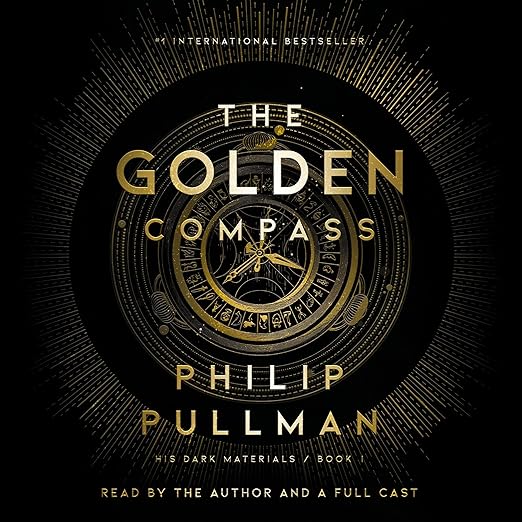
Lyra Belacqua's Oxford, a place of daemons and Scholars and political intrigue so thick it has its own weather, sets the stage for His Dark Materials: The Golden Compass (Book 1), Philip Pullman's Carnegie Medal-winning first volume, narrated here by Ruth Wilson. At ten hours and thirty-three minutes, this audiobook has the length appropriate to what Pullman is actually doing: building a complete alternate world with its own theology, physics, and social geography, then setting an eleven-year-old girl loose in it with a truth-telling compass she cannot yet read. Wilson's performance is one of the production's defining assets, and the format rewards the full commitment the runtime asks of its listeners.
Wilson Finds Iorek Byrnison a Not-Quite-Human Register
Pullman's novel rewards patient attention before it rewards impatience. Reviewer Ryan Sean O'Reilly noted that the book starts slowly before kicking into high adventure, which is accurate but slightly misleading: the opening Oxford chapters are doing necessary work, establishing the texture of a world that is familiar enough to inhabit and different enough to disorient. The daemons, animal companions that are external manifestations of their human's soul, require a listener to recalibrate their understanding of what inner life looks like in this world. That recalibration takes time, and Wilson uses her narration to guide it. She does not rush past the strangeness of the worldbuilding. She inhabits it, and her delivery of the early scenes carries the implication that she knows exactly how significant they will become.
Once Lyra leaves Oxford following the kidnapping of her best friend Roger and begins her journey toward the far North, the novel shifts gear entirely. The armored bears, the witch clans, Lord Asriel's experiments at Svalbard, the Gobblers and their terrible project involving children and the mysterious Dust: the second half of the book moves with the momentum that the first half was building toward. Wilson's narration adjusts to that momentum, and her handling of Iorek Byrnison, the dispossessed armored bear who becomes Lyra's most formidable ally, is particularly strong. She finds a register for him that is not quite human but is unmistakably a person, which is exactly what the role demands.
The novel's central moral structure, the conflict between those who would keep people in ignorance and those who fight for freedom, is embedded in every element of the plot without being stated in those terms until late in the book. Pullman trusts his readers, and Wilson trusts the text. Neither oversells the theme. The result is a fantasy novel whose ideas arrive with genuine force precisely because they have been carried by character and event rather than announced by the author.
Settled Daemons Signal Maturity in Wilson's Reading
The audiobook format makes The Golden Compass more accessible rather than less demanding. Wilson's narration provides a consistent interpretive framework for the worldbuilding, and her voice carries the novel's emotional shifts, from the claustrophobic political intrigue of Jordan College to the terrifying openness of the North, without losing the thread of Lyra's specific perspective. Reviewer Alex Tate described finally engaging with a series that had been sitting untouched for years, and the suggestion there is that having a skilled narrator as a guide through the investment makes the commitment easier to honor than it might otherwise be.
For adult listeners approaching the novel for the first time, the audiobook offers something the print edition does not. Wilson, known for her stage work and for her performance in The Affair, brings an interpretive intelligence to the text that surfaces details a first-time reader might miss. Her distinctions between characters whose daemons are settled and those whose are still changing, a detail Pullman uses to say something specific about maturity and identity, are audible in the way she adjusts her narration, however subtly, in those characters' presence. That interpretive layer rewards attentive listening and makes the themes of the novel clearer without ever stating them outright.
What the Alethiometer Says About Innocence and Knowledge
The alethiometer itself, the golden compass of the title, is introduced early but not fully understood until much later in the novel. Pay attention to the scenes in which Lyra reads it, specifically to the gap between what she knows consciously and what her unconscious understanding of the symbols tells her. Pullman uses that gap to make a specific argument about the relationship between innocence and knowledge that becomes one of the trilogy's central concerns, and Wilson's narration of those scenes is careful not to explain what the text is doing, which is exactly right. The alethiometer scenes work because they are allowed to be mysterious.
The novel's ending is deliberately incomplete. Book One ends at a point that is conclusive in terms of its immediate action but which opens onto the much larger questions that the trilogy will spend two more volumes pursuing. Listeners who are not committed to continuing with The Subtle Knife and The Amber Spyglass should be warned that The Golden Compass is a beginning, not a standalone. The final chapter is more properly a first chapter of what comes next. Reviewer Kindle Customer described loving the whole story, which suggests the series reading rather than the single-volume experience, and that is probably the right framing for new listeners to adopt when approaching this audiobook.
Parents Should Prepare to Discuss the Church
This audiobook is appropriate for children aged ten and up and for adult listeners at any age. The themes dealing with institutional power, the nature of consciousness and the soul, and the relationship between authority and freedom are fully present in Book One, not as abstract arguments but as elements of the plot. Parents reading alongside younger children should be prepared to discuss the novel's treatment of the Church as an institution and its handling of death and loss, both of which are present without being gratuitous. Listeners who want a complete story in a single audiobook will be frustrated by the ending's incompleteness. Those prepared to commit to the trilogy will find that Ruth Wilson's narration makes the investment an easy one, and an experience that genuinely rewards the time it asks for.
Questions Listeners Ask
Is this audiobook suitable for children younger than the standard middle-grade age range?
The novel is generally recommended for ages ten and up. The themes dealing with institutional authority, loss, and the nature of the soul are handled with emotional seriousness rather than being softened for younger readers. Ruth Wilson's narration is sophisticated, and the full import of some passages may be more accessible to older listeners. Eight or nine year olds reading alongside an adult could manage it with discussion.
How does Ruth Wilson's narration compare to other available audiobook versions of The Golden Compass?
Wilson brings distinct stage and screen interpretive depth to the text. Her handling of the book's range, from the domestic intrigues of Jordan College to the terrifying openness of the Arctic North, demonstrates vocal range and tonal intelligence. Pullman has also recorded a version himself, which has the authority of authorial intent but lacks the performance range that Wilson provides across the full cast of characters.
Does this audiobook work as a standalone, or is it essential to continue with the full His Dark Materials trilogy?
The Golden Compass is the first of three books, and it ends in a way that deliberately points forward rather than providing a fully satisfying resolution. The immediate action of Book One is concluded, but the larger questions the novel raises are not. New listeners should approach it with a commitment to the trilogy rather than as a self-contained story.