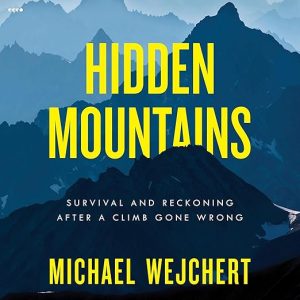
At a Glance
- Read by: Johnathan McClain brings steady authority to Wejchert's visceral prose, maintaining the right tension through both the rescue sequences and the more meditative historical passages.
- At its heart: wilderness risk and responsibility, the cost of survival, technology's role in remote adventure
- Vibe: Tense and ruminative, swinging between adrenaline and grief
- Short version: A genuinely difficult survival narrative that earns its philosophical weight by refusing easy resolution, Wejchert is honest about what the mountains took from everyone involved.
I finished Hidden Mountains on a Sunday afternoon when I had nowhere to be, which turned out to be exactly the right conditions. Michael Wejchert's account of a climbing accident in one of Alaska's last truly unexplored ranges is not a book that lets you out quickly. Even after the rescue is over, and you know from the first pages that a rescue happens, that this is survival nonfiction rather than tragedy, the book keeps working on you. The question it poses is not whether the climbers get out. It's what it costs them to do so, and whether the cost was knowable in advance.
The setup is almost mythologically clean: two couples, experienced alpinists, travel to the Hidden Mountains in 2018 for an expedition to peaks that had never seen a first ascent. The range is described as a rarity even in modern climbing, nearly unexplored, granite spires still awaiting human presence, a place where the map still had genuinely blank spaces. That draw, that pull toward uncharted territory, is something Wejchert doesn't just describe. He traces it back through generations of alpinism, situating his four climbers within a tradition that has always accepted the possibility of dying for the experience of being first.
Our Take on Hidden Mountains
The accident happens when the climbers are near the top of an unclimbed peak. Rockfall injures one of the group while he's out of sight, leaving him stranded in critical condition. What follows is nine hours of attempted rescue by the other three climbers, followed by an extraction by Alaska's Pararescuers, elite military personnel trained specifically for situations like this. Wejchert narrates these hours with precision and genuine visceral intensity. He was there. He knows where people were standing, what decisions were made in real time, what was attempted and failed before the professionals arrived.
The Pararescuer operation is the pulse-pounding centerpiece that the synopsis promises, and it delivers. But what struck me more was Wejchert's honesty about the time before the professionals arrived, the three climbers working toward their companion, the calculations being made about risk and possibility, the weight of watching someone you love be beyond your reach. Johnathan McClain's narration holds this sequence together with real control, modulating pace and tone in ways that honor the gravity of what's being described without tipping into false drama.
Why Listen to Hidden Mountains
Wejchert is not just writing a memoir. He weaves the history and evolution of rock and alpine climbing throughout his account, and this is where some readers may find themselves either grateful or impatient, depending on their prior relationship to the genre. A reviewer who described themselves as not a climber noted that some terminology and gear references didn't fully translate, while simultaneously saying they couldn't put the book down. That tension is real and instructive.
The historical passages enrich the stakes considerably for readers who come with even modest familiarity with climbing literature. Wejchert is placing his experience within a conversation that includes accounts of loss and survival going back generations, and that placement matters. It's what elevates the book from personal survival story to something that asks larger questions about why humans continue seeking out places where the consequences of error are final. Without that context, a non-climbing reader might find the middle sections slower than necessary. With it, those sections feel essential.
What to Watch For in Hidden Mountains
One reviewer who described the book as a partial bait-and-switch noted that the medical details of spinal cord injury felt tedious after the rescue intensity. I understand the frustration, but I think Wejchert's insistence on following the story past the adrenaline is precisely the point. The book is honest that a dramatic rescue is not the end of the story. The climbers return changed. The trauma doesn't resolve with the helicopter flight. Wejchert traces the scars, physical and otherwise, with the same careful attention he gives the vertical terrain.
This is also where the book's larger questions become unavoidable: what does it mean to seek wilderness that is genuinely inaccessible, and then need a rescue that requires massive public resources? Wejchert doesn't moralize, but he doesn't dodge the tension either. The Pararescuers who saved his companion's life operate because the mountains keep putting people in exactly this situation, and the book holds that fact alongside everything else without pretending it's simple.
Who Should Listen to Hidden Mountains
Listen if you have any relationship with outdoor adventure, hiking, climbing, or even just reading about it. Non-climbers with a tolerance for some specialized vocabulary will find Wejchert's prose accessible and rewarding. Listen if you want survival nonfiction that stays honest about aftermath and cost rather than ending at the moment of rescue.
Skip if you want a straightforward adventure story with a clean emotional arc. Hidden Mountains is more complicated, more meditative, and ultimately more honest than the genre sometimes allows itself to be.
Frequently Asked Questions
Do you need to be a climber or know climbing terminology to enjoy Hidden Mountains?
Not necessarily, though some familiarity helps. Multiple reviewers who described themselves as non-climbers found the book compelling despite not recognizing all the gear references. Wejchert writes in prose accessible enough to carry non-specialists through the technical passages, though some terminology will land more vividly for readers with outdoor experience.
Is Hidden Mountains primarily a fast-paced adventure audiobook or a more reflective, literary account?
Both, in sequence. The rescue sequences are genuinely tense and propulsive. But Wejchert is also interested in the history of alpinism, the philosophy of wilderness risk, and the long aftermath of trauma, and those sections are slower and more meditative. Readers expecting relentless action throughout may find the pacing uneven; readers who want depth alongside the drama will find it rewarding.
How does Johnathan McClain handle the different modes of the book, the crisis sequences versus the historical passages?
McClain navigates the tonal shifts effectively. His delivery during the rescue sequences is controlled and tense without becoming theatrical. In the historical and reflective passages, he pulls back appropriately, giving the prose room to work. It's a performance that trusts the writing rather than trying to compensate for it.
Does the book address the ethics of wilderness rescue, who bears the cost and risk when climbers need help in remote terrain?
Yes, and without simple answers. Wejchert raises the question of what it means to seek genuinely remote terrain and then require an expensive, dangerous rescue operation when things go wrong. He is honest that the Pararescuers who extracted his companion were themselves taking on serious risk. The book doesn't resolve this tension into a tidy moral, which is part of what makes it trustworthy.