Quick Take
- Narration: Heath Miller has clearly settled into this series, giving Fischer’s reluctant-leader energy and his animal companions distinct and consistent voices across 22+ hours.
- Themes: Found family, reluctant power, the comedy of earnest communication in an absurd world
- Mood: Goofy and warm-hearted, with enough action to keep the pace from going slack
- Verdict: The fourth volume maintains what makes this series work: the characters feel genuinely inhabited, and the humor comes from affection rather than contempt.
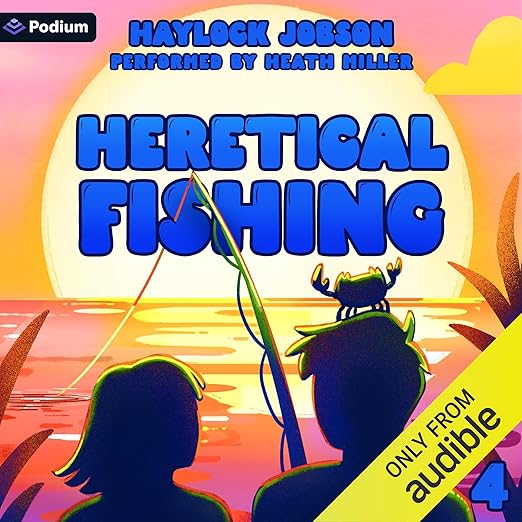
I came to Heretical Fishing 4 having not read the earlier volumes, which is not really the right entry point, and I knew it going in. I spent the first hour catching up on context I did not have, trying to understand who Fischer was, why a grizzly named Snips and a creature called Cinnamon mattered so much to the reviewers who mentioned them, and what exactly a weaponized fish implies in this particular magical system. By the end of that first hour I had mostly oriented myself, and by the time I was two hours in I had fully given myself over to it. Whatever Haylock Jobson is doing here, it works in audio in a way that a lot of comedic fantasy does not.
The series began as a Royal Road serial and accumulated more than three million views before making the jump to Kindle, Kindle Unlimited, and Audible. That origin matters because it shapes the texture of the prose and the pacing. Royal Road LitRPG tends toward serialized momentum rather than tight novelistic structure, and this fourth volume is no exception. It is a long audiobook at nearly twenty-three hours, and it earns some of that length through genuine character development and some of it through action sequences that go long enough that even sympathetic reviewers noted the ancient creatures battling section as running late in the book. That is a real criticism worth naming before you commit nearly a full day of listening time.
Fischer and the Comedy of Reluctant Leadership
The premise that Fischer is a man who would rather be fishing is not just a setup joke. It is the character’s actual psychological position, and the comedy of the series emerges from the gap between what the world keeps requiring of him and what he would genuinely prefer to be doing. By book four, he has founded a church he never intended, leads a growing community in Tropica, and is dealing with the consequences of military success against Gormona’s royal forces. His preference for fishing is now a statement about values rather than just temperament, and Jobson handles that shift with more care than you might expect from a series that includes weaponized fish in its plot summary.
The animal companions, which reviewers mention with consistent warmth, are not simply comic relief. They are fully developed characters in the world of the series, and the breakthrough one of them experiences in this volume, which reviewers were careful not to spoil, is presented with genuine dramatic weight. One reviewer mentioned a kraken with unmistakable enthusiasm. That willingness to play the emotional beats straight even within a comedic register is part of what separates Heretical Fishing from LitRPG that uses humor as a substitute for character development rather than as its own form of it.
Heath Miller Across Twenty-Two Hours
Miller narrates the full series, and at this length his investment in the character voices is what holds the audiobook together. Fischer’s voice is distinct from the supporting cast, and the animal characters, which require a specific tonal register that is neither fully anthropomorphized nor merely animal, are consistently rendered across the full run. One reviewer described the series as brilliantly insane in a tone of genuine enthusiasm, and the narration carries that energy without tipping into exhausting self-consciousness. Miller times the comedic beats well, which is a skill that comedy audiobooks frequently undervalue until a narrator does not have it and you notice the absence immediately.
The humor is described by one reviewer as fast, with great subtle and not so subtle references, all couched in a story of love and acceptance of found family. That description is accurate across both the writing and the narration. The tension between the joke-forward surface and the sincere emotional content underneath is something Miller navigates effectively by treating both registers with equal seriousness. That even-handedness is what allows a reader to feel genuinely moved by a scene between Fischer and his bear companion without feeling that the series is trying to trick them into caring about something absurd.
The Cozy Classification and What It Actually Means
The subtitle promises a cozy guide and the word cozy is accurate in a specific sense. The violence in this world is present but consequence-managed. The emotional communication between characters, which one reviewer noted is emotionally intelligent and mature to a degree that you might have to squint to notice in a story this gloriously absurd, is the real engine of the series. People in this world share how they feel, offer support, acknowledge their own mistakes, and receive understanding with warmth. Wrapped in the packaging of chi-powered fish and reluctant church-founding, it functions as a fantasy space where emotional health is simply assumed rather than struggled toward as a goal.
The Royal Road-to-Audiobook Translation
One of the more interesting things about this series is how well it translates from serial web fiction to produced audiobook. Royal Road stories are written to be read in installments, often weekly, and they develop pacing habits suited to that delivery method: strong episode endings, regular recaps, and a serialized momentum that can feel redundant when consumed in large chunks. Jobson manages this transition more smoothly than most. The serialized rhythm is present but does not become intrusive, and Miller’s narration helps by maintaining consistency that makes the longer listening sessions feel coherent rather than like stitched-together episodes. For listeners who discovered the series on Royal Road and are encountering it in audio for the first time, the production quality is a genuine step up.
Listeners already invested in the series will find book four a satisfying continuation with real stakes and genuine emotional development. Those new to Heretical Fishing should start at volume one rather than here. Available as a free audiobook on Audible, the series represents one of the stronger Royal Road-to-audio transitions currently available, and this fourth installment suggests Jobson has found a sustainable rhythm between the comedy and the feeling that makes it all work.
Frequently Asked Questions
Can Heretical Fishing 4 be listened to without reading the first three volumes?
Not comfortably. This is a continuing series with established characters, ongoing plotlines, and a magical system with specific rules built up over three previous books. Starting here means spending the first several hours catching up on context. Beginning with volume one is strongly recommended.
What makes this different from other LitRPG or progression fantasy series?
The tonal combination of broad comedy with genuine emotional intelligence. Characters communicate about their feelings in ways that are explicitly healthy and supportive, which is unusual in a genre that tends toward power-fantasy dynamics. The humor is affectionate rather than cynical, and the animal companions are developed as real characters rather than mascots.
Is the series appropriate for younger readers or is there content that makes it adult?
The series is broadly appropriate for teens and up. There is action violence and some mature themes, but nothing explicitly sexual. The emotional maturity of the character dynamics and the density of the humor’s cultural references probably makes it most satisfying for adult readers.
At nearly 23 hours, does the audiobook feel bloated or does it earn its length?
Mostly earns it, with one exception. Reviewers who love the series noted that the ancient creatures battling sequence toward the end runs long, and that is a fair assessment. The character development and found-family storylines justify most of the runtime, but the late action section is where the pacing loosens most noticeably.