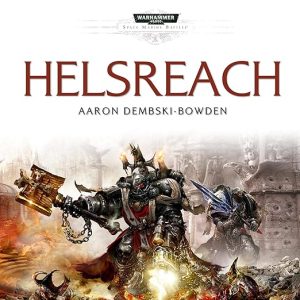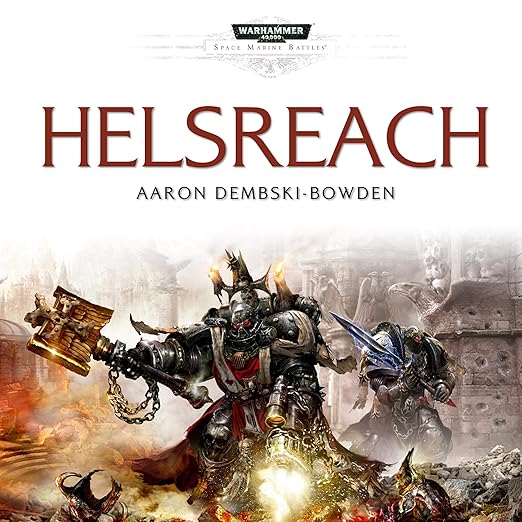
I came to Helsreach late, long after it had already been quietly recommended to me by several people whose reading opinions I trust. I had been hesitant about Warhammer 40K fiction for years, carrying the assumption that it was primarily product, that it served lore consumption more than literary ambition. Aaron Dembski-Bowden's reputation preceded him sufficiently that I finally sat down with this audiobook on a grey Tuesday evening and did not move from my chair until the siege sections pulled me somewhere past midnight. I was wrong about Warhammer fiction, or at least wrong about what it can be in the right hands.
The premise is classical in structure: a small force defending an impossible position, knowing the odds, choosing to hold anyway. Chaplain Grimaldus of the Black Templars Space Marines is given the defense of Hive Helsreach on the planet Armageddon during an Ork invasion of biblical scale. His Chapter mates are deployed elsewhere. His resources dwindle with each assault wave. And Grimaldus, who begins the novel as a figure of cold certainty, is forced through the crucible of this siege to ask what faith actually means when the pragmatic case for surrender grows louder every hour.
Dembski-Bowden writes Space Marines with unusual psychological complexity. These are transhuman warriors built by a civilization-spanning empire to be its fists, indoctrinated from childhood into a culture of controlled violence and religious devotion. Most Warhammer fiction treats this as straightforwardly heroic. Dembski-Bowden treats it as a tragedy in the classical sense: characters of enormous power, limited by the very nature that makes them powerful. Grimaldus believes in his Chapter, in the Emperor, in the sacred duty of the Black Templars, and the siege forces him to discover what remains of that belief when every conventional reason for it has been stripped away.
The Ork antagonists are rendered with a specificity that genre fiction rarely affords to its monsters. They are not a formless horde; they have culture, hierarchy, and something approaching strategy. This gives the siege a genuine war-narrative quality rather than just an action sequence stretched to novel length. The Imperial temple that serves as the final defensive position accumulates meaning across the book in a way that the climactic last stand earns.
The Best Parts of Helsreach
Jonathan Keeble has narrated a significant portion of the Black Library catalog, and his work here is among his finest. Grimaldus as a voice requires a specific combination of qualities: the formal cadences of a military-religious order, the suppressed doubt of a character whose certainty is being dismantled, and the martial resolve that makes the last stand sequences genuinely affecting rather than merely loud. Keeble manages all of this within a single, consistent character voice that evolves across twelve hours without losing coherence.
Multiple reviewers cite this as an ideal entry point for Warhammer 40K fiction, and the non-linear structure of the Space Marine Battles series means no prior knowledge of the setting is required. The war references, Armageddon, the Black Templars, the Ork invasion, are explained through context rather than assumed.
Before You Commit to Helsreach
Readers who want narrative breadth over depth may find the siege structure constraining. This is a book deliberately narrowed to one location, one small force, and one man's interior confrontation with his faith. The Armageddon war is vast; Dembski-Bowden renders only Grimaldus's fragment of it. That is the correct artistic choice, but listeners expecting the kind of panoramic campaign narrative some military SF provides will need to adjust their expectations.
One reviewer mentioned that Helsreach is also available in the Armageddon collection, which contains this novel plus a sequel novella. If the story appeals, that may be the better value purchase.
Should You Listen to Helsreach?
Military fiction listeners who want war narrative inflected with genuine philosophical weight will find this unusually rewarding for the genre. Warhammer 40K newcomers looking for an accessible entry point that also happens to be one of the setting's best-regarded novels will find Helsreach ideal. Readers drawn to characters tested by siege conditions, Alistair MacLean, Bernard Cornwell's Sharpe at his most cornered, will find the narrative architecture familiar and the execution exceptional.
At a Glance
- Narrator: Jonathan Keeble delivers a masterclass in Warhammer 40K narration, giving Grimaldus a voice of iron conviction that never tips into parody.
- Subjects: Faith and doubt in extremis, the meaning of sacrifice, what it costs to stand when standing is hopeless
- Tone: Grim, grand, and surprisingly philosophical for a war story
- Bottom line: One of the strongest Space Marine Battles entries and a genuine high point of Warhammer fiction, as accessible to newcomers as it is rewarding for veterans.
A Few Questions About Helsreach
Do I need to know anything about Warhammer 40K lore before listening to Helsreach?
No prior knowledge needed. Dembski-Bowden grounds the setting through context and character rather than assuming lore familiarity. Multiple reviewers have confirmed it works as a first Warhammer 40K novel and is frequently recommended as exactly that.
Is Helsreach primarily an action story, or does it have significant character and philosophical depth?
Both, in genuine balance. The siege sequences are visceral and well-constructed, but Grimaldus's interior confrontation with faith and doubt is given equal weight. Reviewers consistently cite the philosophical dimension as what elevates it above typical military fiction.
Jonathan Keeble narrates a lot of Black Library titles, how does his Helsreach performance compare to his other work?
It is frequently cited as among his best Black Library work. The Grimaldus role suits his register particularly well, the martial gravity, the suppressed emotion, the cadences of a warrior-priest. He has narrated enough of this setting to bring genuine fluency to the cultural specifics.
Is the Space Marine Battles series linear, and do I need to read Rynn's World first?
The series is non-linear. Each book is self-contained. Multiple reviews confirm you can begin with Helsreach without reading Rynn's World or any other Space Marine Battles entry.