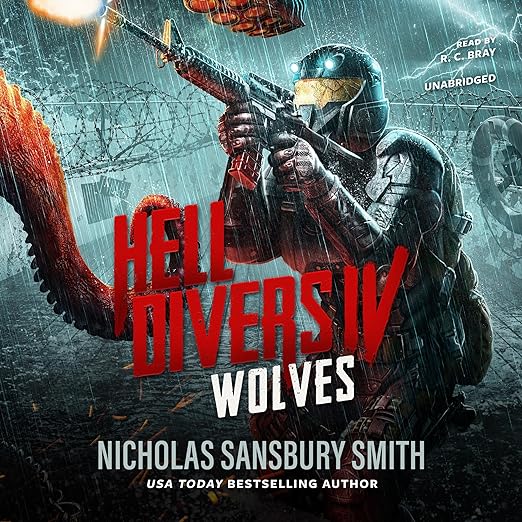
I remember finishing Hell Divers III late on a Wednesday night and thinking the series had done something rare, it had raised the stakes without losing its humanity. By the time I started Wolves, the fourth installment in Nicholas Sansbury Smith's New York Times bestselling series, I was already braced for punishment. Smith does not write books that let you breathe for long. I listened to the first two hours on a solo drive through overcast farmland, which felt weirdly appropriate. The sky outside was grey, the fields were bare, and somewhere at sea, Xavier Rodriguez was fighting for his life.
Hell Divers IV marks a genuine shift in the series' geography. The airships that gave the earlier books their claustrophobic atmosphere recede here, replaced by the Sea Wolf and the terrifying expanse of poisoned ocean. It is a gamble that pays off, giving the series a new source of dread and discovery that the well-mapped air routes could no longer generate.
Smith has built this series on the premise that survival is a debt that keeps compounding. Xavier Rodriguez is not a triumphant hero at the opening of this book, he is a man weathered to bone, carrying a decade of the surface's poison in his body and a hybrid Siberian Husky named Miles by his side. The Sea Wolf's mission to find the Metal Islands sounds, on paper, like hope. In execution, it is a gauntlet. Smith layers the threats with real imagination: natural storms, sea monsters that belong in a different kind of nightmare, and the Cazadores, the cannibalistic society that the synopsis barely does justice to. These are not just obstacles. They are revelations about how humanity fractures when civilization disappears.
What elevates Wolves above pure action spectacle is the historical dimension Smith introduces. The expedition uncovers hard truths about the war that drove humanity into the airships centuries ago. These revelations reframe everything that came before, not in a retcon-heavy way, but in a way that deepens the world's tragedy. Smith has always written science fiction with a melancholy undertow, and that quality is most visible here.
What Works
R.C. Bray is the engine that drives this series in audio form. His narration of Xavier Rodriguez has developed over four installments into something genuinely character-specific, the hoarse authority, the small hesitations when X processes grief, the way his voice shifts slightly when Miles enters a scene. Bray handles the sea voyage sequences with a naturalistic tension that keeps the listener oriented even when the action is chaotic. For longtime fans of the series, his performance is reason enough to stay with the audio format rather than switching to print.
The pacing is relentless without being exhausting. At nine hours and twenty-five minutes, Wolves does not overstay its welcome. Smith structures the book as a series of escalating confrontations, each one revealing a piece of the larger picture, and Bray executes each shift in register cleanly.
Before You Commit to Hell Divers IV: Wolves
Some readers coming from books one through three may feel the shift to sea adventure changes the tonal contract of the series. The airship world had a specific claustrophobic intimacy, small communities under threat, every face known. The Sea Wolf is a smaller crew, which does focus the emotional stakes, but the scale of the ocean can make some of the supporting characters feel underdeveloped against the environment. A couple of reviews note that the plot threads around the Cazadores are more mechanically handled than the character work that made Xavier compelling in earlier books.
Additionally, Wolves ends with threads deliberately left open. If you are the kind of listener who needs resolution, this is a book that will push you toward book five rather than satisfying you on its own terms. That is consistent with the series' design, but worth knowing in advance.
Who It's For
If you have read the first three Hell Divers books, there is no question, you pick this up. If you are new to the series, start at book one; the emotional weight of X's story requires the foundation Smith laid earlier. Fans of post-apocalyptic science fiction with a militaristic edge who also want genuine world mythology will find a lot to appreciate here. Listeners who primarily want introspective character drama may find the action density leaves less room for the quieter moments that distinguished earlier entries.
The Short Version
- Narrator: R.C. Bray delivers his signature gravelly intensity, matching X's weathered, relentless spirit perfectly across every storm-lashed deck scene.
- Subjects: Post-apocalyptic survival, the weight of leadership, humanity's capacity for monstrosity
- Tone: Tense and propulsive, with an oceanic bleakness that feels genuinely new for the series
- Bottom line: A strong fourth outing that trades airship corridors for open ocean dread, with Bray keeping the pace fierce throughout.
Frequently Asked Questions
Do I need to have read the first three Hell Divers books before listening to Wolves?
Yes, strongly recommended. The emotional stakes around Xavier Rodriguez and the history of humanity's survival in the airships are built across the first three books. Dropping in at book four will leave significant context gaps.
How does the shift from airship to sea adventure change the feel of this entry?
It opens the world considerably. The earlier books had a claustrophobic, closed-community tension; Wolves replaces that with oceanic scale and new categories of threat, including the Cazadores and sea creatures. Most readers find the change refreshing, though it does alter the intimate atmosphere of earlier installments.
Is R.C. Bray's narration consistent with the earlier books in the series?
Yes. Bray has narrated the Hell Divers series from the start and his performance of Xavier Rodriguez is one of the more character-specific narrator-protagonist pairings in the genre. His voice work for X has evolved alongside the character.
Does Wolves resolve its story arc, or does it end on a cliffhanger?
Wolves concludes its immediate plot threads but leaves significant series-level questions open, particularly around the Metal Islands and the history revealed during the expedition. It reads as a strong chapter in a larger ongoing saga rather than a standalone conclusion.