Quick Take
- Narration: Christopher Lane brings steady authority to the Whisper Ridge ensemble, handling both the tactical tension of survival sequences and the quieter character scenes with equal competence across nearly fourteen hours.
- Themes: Community resilience after infrastructure collapse, reluctant leadership, the social architecture of surviving together
- Mood: Tense and methodical, with the slow build of a novel that trusts its premise and its characters to carry the pacing
- Verdict: A solid post-CME survival entry that distinguishes itself through character specificity rather than action volume, best suited to readers who want the human story inside the disaster.
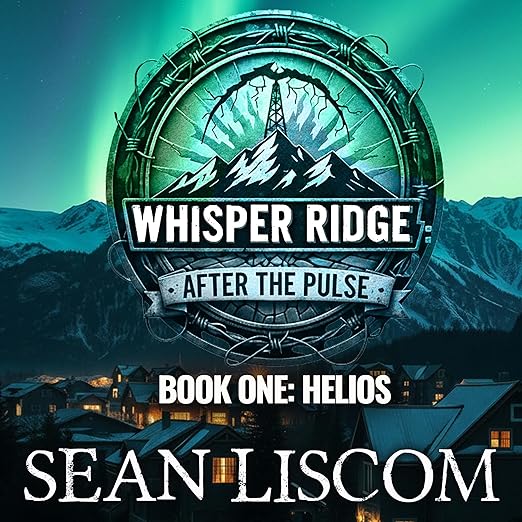
I finished Helios on a Thursday evening after listening in short bursts over a few days, which is unusual for me with survival fiction. I typically either binge or abandon. The fact that I kept returning in twenty-minute increments rather than committing to long sessions says something accurate about this book: it rewards patience more than momentum, and its pleasures are cumulative rather than immediate. Sean Liscom’s setup is efficient and credible. High in the mountains east of Klamath Falls, the community of Whisper Ridge watches the sky ignite as a catastrophic 2027 Carrington Event tears through the Earth’s magnetic shield. The grid goes down. Civilization, as organized infrastructure, evaporates with unnerving speed. What Liscom wants to examine is not the collapse itself but the specific social and psychological work of preventing a small community from following suit.
Mason Ashford and the Problem of Reluctant Authority
The protagonist, Mason Ashford, is described as a solar analyst and the last person who ever wanted to be in a leadership position. That framing could easily become a cliche, and Liscom walks close to the edge of it at points. But what saves Mason as a character is his specificity: he doesn’t resist leadership because he lacks confidence. He resists it because he understands the actual cost of decisions a leader must make when resources are scarce and the wrong call gets people killed. His professional background as someone who understands solar weather gives the Carrington Event setup more grounding than a purely civilian protagonist would provide. There is a moment early in the book where Mason walks someone through what a Class X coronal mass ejection actually does to a magnetosphere, and the specificity of that conversation does more to establish the stakes than any amount of dramatic scene-setting could. Christopher Lane’s narration suits this kind of measured interiority well. He does not overplay Mason’s reluctance or his eventual competence. He lets both qualities exist in the same register, which is the correct call for a character arc that depends on gradual, earned credibility rather than dramatic conversion.
The Supporting Cast and Why Liscom Gets Them Right
Elijah Rourke, a retired Army officer described as having the calm precision of a man who has seen too much, functions as the book’s structural backbone once the crisis settles into a sustained emergency rather than an acute one. Tessa Vaughn, a battle-hardened Navy Corpsman, is the character reviewers consistently single out as the most fully realized. Liscom earns the quiet strength he attributes to her rather than simply asserting it through descriptive adjectives and hoping the reader fills in the rest. Lisa Taylor, the scientist whose understanding of the Carrington Event’s mechanics mirrors Mason’s, is the character who grounds the book’s speculative elements in something that feels researched rather than invented for the narrative’s convenience. One reviewer noted that the premise is realistic enough that they believe the government would suppress advance knowledge of such an event from ordinary citizens. That tension between what institutions know and what individuals are permitted to know runs quietly through the book’s better moments and gives it a political dimension that lighter prepper fiction consistently avoids.
How Helios Sits in the Collapse-Fiction Tradition
The post-EMP, post-CME survival novel is a genuinely crowded category, and Liscom is working in a tradition that includes everything from William Forstchen’s One Second After to lighter prepper-fiction that functions mainly as gear fantasy with a thin narrative wrapper. Helios sits closer to the character-focused end of that spectrum and is more interested in the social contract under extreme duress than in the technical details of what equipment survives an electromagnetic pulse. One reviewer was candid about this: the plot is not exceptionally different from other books in this niche, but the execution is good enough to make the familiar beats feel earned rather than mechanical. That is an honest assessment, and it is the most useful framing for the kind of reader who will get the most from this first volume of the Whisper Ridge series. Readers familiar with Liscom’s earlier series The Ranch will find this operating in the same register, with slightly more social complexity introduced by the gated community setting.
Who Should Listen and What to Expect Going In
This is book one in the Whisper Ridge: After the Pulse series, and it ends in a way that sets up the next volume clearly without leaving the central crisis of this installment unresolved. Listeners who follow the prepper fiction community, who have spent time with Liscom’s previous work, or who find the psychological dimensions of community-under-pressure more interesting than pure tactical action will find this genuinely rewarding. Christopher Lane’s nearly fourteen-hour narration is a commitment, but his pacing does not drag. If survival fiction is not your genre, the character work here alone is unlikely to convert you. If it is, Helios is among the better recent entries, and the Whisper Ridge series looks like one worth following across its subsequent volumes.
Frequently Asked Questions
Is Helios the first book in the Whisper Ridge series, and does it resolve its central plot?
Yes, Helios is book one in the Whisper Ridge: After the Pulse series. It resolves the central crisis of this installment while establishing the arc for subsequent volumes. You will not feel the story is cut off mid-sentence when the final chapter ends.
How does the Carrington Event premise hold up scientifically compared to other post-EMP fiction?
Reviewers have noted the premise is realistic enough to feel grounded. Mason Ashford’s background as a solar analyst gives the setup more internal credibility than a purely civilian perspective would provide, and Lisa Taylor’s scientific knowledge supplements that grounding throughout the narrative.
Is Christopher Lane’s narration well matched to this kind of survival ensemble story?
Yes. Lane has a steady, authoritative voice that suits both tactical sequences and quieter character scenes. He differentiates the ensemble cast without resorting to exaggerated accents, which suits the book’s grounded, realistic tone across the nearly fourteen-hour runtime.
How does Helios compare to Sean Liscom’s earlier series The Ranch?
Reviewers familiar with The Ranch consistently recommend Helios as a comparable experience in terms of character investment and survival realism. Helios may appeal to a slightly wider audience because its gated mountain community setting introduces more social complexity into the survival dynamic than an isolated ranch provides.