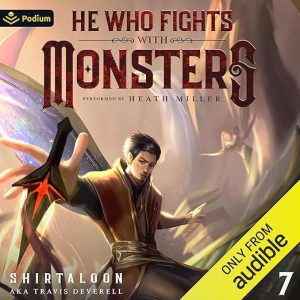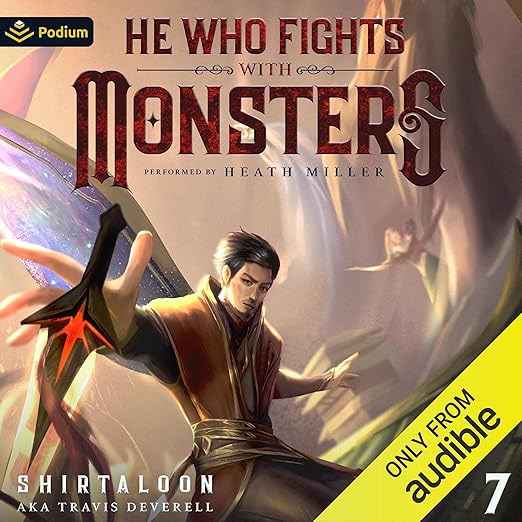
I came to book seven of this series in the middle of a long run of heavy literary fiction, and I'll admit the contrast was welcome. Jason Asano's voice, filtered through Heath Miller's narration, landed on me like a pressure release valve. I was somewhere between relieved and a little embarrassed by how quickly I got pulled back in. That's what a well-built ongoing series does: it earns the shortcut. By now the world of Pallimustus is fully rendered in my imagination, and returning to it feels less like picking up a book and more like stepping back into an ongoing conversation with a protagonist I've spent real time with.
What makes book seven interesting structurally is the premise it hangs its hat on: for once, it is not Jason's job to save the world. The kingdom he arrives in is being competently handled by its own authorities. This is played partly for comedy and partly as genuine character study. Jason, who has spent six books in reactive crisis mode, is forced to do something harder: simply rest. Shirtaloon uses this deliberately lower-stakes premise to poke at questions of identity that have been building for multiple volumes. The man who returns to Pallimustus is not the same man who left, and how the people around him register that change carries most of the book's emotional weight.
Jason Rests While Pallimustus Handles Itself
The humor is sharper here than in some of the middle volumes. The chapter involving the Church of Fertility and its enthusiasm for Jason's participation is exactly the kind of absurdist set piece that made this series popular in its web serial form, and it translates well to audio. Miller's timing helps considerably. The ancient king arriving at a barbecue, the inconvenienced princess, the obstacles facing Jason's friends across the world trying to reach him: Shirtaloon maintains a lot of narrative plates spinning simultaneously, and for the most part the juggling is competent.
Where things get slightly uneven is in the middle portion. A handful of reviewers noted that certain political intrigue subplots feel expansive relative to their eventual payoff, and that's a fair read. The book's first half is deliberately paced, and listeners who came hoping for the kinetic momentum of earlier installments may find it takes time to settle in. The flip side is that the final stretch is genuinely propulsive. The last ten percent of the runtime carries a narrative punch that recalibrates everything that came before it.
Miller Handles Comedy and Dark Undercurrents
If you are already in this series, the central appeal is clear: more of Jason, more of the world, more of the ensemble. But book seven offers something specific that distinguishes it from its predecessors. The character work on Jason himself, as he grapples with anger, loss, and the version of himself that emerged from his years away, is more introspective than previous volumes. The author is willing to slow the plot down to let the protagonist breathe, which is a choice that not everyone will love but that I found genuinely rewarding. There is also an understated elegance to the way old and new antagonists are layered in without collapsing the story's tonal lightness.
Heath Miller has been the voice of this series for several volumes now, and his comfort with the material is audible. He handles the comedy without overselling it, which is easy to get wrong in LitRPG fantasy where the humor can tip into self-parody. He also handles the genuinely dark undercurrents in Jason's psychology without making them feel out of place next to the barbecue scenes.
Political Subplots Test Patience Before the Payoff
The political subplot in the book's middle section requires patience. Several listeners identified it as the weakest structural element, and if you find your attention drifting around the midpoint, it is worth pushing through. The payoff is real. Also worth noting: this is absolutely not an entry point. The reviewer who emphasized going back and starting from book one is correct. Character relationships and world mechanics have been built over six prior volumes, and book seven assumes full fluency in all of them. Coming in cold here would not just be confusing, it would rob the emotional moments of their context.
The series-within-series structure, where Jason's friends face their own parallel obstacles trying to reach him, occasionally fragments the momentum. This is a pacing choice that reflects the web serial origins of the material, where multiple plot threads running simultaneously sustains reader engagement between updates. In audio form, with a runtime approaching nineteen hours, those transitions between storylines can feel more pronounced.
Followers of Jason Get a Worthwhile Chapter
Readers who have followed Jason's journey from the beginning will find this a worthwhile chapter, particularly for the character introspection and the strength of its final act. If you enjoy LitRPG fantasy that blends genuine humor with real emotional stakes, and you have the patience for a deliberately paced opening section, book seven delivers. Listeners new to the series should start at book one without question. Those who burned out on the genre's tendency toward power escalation will find that this installment actively subverts that expectation, at least temporarily, which is either refreshing or frustrating depending on what you came for.