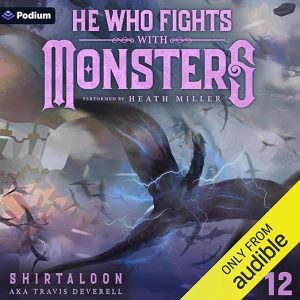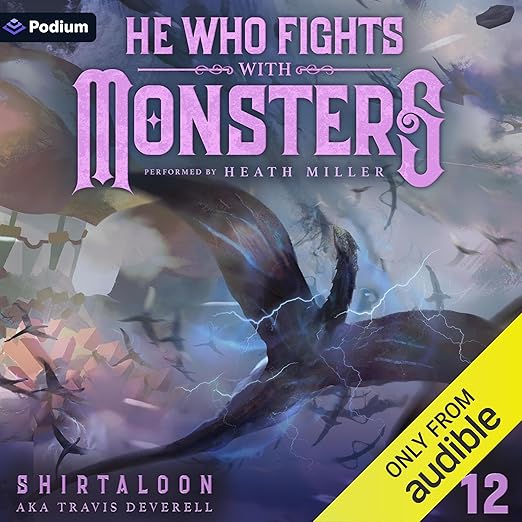
Jason Asano has fought gods, angelic armies, interdimensional cults, and the literal governing forces of reality, and he did not win most of those fights fairly. Volume 12 of Shirtaloon's long-running LitRPG audiobook series opens on a version of Jason who has earned the right to take a gap year and is absolutely determined to use it, which means the threat this time is not a cosmic horror but the accumulated bureaucratic and political resistance of every institution that finds his existence inconvenient. That tonal shift, from existential to absurdist, is exactly what this series needed after several entries that reviewers noted had a repetitive, tonally flat quality undermining the story.
I caught up to this series over a few weeks of long drives, and what strikes me most about Shirtaloon's world of Pallimustus is how much the LitRPG system underpinning it all actually serves the comedy rather than competing with it. Jason's power set is built around curses and shadow magic and debuffs that trigger over time, which suits a protagonist whose primary combat strategy is to make every opponent's life increasingly unpleasant while he makes jokes about it. At nineteen hours and twenty-six minutes, this is a generous runtime, and the audiobook earns it.
What reviewers are flagging in volume 12 is that Shirtaloon has found his rhythm again after a run of entries that felt creatively adrift. One longtime reader describes it as "the true five-star book I've always hoped Shirtaloon had in him," after acknowledging the last few entries had a bizarre repetitive vibe that undercut the story. For a series at book twelve, that kind of recalibration matters enormously. The best long-running fantasy audio series know how to regenerate energy rather than coast on accumulated goodwill, and this installment does that.
The main plot thread involves Jason attempting to liberate a slave town by maneuvering a prestigious noble house into doing it for him, which is a perfectly illustrative piece of the Jason Asano method: arrange the situation so that everyone else performs the heroism while he stands nearby looking innocent and technically correct about everything. It is the same broad joke the series has been telling for twelve volumes, but the execution here feels freshly motivated rather than mechanical.
The Strengths
Heath Miller is the narration choice that made this series work in audio, and his performance here is comfortable in the best sense. He knows Jason's rhythms intimately by now, the way a pause before a punchline needs just a beat more space than a straight dramatic line, and the larger ensemble of Pallimustus characters each have consistent vocal identities that make the long runtime navigable. The PDF companion included with the audiobook purchase is worth noting for listeners who want to track the system details, though the audio stands fully on its own for anyone who just wants the story.
The worldbuilding in volume 12 leans into geography in a way the series has not prioritized before. Jason actually gets to explore Pallimustus rather than just fighting things in the next crisis location, and Shirtaloon takes the opportunity to flesh out regions and social structures that have been referenced but underutilized. For the LitRPG listener who reads for system depth as much as plot, this is a particularly satisfying entry.
Things to Know Before Starting He Who Fights with Monsters 12: A LitRPG Adventure
The series prerequisite here is absolute. This is book twelve in a continuous narrative, and there is no meaningful entry point at this volume for a new reader. If you have not spent at least several hundred hours with Jason Asano already, the emotional weight of him finally getting to visit his friends' hometown will mean nothing, and the running jokes about angelic armies and the people who want to discuss that time he altered the fundamental laws of magic will read as noise rather than payoff. Start at book one if the premise interests you.
The note about the gap year conceit is worth expanding on, because it does real structural work in volume 12 that earlier installments lacked. When Jason has to save civilization, the stakes are high but the comedy has to fight against the weight of consequence. When Jason is trying to have a nice, sensible gap year and the universe keeps conspiring against him, the comedy and the stakes are pulling in the same direction. Every obstacle to his rest is simultaneously a reason to laugh and a reason to root for him, and Shirtaloon has rediscovered that alignment here after several books where the two registers felt disconnected.
The typos that one reviewer flagged are a known issue with Shirtaloon's releases across the series, a byproduct of a rapid production pace that prioritizes momentum over polish. In audio it is largely invisible, but listeners who toggle between the text and audio may notice occasional inconsistencies. It does not materially affect the listening experience, but it is worth knowing this series operates at a pace that trades some precision for volume.
Recommended For
Series readers who stayed loyal through the weaker middle entries will find volume 12 the most rewarding installment in several books. If you bounced off volumes nine or ten and have been waiting to see whether the series found its footing, the critical response here suggests the answer is yes. For LitRPG listeners who have not encountered this series, the correct entry point is book one, where the premise, Jason being pulled from Earth into Pallimustus and navigating an entirely alien magical system with deadpan humor, is fresh and the comedic foundations are laid properly. New readers should simply know they are committing to a very long, very fun series before they begin.