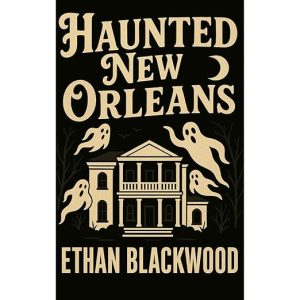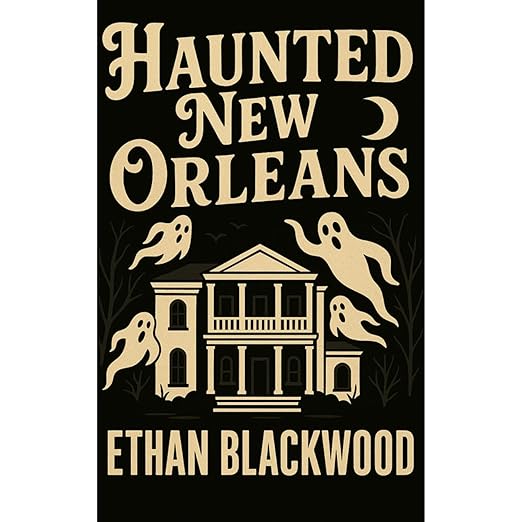
Five ghost emoji sit in the retail copy for this audiobook, one at the head of each promised section, and not one of them makes the trip into audio. Small thing, and a useful one, because it tells you what the listing really is underneath: a page built for somebody scrolling, repurposed for somebody listening. Ethan Blackwood's subject is the ghost lore of New Orleans, six hours of it, organized around five landmarks and traditions that any visitor hears about inside a day. Whether the recording serves that material is a separate question from whether the material is worth having, and the answers point in opposite directions.
The five headings are the ones any New Orleans ghost tour would use, and that is not the criticism it sounds like. LaLaurie Mansion comes first, described here as the darkest legend the city has, and the ordering is correct, since nothing else in the local repertoire carries that weight. From there the book moves through the French Quarter's shadowed doorways, the Voodoo tradition and the unexplained events attached to it, the hotels where guests report flickering lights and footsteps with nobody attached to them, and finally St. Louis Cemetery No. 1, where Marie Laveau is said to walk still. Each of the five is an actual place or an actual practice, not an invention, which gives the collection more ballast than the packaging around it suggests.
The copy calls these chilling true stories, and that word is doing a great deal of quiet work. True in what sense? A haunting is not a claim you can check the way you check a date on a deed. What a book like this can honestly deliver is that people reported these things, in these buildings, and that the reports were repeated long enough to become part of how the city describes itself to visitors. Nothing in the framing suggests any appetite for adjudicating the difference. A listener who wants the debunking, the archival record, or the argument about what the LaLaurie story has been made to carry over the years will find the book pointed somewhere else entirely.
The Best Parts of Haunted New Orleans
Ghost stories are one of the few nonfiction subjects where audio holds a native advantage, because the form started as spoken material and never fully left. Hearing a room described while you stand in the street outside it beats reading the same paragraph off a screen, and the gap is not small. Six hours and five minutes runs roughly the length of a long afternoon on foot, which makes this a plausible companion for somebody actually in the city, and the landmark-by-landmark structure means you can jump to whichever section matches the corner you are standing on. Nothing about the book demands to be taken in order, and the sections carry no dependency on one another.
Which raises the shelving, since the record files this under travel rather than anything paranormal. That looks wrong at first and turns out to be defensible, because the book is organized by address instead of by phenomenon and its practical function is telling you what happened where. Somebody planning a trip who wants more than the printed placard at each stop is being served exactly. The cost is a discovery problem in both directions: a browser hunting ghost stories has to find this on a shelf of itineraries and hotel roundups, and a browser after a travel guide gets six hours with no restaurant anywhere in it.
Before You Commit to Haunted New Orleans
The credit line here names a synthesizer. Virtual Voice is the platform's machine reader, and for this genre above nearly any other, the choice matters. Ghost stories are a performance form. The whole effect lives in timing, in the pause before the last clause, in the flattening of a voice at the moment a detail turns wrong, in a reader willing to slow down and let a room go quiet for a second. Machine narration produces none of that, so the words are left to do all the work by themselves in a register that never once changes. Six unvarying hours on a subject built entirely out of dread is the largest single obstacle between this book and the effect it is reaching for.
The written column is empty. One person has left a three out of five and not a syllable of explanation, which is close to the least useful shape a public verdict can take, since a middling grade with no reasoning behind it might mean the writing disappointed, or the reading did, or the buyer wanted a different book altogether. The series field carries the word Haunted and then stops, with no number after it, so a listener who finishes this one cannot learn from the record whether other cities received the same treatment or in what order they arrived. Both gaps belong to the listing rather than to the author, and both cost a buyer real information at the moment of deciding.
Should You Listen to Haunted New Orleans?
Ghost lore delivered by address is what this genuinely offers, and the best-served listeners are the ones with a trip already booked. Walk the Quarter with the relevant section playing and the runtime earns itself back inside an hour. Collectors of regional folklore get a competent survey of the canonical New Orleans material with all the famous names present and correct. Skeptics who enjoy the storytelling without buying the premise are welcomed outright by the copy and will not be preached at for it. And anybody wanting a way into the city's stranger history without committing to an academic treatment has a reasonable door here at a modest length.
Nothing here will frighten a listener already well read in the genre, because these are the canonical stories rather than obscure ones, and the machine reading strips out precisely the atmosphere that might have carried a familiar tale across anyway. Anyone wanting the historical argument underneath the legends, particularly around the LaLaurie house and the uses its story has been put to, should look for a book that takes that on directly. And if the travel shelving led you to expect a guide, be clear that the contents are not one: no lodging recommendations, no restaurants, no logistics, only the parts of the city that are supposed to be occupied after dark.
Key Details
- What it covers: New Orleans ghost lore, Voodoo tradition and its retellings, landmark history told as haunting
- Feel: Atmospheric on the page, considerably flatter in the ear
- Our call: A competent address-by-address tour of the canonical New Orleans hauntings, worth having in the city itself and badly undercut by a machine reading of a genre that lives on timing.
Good to Know
Does the audiobook organize itself by location?
Yes, and that is its main structural virtue. Material is grouped by address and by tradition instead of by chronology, so the mansion, the cemetery and the hotel sections each stand on their own. You can navigate straight to whichever part matches where you happen to be standing without losing the thread of anything that came earlier.
Is this a sensible thing to listen to while walking around New Orleans?
Arguably it is the best use for it. Six hours and five minutes roughly matches a long day on foot, and because the sections are self-contained you can skip to the landmark in front of you. The recording asks nothing of you in the way of sustained attention, which suits a walk better than it suits an armchair.
How frightening does the audiobook actually get?
Less than the packaging promises. The stories are the standard New Orleans repertoire, familiar to anyone who has taken a tour of the Quarter, and the synthesized delivery removes the timing that makes a well-worn story land regardless. Expect local color and atmosphere on the page rather than genuine dread in the ear.
Does the book treat the hauntings as literally true?
The copy calls them true stories, which is a claim the material cannot really settle. What it delivers is that people reported these events in these buildings and that the reports became part of how the city talks about itself. Archival verification and a skeptic's counterargument are both outside the scope on offer here.