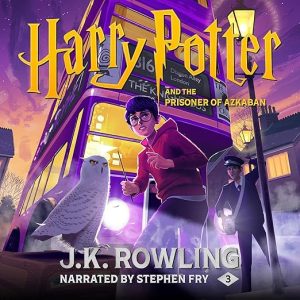
Dementors arrived at Hogwarts in this audiobook, and Stephen Fry's voice did something I did not expect: it made them frightening. I had read Prisoner of Azkaban in print as a child and knew the shape of the story well. But listening to Fry navigate the Dementor scenes at platform nine and three-quarters, and later on the Hogwarts Express, reminded me that the way a story is delivered is not incidental to what the story does. Harry Potter and the Prisoner of Azkaban, Book 3 is the British edition narrated by Fry, and it represents the audiobook format at its most fully realized.
A Time-Turner Plot Built to Reframe Everything
Prisoner of Azkaban is the book where J.K. Rowling's storytelling architecture became genuinely sophisticated. The earlier two volumes are wonderful, but they operate in a more linear mode. Azkaban introduces Rowling's first major use of temporal complexity, the Time-Turner plot, and does it with an elegance that holds up under re-examination. The Sirius Black mystery, layered across the whole novel, is constructed so that the revelations of the third act reframe everything the reader understood about the first two acts. That kind of structural craft is rare in children's literature, and it is rarer still when it also works on an emotional level.
Fry captures the tonal shift this book represents in the series. Azkaban is darker, more psychologically serious, and more morally ambiguous than its predecessors. Professor Lupin is the series' most fully realized Defence Against the Dark Arts teacher, and the scenes Fry has with him, particularly Harry's early Boggart lesson and the later confrontation in the Shrieking Shack, are among the finest passages in all seven books. Fry holds the complexity of Lupin: kind, brilliant, hiding something, genuinely dangerous, genuinely good. He does not simplify the character to make him easier to deliver.
Fry's Trelawney Splits the Difference on Purpose
Fry's vocal range across the Harry Potter series has become one of the most discussed narrator performances in English-language audiobook history, and Prisoner of Azkaban is often cited as the installment where his full range was on display. His Snape is contemptuous with precise calibration. His Dumbledore carries a quality of enormous patience that the page alone cannot entirely convey. His Trelawney, the Divination teacher Harry and Hermione encounter for the first time, is something between self-parodying theater and genuine dramatic menace, and the double register is exactly right.
The production adds theme music composed by James Hannigan, which frames the Hogwarts world with a sonic architecture that makes the audiobook feel complete rather than merely recorded. The music appears at chapter transitions and at key emotional moments without becoming intrusive. For listeners who have grown up with the films, the music introduces a distinct and interesting counterpoint. For first-time listeners, it adds a layer of atmosphere that works in the format's favor.
At twelve hours, Prisoner of Azkaban is the longest of the first three books, and the pacing rewards it. Rowling has given each supporting character enough space to breathe, and Fry uses that space. The Hogsmeade sections, the Quidditch matches, the extended Shrieking Shack confrontation: all of them take the time they need without feeling slow.
Darkness as a Condition, Not a Person
This is book three in a seven-book series with continuous narrative and character development. Listeners new to the series who begin here will follow the main plot without difficulty, but they will arrive at the Sirius Black revelations without the emotional freight those revelations carry for readers who have lived with Harry since book one. The entry point for new listeners is Harry Potter and the Sorcerer's Stone, also narrated by Fry in this British edition.
One reviewer mentions building their print collection alongside their listening, which reflects the series' unusual cross-format presence. This is a book that works beautifully in both forms, but Fry's narration adds something specific: the sense of a storyteller in the room. For listeners who already own the print edition, the audiobook is not a substitute but a different and equally valid experience.
It is also worth considering what Prisoner of Azkaban does that the earlier volumes do not. Books one and two establish the world and introduce its rules. Azkaban begins to complicate those rules. The Dementors are not evil in the way Voldemort or Quirrell is evil; they are a phenomenon, an environmental darkness that affects everyone regardless of intent. That shift in how darkness is conceived, from a person to a condition, marks a significant maturation in Rowling's storytelling. Fry captures that shift by reading the Dementor scenes with a different quality of stillness than he brings to the earlier villain scenes. It is subtle, but it is audible to anyone listening closely, and it is one of the reasons this audiobook holds up across repeated listens.
British Theater Meets American Storytelling
This audiobook belongs in any listener's collection who has started the Stephen Fry Harry Potter editions. It is the installment where the series reaches full creative stride, and Fry's narration meets that stride with his own. It works for children listening with adults, for adults returning to the series, and for first-time adult readers approaching the books without nostalgia.
Those who have been listening to Jim Dale's US editions will find Fry's British recordings a genuinely different experience. Both narrators are exceptional; they simply make different choices. Fry's versions have a quality of British literary theater. Dale's have a quality of American dramatic storytelling. If you have only encountered one, the other is worth exploring, and Azkaban is an excellent point of comparison.
- Narrator: Stephen Fry's performance here is among the finest in English-language audiobook history; his Lupin, Snape, and Trelawney are each fully inhabited and precisely calibrated.
- Subjects: Time and consequence, the burden of secret-keeping, moral complexity in a children's world
- Tone: Atmospheric and structurally rich, darker and more sophisticated than the first two volumes
- Bottom line: The book where Rowling's craft became genuinely ambitious, paired with a narrator whose range matches that ambition; an essential audiobook for anyone in the series.
Can I start the Harry Potter audiobook series with Prisoner of Azkaban, or do I need to begin at book one?
You can follow the plot, but starting at Sorcerer's Stone gives you the emotional foundation that makes Azkaban's revelations land with full force. The Sirius Black arc is significantly more powerful for listeners who have spent two books not knowing what to expect from him.
How does Stephen Fry's British narration compare to Jim Dale's American recording?
Both are excellent and distinct. Fry brings a British literary theater quality and an especially precise comic register. Dale is more dramatically expansive. They make genuinely different choices throughout. Many listeners eventually explore both editions.
Is the theme music a significant part of this audiobook production?
It is present at chapter transitions and key moments, but it is not intrusive. Composer James Hannigan's music creates a distinct sonic world separate from the film scores. Most listeners find it adds to the atmosphere rather than interrupting the narrative flow.
At 12 hours, is this audiobook too long for younger listeners?
It depends entirely on the child. Many children listen in segments over days or weeks, and the chapter structure supports that kind of episodic listening well. The pacing within chapters is always purposeful, so natural stopping points are plentiful throughout the audiobook.