
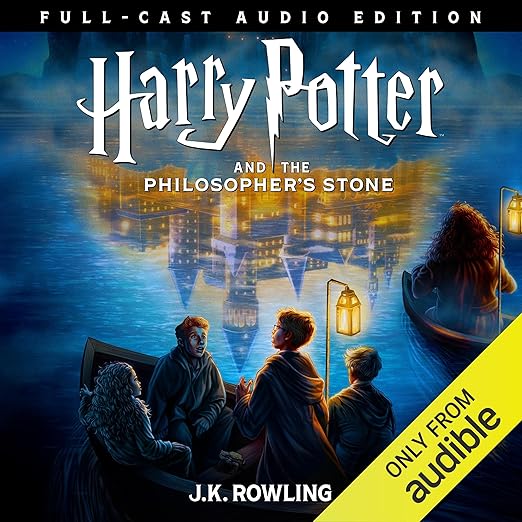
Wear headphones for the best experience, says the very first line of the description, which is an unusual instruction on a children's audiobook and an accurate one. This is not a reading of the first Harry Potter novel. It is a Dolby Atmos production with a new musical score and sound design built so a Golden Snitch darts past your ear instead of across a page. Eight hours and forty-one minutes of it, and the strangest thing on the record is that the credit fields have no idea what to do with a cast this size.
A Bet on Every Future Book's Voices
Hundreds of unique voices is the copy's own phrase, and the named portion of that cast is substantial: Frankie Treadaway as Harry Potter, Max Lester as Ron Weasley, Arabella Stanton as Hermione Granger, Hugh Laurie as Albus Dumbledore, Riz Ahmed as Professor Snape, Michelle Gomez as Professor McGonagall, Matthew Macfadyen as Lord Voldemort, and Cush Jumbo carrying the narration. That last credit is the one doing the structural work. In a full-cast production somebody still has to speak the prose between the lines of dialogue, and who holds that job decides whether the result feels like a book performed or a film without pictures.
Casting a first volume this way is a bet on everything that follows, since these voices now belong to these characters for however many books come after. It also changes what the story is for a young listener. The letters dropping on the doormat at number four, Privet Drive, the purple wax seal with its lion, eagle, badger and snake, the beetle-eyed giant arriving with astonishing news: those are moments the original text delivers by description, and a full-cast treatment converts them into events with footsteps, weather and a score underneath. A good deal of what a reader used to supply is now supplied for them.
From the First Moments, This Feels Like Film
Production is the whole proposition, and a five-star from January 2026 makes the case better than the marketing does. That entry opens by ruling things out: it is not about J.K. Rowling as a person, not about the books themselves, and not about the traditional single-narrator recordings many listeners already know and love. What it is about is how extraordinarily well this particular production was executed, and its verdict is that from the very first moments this is obviously not a typical audiobook but something closer to an audio film. That distinction is what a buyer actually needs, and it is the reason to consider paying again for a story most households already own in some form.
Atmosphere is where the March 2026 five-star lands. That entry reports the full cast bringing energy and variety to the dialogue and the sound design helping to establish atmosphere, and the quotation stops where the page truncates it. It also makes a point worth keeping: the magic, the sense of wonder and the nostalgia are as effective here as they are elsewhere, which is a compliment to the material rather than to the mix, and a useful reminder that no amount of production manufactures affection that was not already present.
Eight hours and forty-one minutes is a manageable length for a household, and the promise of a spellbinding listening event for the whole family is not wrong about who this is for. Play the Quidditch passage through headphones before committing, because that is where the spatial mix does something a stereo file cannot, and because it is also where a production of this kind risks burying the words underneath the effects. If the words stay on top of the sound design there, the rest of the sequence is worth signing up for.
Credit on This Record Is Simply Wrong
Credit on this record is simply wrong. The narrator field names Hugh Laurie. The copy names Hugh Laurie as Albus Dumbledore and names Cush Jumbo as Narrator, in the same sentence. Somebody has lifted a performer out of the middle of a cast list and installed that name in the slot belonging to someone else, so a buyer searching for the reader of this edition arrives at the wrong person, and whoever actually holds the narration gets no credit in the field built for exactly that purpose. On a production advertising hundreds of voices, compressing the cast to one name was always going to go badly. Picking the wrong one compounds it.
Which stone is this? The listing says Philosopher's, the name used outside the United States, while three of the five written entries call it the Sorcerer's Stone. A separate entry, written about the story rather than about the production, describes it as a warm and inviting introduction to the wizarding world, and reaches for the American title as well. None of that is a defect in the recording. It does mean the listing is showing one edition's name to a column of buyers using another, which matters to anyone trying to work out whether the thing they already own is the same thing.
Decorative characters make up the reviewer name on the fifth entry, a string of stylized letterforms most systems will refuse to render, which says something about how little this column has been curated. That entry was filed in Germany and is a plain retelling of the novel's opening: an uncle and aunt keeping a boy in the dark about how his parents died, a letter arriving, a school he has never heard of. Cast, score and mix go entirely unmentioned in it. The copy carries a slip in the same spirit, running the words Editions and present together without a space, in the sentence whose whole job is to sell the format.
The Price Only Makes Sense With Headphones
Families listening together are the intended audience, and the intention is well judged. It works for a household with a child old enough for the mild peril and an adult who has read the book often enough to want it altered slightly. It works equally for anyone curious about what a cast of this size does to material they know by heart. And as a first encounter it is generous: the story arrives with weather, footsteps and music, and no prior knowledge of anything at all is assumed.
Purists attached to a single voice should think twice, and so should anyone who listens mainly in a car or over a phone speaker, because a mix engineered for Atmos and headphones surrenders most of what it charges for on poor hardware. Give it a miss if you want the book rather than the event, since the text is unchanged and the words alone are available for less. Headphones are not a suggestion on this one; they are the condition under which the price makes any sense at all.
Common Questions
Who actually narrates this Harry Potter audiobook?
Cush Jumbo, according to the copy, which lists that name as Narrator inside the cast. The credit field says Hugh Laurie instead, and the same sentence of description has Laurie playing Albus Dumbledore. Treat the field as an error and the cast list as the accurate source.
How is this audiobook different from the standard single-narrator recording?
It is a full-cast production in Dolby Atmos, carrying an original score and, on the publisher's own account, hundreds of separate voices. Named performers take Harry, Ron, Hermione, Dumbledore, Snape, McGonagall and Voldemort, a separate narrator carries the prose between them, and sound design places footsteps and a Quidditch match around the listener.
Do I need particular equipment to get the full effect?
Headphones, at minimum. The opening line of the description asks for them outright, and a spatial mix is the one thing this format offers that an ordinary stereo file cannot. Played through a phone speaker or a car system it still works, but it stops being meaningfully different from a plain reading.
Is it suitable for a young first-time listener?
Yes, with a caveat about format rather than content. The record files it as a children's title and the story assumes nothing at all, but a production this dense rewards attention: a child half-listening in the background will follow the plot and miss the entire reason for buying this edition instead of a cheaper one.







