Key Details
- Performance: A full cast with hundreds of voices, an original score and a Dolby Atmos mix, with Cush Jumbo cast as narrator and Hugh Laurie as Dumbledore.
- What it covers: Institutional denial, secret resistance, grief, a teenager's own mind as contested ground
- Feel: Dark, crowded, cinematic
- Our call: A staged production rather than a reading, tackling the one book in the series whose central action happens inside a single head.
One line of dialogue is lifted out of the copy for this full-cast audiobook, and whoever chose it knew what the fifth book is about. Someone tells Harry that he is sharing the Dark Lord's thoughts and emotions, that the Headmaster considers this inadvisable, and that the speaker has been instructed to teach him how to close his mind. That is the year in one exchange, and it is also the production problem. Order of the Phoenix turns on things happening inside Harry's skull, and a full-cast staging with hundreds of voices, an original score and a Dolby Atmos mix is an instrument built for the opposite job: rooms full of people, all of them audible.
Finding Sound for a Mind Being Invaded
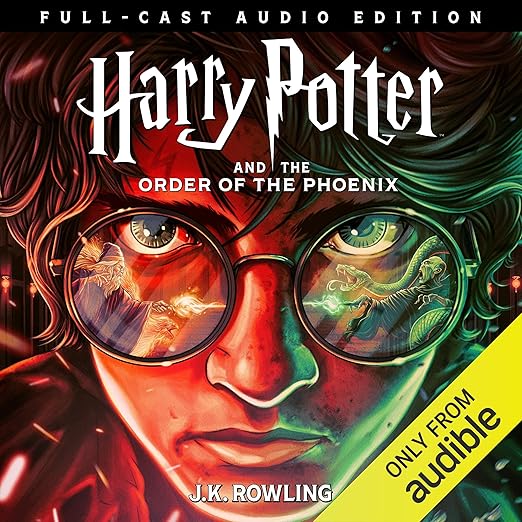
Take the production on its own terms first, because it is not an audiobook in the ordinary sense. The description promises footsteps echoing along the Hogwarts corridors and the whoosh of the Golden Snitch passing your ear during a Quidditch match, which tells you the sound design is doing narrative work rather than decorating it. Seventeen performers are named before the words and a full cast appear at the end of the list, among them Riz Ahmed as Snape, Keira Knightley as Dolores Umbridge, Michelle Gomez as McGonagall, Matthew Macfadyen as Voldemort and James McAvoy as Alastor Moody. Casting at that level is a statement about who this edition is for, and it is not only children.
What makes this particular volume the interesting one in the set is the mismatch already described. The plot of the fifth year is bureaucratic on the surface and internal underneath. A ministry insists nothing has happened, a teacher takes over the school by decree, a boy has nightmares that turn out not to be nightmares, and the resistance meets in a house that has to stay quiet. Almost none of that is action. A cast production has to find sound for denial, for surveillance and for a mind being invaded, and if it manages that, the format has justified itself on the hardest possible material rather than on the Quidditch.
Grimmauld Place Needs Eight Separate Voices
Grimmauld Place is the argument. The fifth book is the first one built around a household of adults, and ensemble scenes with eight people talking over each other are exactly what a single reader has to flatten and a cast does not. Simon Pegg as Arthur Weasley, Ruth Wilson as Bellatrix Lestrange, Ambika Mod as Tonks and Alex Hassell as Lucius Malfoy are separate voices in separate rooms rather than one performer signalling four people. For a story about a secret order that gathers in kitchens, that difference is not cosmetic. It restores the crowd the prose describes.
Family listening is the other case, and the copy makes it explicitly, calling the result a listening event for the whole family. At 26 hours and 39 minutes this is a long shared object: several car journeys, a set of evenings, a household audio project rather than a personal one. Adults returning to the series get something genuinely new instead of a reread, which is the only honest reason to buy a story this widely known for a second time. A five-star from June 2003 put its finger on why the fifth book rewards that return, noting the arrival of darker themes, of death and consequences and villains who are truly evil, in what had been a children's series.
One Reader Carries the Connective Prose
The written column belongs to other editions entirely. Two of the five responses were filed in June 2003, one describing a preordered parcel found on a doorstep and opened in a hurry. A February 2026 five-star praises printed edges and a gift for a Harry Potter fan and says it would buy other special editions. The remaining two were filed in Turkey and in Spain, the Spanish one admiring the binding and how portable the volume is. Every one of those is a legitimate response to a physical book, and none of them describes the production released in March 2026 that this page is selling. A 4.8 across 100 ratings inherits the same problem.
A pair of practical notes follows. The credit field on this record shows Hugh Laurie, while the cast list in the copy gives Laurie the part of Dumbledore and assigns the narrator role to Cush Jumbo, so the name a buyer sees first is not the voice carrying the connective prose. And the Atmos mix that half the pitch rests on depends on what you play it through, which is worth checking before paying for spatial audio you will hear as ordinary stereo. On the shelving, note that this sits under children's listening while the material is the point in the series where the series stops being for children only.
Umbridge Asks One Voice for Two Things
Households doing a family reread, adults who know the books well enough to be curious about interpretation rather than plot, and anyone who enjoys audio drama as a form should start here rather than with the earlier volumes, because this is the book with the most for a cast to do. Listeners who care about performance will find the casting choices worth arguing about on their own, particularly Umbridge, whose comedy and menace have to coexist in the same voice.
Buyers who want a straight reading with one voice and no score should look elsewhere, since that is a different product and this one is unashamedly theatrical. Younger children who found the earlier books comfortable may find this year and this treatment considerably less so, and 27 hours of it is a long time to be uneasy. For everyone else, the sensible plan is a household schedule and a decent pair of headphones for whoever is listening alone.
Frequently Asked Questions
How does this full-cast edition differ from the standard audiobook?
It is a staged production rather than a single reading. The description promises hundreds of unique voices, an original musical score, environmental sound design and a Dolby Atmos mix, with named actors playing individual characters. The text of the novel is the same. What changes is that dialogue is acted between performers instead of voiced by one reader.
Who actually narrates the audiobook?
The copy's cast list gives the narrator role to Cush Jumbo, several lines below Hugh Laurie, who is cast as Albus Dumbledore. Since the credit field on the record shows Laurie, a buyer scanning for the narrator will see the wrong name first. Jumbo is the voice carrying the prose between the acted scenes.
Is 26 hours of Order of the Phoenix suitable for younger children?
Approach with care. This is the volume where the series turns properly dark, and the description signals it directly: Dementors attacking a cousin, a secret order meeting in hiding, and lessons in shutting an enemy out of your own mind. Add cinematic sound design and a near 27 hour runtime, and the experience is considerably more intense than the earlier books.