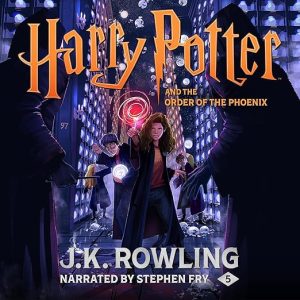
Fry is the reason this file exists as a separate object, and the description says so in its opening line: these are the original British recordings. Twenty-nine hours and one minute of Harry Potter and the Order of the Phoenix is a serious commitment, and a buyer would reasonably want to know how the reading holds up across that distance. What the audiobook page offers instead is a review column belonging to a different product. Two entries date from June 2003, more than twelve years before this edition appeared in November 2015. A third grades a printed special edition bought as a gift, a fourth, filed in Turkey, runs to two words, and a fifth, filed in Spain, admires the binding and calls the volume easy to carry.
More Unsettling to Be Told Than to Read
Performance claims on this page all come from the seller. The copy invites you to treat your ears to something rich and captivating, and promises that the unmistakable voice of Stephen Fry will guide you deeper into the story. That is the publisher talking, and a buyer should weigh it accordingly. The credit line itself is clean and specific: one reader, theme music composed by James Hannigan, Pottermore Publishing as the imprint. For anyone choosing among English-language readings of this novel, the useful phrase is original British recordings, because it identifies exactly which one this is without your having to hunt down sample clips and compare them by ear.
Grimmauld Place is where the secret order gathers, and the fifth volume is where this series stops being a school year with adventures attached. The description lays out the shape: a Dark Lord whose return is widely denied, an attack on Harry's cousin, and Professor Snape assigned to teach Harry how to close his own mind against a connection that keeps opening by itself. That last thread is why this particular book works so well aloud. It is interior, it turns on intrusion and control, and another presence described from inside a teenager's head is a far more unsettling thing to be told than to read.
One Credited Voice Carries the Entire Span
Darkness is what the spoiler-free June 2003 entry flags, and it is still the most useful observation any of these responses contains. It names death, consequences and genuinely evil villains as new arrivals in the series, then asks other reviewers to stay vague for a month or two out of courtesy to people still reading. Both details date the response precisely to the week the printed novel landed, but the observation survives the move to audio: this is the volume where the stakes stop being theoretical. A parent weighing whether a young listener is ready will get more guidance from that one paragraph than from the category field, which says children's audiobooks and leaves it there.
Immersion is what the length buys, and the runtime is enough to live inside the story rather than visit it. The description leans on exactly that promise, offering you the halls of Hogwarts, and the format suits a volume in which pressure accumulates slowly and very little resolves early. In practical terms you are looking at a month of daily sessions or a couple of weeks of long ones, and it rewards being taken in order rather than dipped into at random. One credited voice carries the entire span, and the fields name no full cast, no dramatization and no sound design beyond that single music credit.
One Hundred Ratings Reads Like an Approximation
Parcels are what three of these responses are actually about. The February 2026 entry praises printed edges on a special edition bought as a gift and says it would buy other special editions. The Turkey entry is two words long. The Spain entry admires the binding. None of that is dishonest and none of it belongs to a recording of this length, because these are print listings pooled under a single title. The oldest response in the set describes preordering the hardback, finding the package at the door and starting to read that same morning. The counter alongside them reads exactly one hundred ratings, a round enough number to treat as an approximation rather than a census.
Sequence matters more here than almost anywhere else in the series. This is book five of seven, the series fields say as much, and the description assumes you already know who the Dark Lord is, what a Dementor does and why an attack on Harry's cousin sets everything moving. Anyone arriving cold will be lost inside an hour, and nothing on the page steers them toward a starting point. The category reads children's audiobooks with an Action and Adventure tag, which undersells what the copy itself calls dark times, and the record carries neither a content note nor any age guidance. Parents of younger listeners are being asked to judge this one blind.
Test the Reader for Three or Four Hours
Returning listeners are the obvious audience, particularly anyone working through the British recordings in order and arriving at the point where the story turns. Households planning a long shared listen will get real value out of the length, since a stretch of travel that would swallow three shorter books will not exhaust this one. Anyone who came to this reader through other work will find the casting well matched to a book about surveillance, secrecy and being disbelieved, since so much of it depends on tone rather than on incident, and tone is the thing a reading can add or destroy.
Newcomers should not start here, and nothing on this page will stop them from trying. The record sells a very long reading through the publisher's own adjectives, files a book its copy calls dark under children's audiobooks, and pools a print column underneath the whole arrangement. None of that makes the recording a poor buy. It makes the page a poor guide. Begin the sequence at the first volume, test the reader across three or four hours rather than committing to the full runtime, and come back to this one when the story has earned the time it asks for.
- Narrator: Stephen Fry takes the reading, in what the copy calls the original British recordings, with theme music by James Hannigan and no other credited voice.
- Subjects: A denied warning, an interior invasion, a school under new management, friendship under pressure.
- Tone: Long, dark and accumulating.
- Bottom line: The right recording of the wrong entry point; worth the twenty-nine hours only if you have the four books before it behind you.