In Brief
- Voice: Stephen Fry is the sole reader credited, on what the copy presents as the original British recordings, with theme music by James Hannigan.
- Big ideas: A school year under suspicion, mentorship and withheld information, the war arriving at Hogwarts, first romances
- Atmosphere: Darkening, conversational, quietly ominous
- Worth it?: The volume where the series explains itself, and a strong candidate for a re-listen if you want the British production.
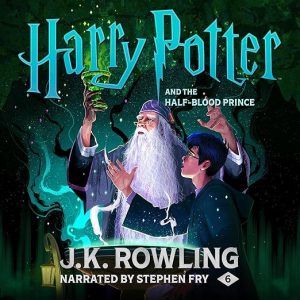
Theme music gets a composer credit on this listing, which tells you what kind of production Pottermore commissioned. James Hannigan is named for it, Stephen Fry is named for the reading, and the audiobook runs twenty hours and thirty-one minutes as part of what the copy calls the original British recordings. Very few audiobooks credit a composer at all. That single line at the bottom of the description signals a package built as a presentation rather than a straight reading, which matters when you are choosing how to spend a long week with a book you may already know by heart.
What a First-Time Listener Cannot Recover
Dumbledore arrives at Privet Drive in the opening the copy chooses to advertise, with a blackened, damaged wand hand and no explanation of how he got it, and that image is a good summary of the whole book's method. Information is withheld from Harry by the one adult who could supply it, while suspicion spreads through a school that is no longer safe. Harry is convinced Malfoy carries the Dark Mark, nobody believes him, and the year proceeds as an investigation nobody has authorized. The description keeps the promise implicit: this is the volume where the series stops protecting its reader.
Suspicion is also what the earliest responses fixed on. A July 17, 2005 five-star headed with a warning that the magic grows darker recalls the state of the series before this book existed, listing the threads left dangling by the previous volume and the speculation that filled the gap: who Voldemort would take next, which of the young couples would survive their own awkwardness, how much of the war was already lost. That entry captures something a first-time listener cannot recover, namely what it felt like to reach this point without knowing.
You Dip In, You Leave, You Come Back
Density increases here, and the other 2005 five-star, the one that opens by announcing spoilers, describes it precisely: a sense of learning more and faster than in the previous book, while a great deal stays unanswered, and a conviction that the seventh volume would need to be the size of an encyclopedia to close everything opened. That is an accurate structural reading. Book six is where the series converts atmosphere into mechanism, explaining how the enemy works rather than only what he does, which makes it the volume that rewards attention most.
Twenty and a half hours with one credited reader is the practical shape of the offer. A single voice carrying a school year's worth of characters works differently from a dramatized cast, and this record names Fry alone, so every teacher, student and portrait comes from the same source. The copy frames these as the original British recordings, and the description itself is written in British spelling throughout, so listeners who prefer the text as first published are in the right place. That framing is the closest thing to edition guidance the page offers.
Repeat listening is the real use case, and the publisher clearly knows it. The closing paragraph of the description sells comfort and escapism, a message of hope and belonging, and the continuing appeal of the story to new listeners, which is publisher language for a title people put on while cooking, driving or falling asleep. A file this size, whose shape you already know, behaves differently from a new book: you dip in, you leave it, you come back. Priced against that pattern, the runtime stops being an obstacle.
Nobody Here Has Tested the Promise to Your Ears
Parcels dominate the written column, and the pattern is worth spelling out. A January 5, 2026 entry filed from Mexico praises the physical condition of a delivery and the print quality of the pages. A January 19, 2026 entry from Germany reports fast arrival and no damage. An October 28, 2015 entry from France is a complaint about a stock shortage and a late shipment. Add the pair of responses written a decade before this recording existed, and nobody underneath this listing has tested the promise the copy makes about your ears.
Editions are being pooled, in other words, and the November 20, 2015 date belongs to this audio release rather than to the novel. The star average sits on top of that mixture: paper buyers, delivery experiences, readers writing in 2005 about a hardback, and whoever has listened since. None of the printed-book responses are dishonest, and none of them are about a recording. Read them for what they are, which is enthusiasm about the story, and look elsewhere for guidance on this particular file.
Cataloging is untidy in a smaller way. The title field ends with a volume number that the series field already carries, so the same information appears twice, and the catalog drops a twenty-hour school-year mystery into Action and Adventure. Neither error will cost you anything at checkout, but they are a reminder that the page was assembled rather than written, which is also the likeliest explanation for the review column landing in the state it did.
School Term Fills the Middle Stretch
Series listeners arriving in order are the obvious audience, and they should know this is the volume where the tone commits. Newcomers to audio versions of books they read on paper years ago are the second group, and this recording is a strong candidate for that project, given a single reader, a composer credit and a publisher presenting it as the original British production. Anyone starting the series here will be lost within an hour, since the book opens on consequences from the previous volume and never pauses to summarize them.
Patience is the requirement. Twenty hours is a genuine commitment, the middle of the book is school term rather than warfare, and much of the revelation arrives through conversation rather than incident. Listeners who want the series at its most propulsive should know that this one builds slowly toward its last stretch. Listeners who want to understand how the whole thing works, and who enjoy watching a familiar story reveal its machinery, will find this the most rewarding volume to hear read aloud.