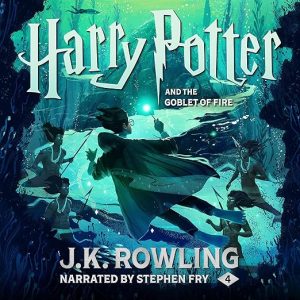
- Read by: Stephen Fry alone for the whole file, with theme music credited to James Hannigan and every claim about the reading coming from the seller's own copy.
- At its heart: A tournament with a broken age rule, friendship under strain, a series turning darker.
- Vibe: Festive at the start, dangerous by the end.
- Short version: The edition to own if you are returning to the series; sample the voice before committing the hours.
Stephen Fry's name does more selling on this page than the plot does, and the publisher's copy makes no secret of it. Stephen Fry brings the richness of these magical stories to life in the original British recordings, it says. Treat your ears to a performance so rich and captivating you will imagine yourself in the halls of Hogwarts. Those two sentences were written to move this audiobook, which makes them the only account of the recording anywhere on the page. The five people who wrote in are grading a novel, a parcel, a cover and a reading challenge instead, across a file that asks for the better part of a day.
Scheduled Tasks Suit Scheduled Listening Sessions
Fry is credited alone, and the copy supplies one production fact worth having: theme music composed by James Hannigan. That is more than most audio listings disclose, and it says this is a produced edition rather than a bare reading, with at least a musical frame around it. Everything else the seller offers about the performance is adjectival and cannot be checked from here. What can be checked is how large the job is. Book four is where the series stops being a school year with a mystery attached, and the April 2023 entry says so directly: the author takes the series in a slightly darker and more mature direction while maintaining the sense of wonder and adventure.
Triwizard Tournament drives all of it, and the description quotes the rules outright: three tasks, spaced through the school year, testing magical prowess, daring, powers of deduction and the ability to cope with danger. Only wizards over seventeen may enter, which is precisely why Harry's name emerging from the cup is a problem rather than a prize. Structurally that produces three set pieces with long stretches of school life between them, and in audio those stretches are where a listener either settles in or drifts off. A tournament with scheduled events suits sessions unusually well: you can stop between tasks without losing your place in the story.
Crying at the End of the Maze
Hogwarts at this length is the case for hearing the book rather than rereading it. The full runtime is long enough that the school year passes at close to the pace the characters live it, and the copy leans on exactly that promise, offering to carry you deeper into the story rather than summarize it. The July 2015 response describes the same effect from the page, reporting that the book is all kinds of long, that finishing it took several days, and that every moment of the reread was worth having. That reader also remembers crying at the end of the maze, which is a fair warning to anyone treating book four as more of the same.
Classics of our time is the phrase the copy now uses, and the framing tells a buyer who this edition is for. The description sells comfort and escapism, a message of hope, belonging and the enduring power of truth and love, and a story that keeps collecting new listeners. That is a rereading pitch, aimed at people who already know how it ends. The written column bears it out: the April 2023 entry types a full bibliographic header before its review, and the entry filed in India in July 2025 logs the book as number 25 of 52 in a reading year and awards it five out of five. Nobody on this page is discovering the plot.
Two Five-Star Grades Are About a Box
Parcels are what two of these five responses grade. The entry filed in the Netherlands in November 2020 praises the book and its handsome exterior, in Dutch. The entry filed in Brazil in June 2025 reports only that it arrived in excellent condition, and the handle it was posted under is itself a remark about the cover. Both awarded five stars. Both concern a physical object that turned up in a box, and this edition does not come in one. Those two grades sit inside the 4.8 average regardless, alongside 97 more that nobody can read.
Bloomsbury and Scholastic are the publishers named in that same 2023 response, next to a publication date of July 8, 2000. This record says Pottermore Publishing and November 20, 2015. Both are accurate about different objects, one the novel and one the recording, and nothing in the column distinguishes them. The category line adds its own muddle, filing a twenty-hour book under children's audiobooks with an Action and Adventure tag while the same column calls the series darker and more mature from this point. Parents using the category as a guide should treat book four as the volume where the register changes.
On a Book This Long, You Buy the Voice
Families listening together are the obvious audience, with one caveat the copy will not supply. A young listener who loved the first three years at Hogwarts is now meeting dragons, Dark wizards and a tournament the book itself describes as a test of the ability to cope with danger. The description promises comfort and escapism, which is honest about the series as a whole. Book four is where the danger stops being decorative. Returning adults, and anyone who wants the run in a single voice with the same production values throughout, will find this the edition the publisher treats as definitive.
Stamina is the only genuine barrier. If the appeal is a familiar story delivered in one continuous voice with music framing it, this is a straightforward purchase and the length becomes a feature rather than a cost. If the appeal is discovering the plot for the first time, the column offers nothing useful: five five-star grades from people who already knew the ending, and 97 more nobody can see. Sample the opening minutes before committing an entire month of listening sessions to a single reader, because on a book this long the voice is what you are actually buying.
How long is the Goblet of Fire audiobook, and is anything cut?
The record states twenty hours and fifty-four minutes, one of the longest files in the series by any measure. Nothing in the description mentions abridgment, cuts or a condensed edition, and the copy sells it as the original British recording rather than an adaptation of one.
Which version of the text does this recording use?
The copy identifies these as the original British recordings, so British spelling and vocabulary are what reach your ears. The description writes Hallowe'en with the apostrophe, a small visible sign of the same thing. No alternative version is offered or mentioned anywhere on the page.
Can I start the audiobook series here at book four?
The series field marks this as number four, and the description assumes you know Hogwarts, Ron and Hermione without introducing any of them. The tournament plot is self-contained enough to follow, but the emotional weight depends entirely on three previous school years.
Is this a recent release or a long-standing edition?
The recording appeared on November 20, 2015, so it has been on sale for a decade. The written responses stretch from 2015 to 2025, which is why they read like scattered notes from different eras rather than a launch reaction to a new recording.