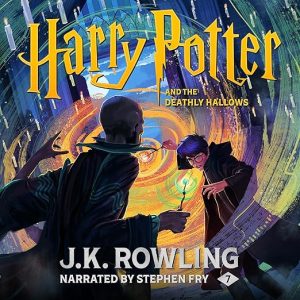
In Brief
- Performance: Stephen Fry alone on a file that has sat in the catalog since 2015, and the description sells his name before it sells the book's own title character.
- What it covers: The last stretch of a seven-book story, sacrifice and loyalty, a hunt for the remaining Horcruxes, hope and belonging as the publisher frames it
- Feel: Dark and propulsive, with a valedictory weight the comfort copy underneath it does not quite admit
- Our call: Worth the full day it costs if the British set is what you want, though the 4.9 above it is not the reason, given what the responses beneath are actually grading.
Pottermore Publishing put the phrase original British recordings at the top of this listing, which is a quietly loaded piece of copy. It tells you another set exists, and the page never says whose or how the two differ. What the audiobook contains is Stephen Fry reading the seventh volume for twenty-three hours and fifty-nine minutes, published in November 2015, filed under children's listening, carrying a hundred and eight ratings and a 4.9 above five written responses that turn out to be grading several different things at once.
Gloriously and Wholeheartedly a Child Again
John Bounds, writing in December 2007, produced the best sentence anybody has managed about this series. A thirtysomething with a mortgage, a bum knee and a tax bill, doing all the things an adult is supposed to do, who becomes gloriously and wholeheartedly a child again the moment he opens one of these books. That entry came to the series around the third volume, by way of an ex-girlfriend who was a fanatic and two films he had liked without liking enough to pick up the novels.
Stephen Fry is the whole proposition here, and the copy knows it. Treat your ears to a performance so rich and captivating you'll imagine yourself in the halls of Hogwarts is publisher language, and publisher language proves nothing on its own. What the description does establish is priority: the reader's name arrives in sentence one, ahead of the title character, ahead of the plot, ahead of the threat. Few pages in this catalog are built that way, and it tells you what Pottermore believes it is selling.
Hagrid's motorbike, Privet Drive left behind for the last time, a protective charm that no longer holds, Horcruxes still to find and destroy: every image the copy chooses is a departure. Whatever safety the earlier volumes offered has been withdrawn before this one starts, and the listening rhythm changes accordingly. Voldemort gets the first quoted line on the page, repeating his offer three times, and the repetition is the tell for how the volume is pitched.
Long Stretches Beat Bedtime Fragments Here
Midge, writing in December 2007, loves the series and still files a complaint worth hearing: a tone of the author's growing resentment toward her own main character, which that entry says has increased across each of the last four books. The argument attached to it is the interesting part. Once a writer publishes, the books stop belonging to the writer alone. Agree or not, it is a real reading, offered by somebody over fifty who calls the series a work of genius that will entertain generations.
Publisher copy at the foot of the page is worth weighing against that. It describes stories that never fail to bring comfort and escapism, with a message of hope, belonging and the enduring power of truth and love, sitting a few lines below Voldemort promising that nobody will be harmed if Harry is handed over. Both descriptions are accurate about different halves of the book, and knowing that the comfort framing is publisher-side rather than text-side will save you a surprise around the middle hours.
Endurance is the honest argument for choosing audio here. A print copy gets read in whatever fragments a week allows, while a file can be taken in long uninterrupted stretches, which is what this volume wants: it moves constantly, it has no fixed setting to return to, and continuity is most of its effect. Three or four long sessions produce a version of the seventh book that somebody working through it at bedtime never quite reaches, and that is a real difference rather than a format preference.
A Review About Book One, Filed Under Seven
Erin Miranda, writing from Canada in April 2025 under the heading My daughter is obsessed, describes loving Harry Potter and the Sorcerer's Stone: learning to use magic, flying on a broomstick, wanting the next one immediately, and a recommendation for any ten-year-old girl who likes magic and fun stories. It is a charming response and it is about the first book in the series, filed under the seventh. Five stars from a reader who has not reached this volume still count toward the average.
Eight years separate this recording from the two oldest responses beneath it, both filed in December 2007. Whatever those entries are grading, it cannot be a file Pottermore published in November 2015. The pooling gets stranger lower down, where Erman Becerikli, in an October 2024 entry filed from Turkey, leaves a two-word verdict under a headline praising speed, which is a comment on delivery rather than on anything Rowling wrote or Fry read.
Children's audiobooks is the shelf this sits on, with Action and Adventure as its only tag, above copy describing the Dark Lord breathing fear into everything Harry loves and a final battle that must begin. Anybody buying by category should understand the classification is inherited from the series rather than calibrated to this volume, and the runtime compounds it: one minute short of a full day is a genuine commitment for a young listener with a bedtime.
Twenty-Four Hours Is a Serious Thing to Give a Child
Italy supplied the most useful response on the page. Writing in July 2024, that entry recommends taking the book in its original English on the grounds that nuances and wordplay get lost in translation, and adds that the original doubles as a way to widen your English vocabulary. For a non-native listener that is precisely the argument for this edition: a British reading you can slow down, on a story you probably already know well enough to follow through the difficult passages.
Twenty-four hours is a serious thing to give a child, and the record gives you no help sizing it: the series field says seven, the shelf says children's listening, and no reading age appears anywhere. Adults coming back to the series, collectors completing the British set, and English learners who already know the story are the safest buyers here. Whether you want this set or the other one the copy alludes to is the one question a sample will settle in five minutes.