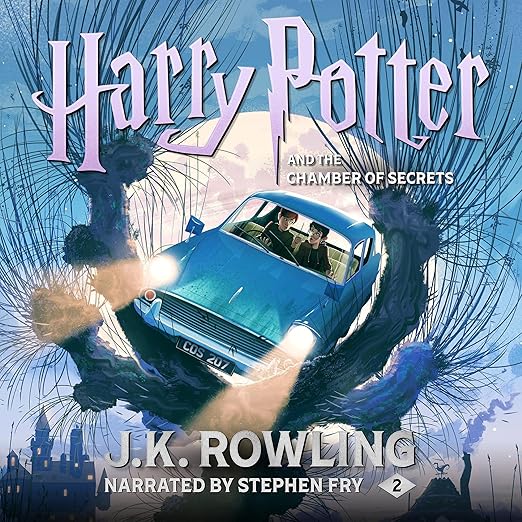
Stephen Fry's narration of the Harry Potter series is one of those audiobook performances that defines a generation's relationship with a story. Harry Potter and the Chamber of Secrets, Book 2 is where Fry hit his stride: the cast of characters expanded, the tonal range of the material widened, and the demands on a single narrator multiplied. Over nine hours and forty-three minutes, Fry voices everyone from the panicked diary ghost of Tom Riddle to the unctuous disaster of Gilderoy Lockhart, and the result is an audiobook that functions as something close to a one-person theatrical performance.
I have a clear memory of first listening to this installment on a family road trip as a child, and returning to it as an adult reveals how much craft was present in Fry's performance from the beginning. The Dobby chapters are remarkable. Fry gives Dobby a voice that is simultaneously comic and genuinely unsettling, the elf's self-punishment both funny and disturbing, and that double register, which Rowling maintains throughout the character's arc, is extremely difficult to render in a single voice without tipping too far in either direction. Fry does not tip.
Fry Commits Fully to Lockhart's Pomposity
The Second Book has a structural complexity that is easy to underestimate. The mystery of who opened the Chamber, the whispers Harry hears in the walls, the string of Petrified students, and the escalating suspicion around Harry himself are all interlocking narrative threads that Rowling maintains simultaneously across nine hours. Fry's narration keeps those threads distinct: he signals the difference between the comic relief of the Weasleys' flying car and the genuine dread of the Chamber's voice with a precision in tone that allows both to be effective rather than undermining each other.
The Lockhart problem is worth discussing specifically because it is one of the most demanding comic performances in the series. Gilderoy Lockhart is a satire of a certain kind of self-promoting incompetent, and Fry commits to the pomposity so fully that the character's eventual unmasking carries genuine comic satisfaction. A reviewer notes that Fry's voice is 'guaranteed to guide you ever more deeply into this magical story,' and Lockhart is evidence of why: Fry makes a character who could easily be irritating into someone who is funny in exactly the proportion Rowling intended.
A Classroom Where Sound Effects Build a World
One reviewer, a special education teacher, describes using this audiobook in a classroom context and notes that 'the sound effects, music, and ambience don't just tell the story, they build an entire world.' The James Hannigan theme music composed for this production is worth noting: it adds a layer of atmospheric support that elevates the listening experience beyond narration alone. Fry's reading is so strong that it would stand without the music, but the combination creates something genuinely immersive.
The British recording version, which this is, uses the original UK text rather than the Americanized edition. For listeners who grew up with the US editions, this means small differences in vocabulary, 'Philosopher's Stone' versus 'Sorcerer's Stone' in Book 1, and slightly different idioms throughout. These differences are minor but noticeable, and most listeners find the UK text's specificity to be a feature rather than a problem.
Myrtle Swings From Funny to Genuinely Eerie
At nine hours and forty-three minutes, this is a longer commitment than many middle-grade audiobooks, but the pacing sustains it. Rowling's plotting at the chapter level is notably tight, and Fry's narration reflects that: each chapter ends at a point that makes stopping feel like a small defeat. For family listening, this quality can be both an asset and a logistical challenge.
The darker material in this book, the Basilisk, the threat to Muggle-born students, and the Chamber itself, is handled by Rowling with enough restraint for the intended age range while being genuinely frightening in context. Fry calibrates the dread appropriately, and the whispers Harry hears in the walls are among the most atmospherically effective passages he narrates in the entire series. The balance between the comic elements and the genuine threat is one of Rowling's great structural achievements in this volume, and Fry honors it throughout.
The Moaning Myrtle chapters are another showcase for Fry's comic range. Myrtle's melodrama is written at a pitch that could easily become grating in a lesser performance, but Fry finds the precise calibration between pathos and absurdity that makes her both funny and, in the scenes near the end of the book, genuinely eerie. The tone of those bathroom scenes shifts considerably between the early Myrtle appearances and the final revelation, and Fry handles the shift with the same care he brings to Lockhart's arc. Both characters reveal something different about themselves in the book's final sections, and Fry lets those revelations land without telegraphing them in advance.
One of the Best Long-Car-Trip Audiobooks Here
This audiobook is for every listener who has started the Harry Potter series in audio with Book 1 and wants to continue in the same format. Fry's narration is cumulative in its rewards: characters that were introduced in the first book deepen with his handling here, and the confidence with which he now inhabits the world of Hogwarts is evident throughout. For new listeners, starting at Book 2 without Book 1 is not recommended, as the story's premise and character relationships are established in the first volume. For families, this is one of the most reliable long-car-trip audiobooks available, with the recurring music and Fry's voice providing a complete sensory environment.
Before You Press Play
- Read by: Stephen Fry's performance is one of the defining achievements in children's audiobook narration, handling Dobby, Lockhart, and the Chamber's dread with equal precision.
- At its heart: Identity and prejudice against Muggle-borns, the cost of celebrity and self-promotion, belonging at Hogwarts.
- Vibe: Comic and genuinely frightening in equal measure, with immersive theme music.
- Short version: An essential audiobook for Harry Potter listeners following the series in Fry's British recording; a benchmark for single-narrator performance across a full cast.
Is the UK audiobook version different from the US version narrated by Jim Dale?
Yes. The Fry recording uses the original UK text with British idioms and spelling conventions, while Dale narrates the Americanized edition. Both are strong performances, but they create somewhat different listening experiences. The Fry version is generally considered closer to Rowling's original voice, and the UK text's specificity is part of its appeal.
Does the audiobook include music, and how much does it add to the experience?
Yes, theme music composed by James Hannigan is included. It adds atmospheric support at key moments rather than running continuously. Most listeners find it enhances the immersive quality of the production, and the classroom reviewer specifically cited the 'music and ambience' as part of what makes this audiobook work in an educational setting.