Quick Take
- Narration: A genuinely impressive cast, David Tennant, Hugh Bonneville, Sophie Okonedo, Jason Isaacs, and Alexander Vlahos each take one of the five novels, with Tennant’s War of the Worlds and Isaacs’s Island of Dr. Moreau as standout performances.
- Themes: Science unchained from ethics, class and evolution, the terror of the unknown
- Mood: Propulsive and deeply unsettling, with the particular uncanniness of ideas that were radical in 1895 and remain troubling in 2026
- Verdict: The cast alone makes this collection extraordinary, five Wells novels performed by five distinct voices, each matched to the material with care. The War of the Worlds section with David Tennant is alone worth the price.
My particular fondness for H. G. Wells goes back to a university seminar on the literature of scientific anxiety, where a professor pointed out that Wells had done something no one else had quite managed: he had imagined the future as something that might consume us rather than something we were building toward. The War of the Worlds is not about Martian invasion. It is about what it would feel like to be the colonized rather than the colonizer, which is a thought that the British Empire in 1898 was spectacularly unprepared to think. That kind of conceptual radicalism, wrapped in narrative velocity, is what makes Wells durable in a way that most of his contemporaries are not.
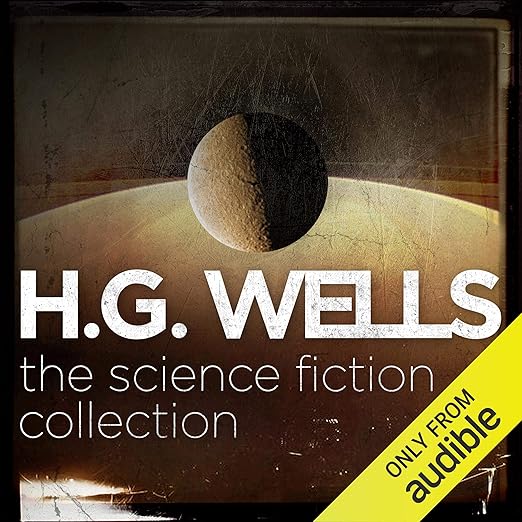
This Audible Studios collection presents five of his major science fiction novels with a cast that made me stop what I was doing and read the description twice: David Tennant narrates The War of the Worlds, Hugh Bonneville takes The Time Machine, Sophie Okonedo narrates The Invisible Man, Jason Isaacs handles The Island of Doctor Moreau, and Alexander Vlahos reads The First Men in the Moon. At twenty-seven hours across five novels, this is a significant listening commitment, but the casting is doing serious intellectual work in how these stories are positioned for a contemporary audience.
Our Take on H.G. Wells: The Science Fiction Collection
Wells’s five major scientific romances, collected here, represent a remarkably consistent set of anxieties. The Time Machine imagines class division taken to biological extremes. The Island of Doctor Moreau asks what distinguishes the human from the animal and arrives at uncomfortable answers. The Invisible Man is a study in how power without accountability produces monstrosity. The War of the Worlds applies the logic of colonial violence to the colonizers. The First Men in the Moon is the lightest of the five, closer to adventure than anxiety, though it too contains something distinctly uneasy in its portrait of the Selenite civilization.
Each novel is matched to its narrator with evident care. Tennant’s The War of the Worlds is the centerpiece, his particular combination of intellectual intensity and emotional accessibility is ideal for a first-person narrator who is processing genuine civilizational terror. The novel is written in a high-Victorian scientific journalism register that could easily become stiff in lesser hands; Tennant gives it momentum and humanity simultaneously. This is the performance that will draw listeners to the collection, and it earns that attention.
Why Listen to This Audiobook
The multi-narrator format does something that a single narrator cannot: it creates genuine variation across the five novels that mirrors the variation in Wells’s own tonal range. Isaacs’s Island of Doctor Moreau is notably darker in register than Vlahos’s First Men in the Moon, which is as it should be. Moreau is one of Wells’s most disturbing works, the vivisection experiments, the Law that barely contains the animal natures of Moreau’s creations, Prendick’s horror at what science can produce when it abandons ethical constraint, and Isaacs brings a menacing intelligence to the material that suits it exactly.
Okonedo narrating The Invisible Man raises a structural question that the collection does not explain but which is worth noting: Griffin, the Invisible Man, is written as male, and Okonedo’s casting in the role is an interpretive choice rather than a straightforward assignment. Whether you find this enriching or distracting will depend on your relationship to adaptive casting decisions in audio performance. For what it is worth, Okonedo is an extraordinarily talented performer, and the novel’s themes of isolation, madness, and power arguably translate across this casting choice without damage to the material.
What to Watch For in This Collection
One negative review in the listener feedback flagged audio quality issues with the volume level, this appears to be a specific technical concern with at least one listener’s copy and may not be universal, but it is worth verifying your playback settings before assuming a content problem. Wells’s prose can sound distant at lower volumes, particularly in The Time Machine and the passages of The First Men in the Moon involving extended description.
The collection also benefits from being listened to in the order presented, or at least with some sequence in mind. Beginning with The War of the Worlds and Tennant’s performance is a strong choice for listeners who want to be persuaded that Wells deserves their time. Moving through to Moreau and the Island at the end places the most disturbing work near the conclusion, which creates a useful gravitational pull. The First Men in the Moon is best in the middle rather than at the end, it is the collection’s lightest entry and works better as a breath between heavier novels than as a finale.
Who Should Listen to H.G. Wells: The Science Fiction Collection
This collection is the ideal audio introduction to Wells for listeners who have not read him, and it is a genuine event for those who have. The cast represents one of the most thoughtfully assembled narrator lineups in recent audiobook history, and the quality of the individual performances, particularly Tennant, Isaacs, and Okonedo, elevates the experience well beyond a simple recitation of Victorian texts.
Listeners who are familiar with Wells primarily through film adaptations, the various War of the Worlds films, the Island of Doctor Moreau movies, will find the source material significantly more interesting and unsettling than those adaptations suggest. Wells was writing in a tradition of scientific romance that valued conceptual originality over plot mechanics, and what he was actually worried about comes through more clearly in prose than any film has managed to convey.
Frequently Asked Questions
Which of the five narrators is most worth hearing, is there a standout performance in this collection?
David Tennant’s War of the Worlds is the most frequently cited standout, and it earns that reputation. Jason Isaacs’s Island of Doctor Moreau is a close second for listeners who want the collection’s darkest and most unsettling material at its best. Both performances suit their respective novels with unusual precision.
Should I listen to the five novels in a specific order, or can I jump between them?
The collection is presented in a specific order, and listening sequentially is reasonable. Starting with The War of the Worlds is a strong choice regardless of sequence, both because Tennant’s performance is the most immediately compelling and because it represents Wells’s most accessible and dramatically urgent work. The First Men in the Moon works better mid-collection than at the end, given its lighter register relative to the others.
Is Sophie Okonedo’s casting as the Invisible Man, a male character, something that affects the listening experience?
This is an adaptive casting choice rather than a straightforward assignment. Okonedo is a highly accomplished performer, and the themes of The Invisible Man, isolation, the corruption of power, identity under erasure, do not depend on the narrator being male to carry their weight. Whether you find the casting decision enriching or distracting will depend on your openness to interpretive performance choices in audiobook casting.
Is this collection appropriate for listeners new to Wells, or does it assume prior familiarity with his work?
It is an excellent entry point for new listeners. The five novels collected here are Wells’s most significant and most accessible scientific romances, and the cast makes them considerably more alive than standard audiobook performances of Victorian texts. No prior familiarity is required, each novel works as a standalone, and the collection’s variety means that if one novel does not immediately connect, another will.