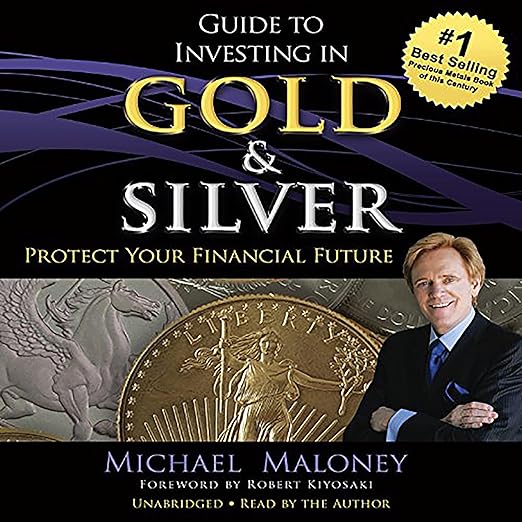
- Read by: Michael Maloney self-narrates with the conviction of a true believer; the delivery is engaging and accessible, though it carries an evangelical quality that listeners should factor into their assessment of the argument.
- At its heart: Currency debasement, precious metals as wealth preservation, cycles of inflation and deflation
- Vibe: Urgent and persuasive, calibrated to make the listener feel a decision needs to be made soon
- Short version: A clear and historically grounded primer on gold and silver investment, best approached as an articulate case for one position rather than a balanced overview of the field.
I listened to Guide to Investing in Gold and Silver on a morning when the financial news was particularly grim, which is probably not the ideal conditions for evaluating it objectively. Maloney's argument, that fiat currency systems are inherently unstable and that gold and silver represent the only historically proven store of real wealth, is presented with the force and clarity of someone who has been making this case for decades. The timing of my listening gave the argument more emotional resonance than it perhaps deserved on its own terms.
Michael Maloney is a precious metals dealer and educator who has been a prominent voice in the gold and silver investment community since the early 2000s. He is associated with Robert Kiyosaki's Rich Dad advisory network, a connection that several reviewers note. The book was first published in 2008, accurately predicting the global financial crisis of that year, and this updated edition incorporates Maloney's assessment of what has happened since and what he believes is coming next. He narrates the audiobook himself, which gives the material a personal and direct quality.
The book's historical foundation is its most durable contribution. Maloney traces the relationship between gold, silver, and monetary systems from ancient civilizations through the Bretton Woods era and into the present day of quantitative easing and ballooning central bank balance sheets. This historical sweep is genuinely illuminating, particularly for listeners who have never studied monetary history and who may have absorbed the assumption that the dollar's dominance is a natural and permanent condition rather than the product of specific political decisions made at specific historical moments.
Reviewer Todd A. described it as one of the best books on real money and the history between real money versus currency, and that assessment is fair for the historical sections. Reviewer 48 Panhead recommended it as the first book to read to open your eyes to what is going on, which captures the book's primary function: it is an introduction, not a comprehensive investment guide.
What Stands Out
Maloney's narration is the right vehicle for his material. He speaks with the cadence of someone who has explained these concepts many times to many audiences, and that fluency shows. The ideas are never obscured by technical jargon; he is careful to define terms and build his argument incrementally. For listeners who are genuinely new to precious metals investing and want a readable, non-academic introduction, the audiobook format works well because Maloney's enthusiasm keeps the economic history from feeling dry.
The book's prediction accuracy is one of the things that distinguishes it from purely speculative investment titles. The original 2008 edition did correctly forecast the financial crisis, which gives Maloney's framework credibility, even if reasonable people disagree about whether his proposed solutions are as universally applicable as he presents them.
Things to Know Before Starting Guide to Investing in Gold and Silver
The book wears its perspective openly, but listeners should still engage with its argument critically. Maloney is both an advocate for precious metals investment and a seller of precious metals products, and that alignment of interest shapes the book's conclusions. The argument for gold and silver is presented as essentially inevitable given the monetary analysis; the counterarguments, including the opportunity costs of holding non-yielding assets, the storage and insurance costs of physical metals, and the volatility of precious metals prices over short and medium time horizons, receive less attention than they deserve.
Reviewer Rob Kirk's note that the book has good information if you are new to the subject captures the appropriate audience calibration. Investors with more experience in alternative assets will find the historical narrative useful but the investment prescriptions familiar and potentially one-dimensional. The absence of discussion about ETFs, mining stocks, and the full range of vehicles for precious metals exposure is notable for a guide that presents itself as comprehensive.
Best Suited For
This audiobook is best suited to listeners who are new to thinking about monetary history and want an accessible, opinionated introduction to the case for precious metals. It works well as a starting point before moving on to more balanced or technically detailed investment resources. Experienced investors who already have views on asset allocation and monetary policy will find it less useful; the historical narrative is solid but the investment prescriptions are not calibrated for sophisticated portfolios. Anyone who has read Kiyosaki's Rich Dad series and wants to extend that framework into hard assets will find Maloney's book a natural next step.
Is the book dated given it was originally published in 2008?
The historical foundations remain sound. The updated edition incorporates Maloney's commentary on post-2008 developments including quantitative easing and the growth of central bank balance sheets. However, some of the specific predictions and price targets from earlier editions have not materialized on the timelines he suggested, which is worth bearing in mind.
How does this compare to other books on precious metals investment?
Guide to Investing in Gold and Silver is more accessible than most technical treatments of the subject and more historically grounded than most retail investor guides. For a more balanced perspective that includes discussion of when gold may not be the right choice, pairing this with a broader investment title is advisable.