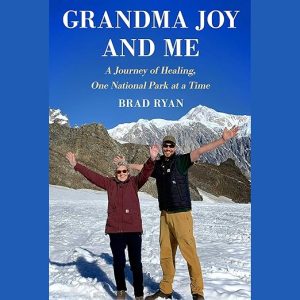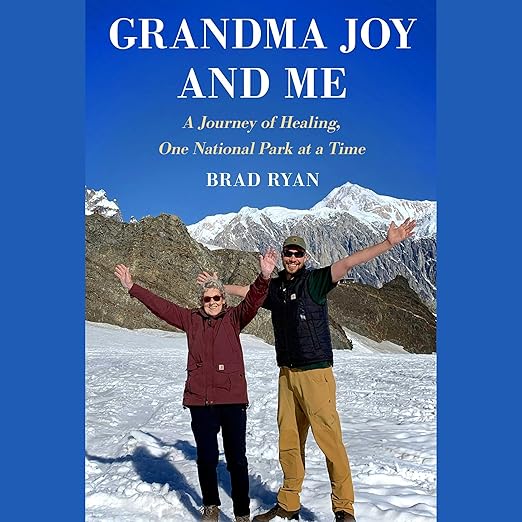
Joy Ryan was ninety years old when she became the oldest person to complete a visit to all sixty-three US National Parks. The journey took seven years and began with her grandson Brad proposing the quest partly as adventure and partly as something harder to name, a reckoning with family damage that had accrued across generations. I came to Grandma Joy and Me through a recommendation from someone who described it as 'a travel book that forgets it's a travel book,' and that description holds. The audiobook edition carries that dual identity, landscape writing and family repair, with a structure that moves between park visits and the emotional archaeology that made those visits necessary.
How Grandma Joy and Me Holds Up
Brad Ryan grew up in Appalachia, and that background shapes the book's relationship with place. Joy lived a life shaped by constraints specific to her generation and geography: limited education, early marriage, financial precarity, and the emotional compression that Appalachian culture often demands of women. Their quest to see Denali and the Everglades and the Redwoods and all sixty-three parks in between is, at one level, an act of profound expansion for someone whose life had not offered much of it. The book does not sentimentalize that expansion. Joy is not transformed into an inspirational symbol. She is a specific ninety-year-old woman from a specific place, and Ryan's writing about her maintains that specificity throughout.
The intergenerational healing arc is the book's primary emotional engine, and Ryan is honest about how uneven that process is. Family rifts built over decades do not resolve in a single conversation at Yellowstone. The book traces the slow, nonlinear quality of genuine repair, moments of unexpected clarity followed by reversions to old patterns, small gestures that mean more than formal reconciliation, the way physical experience can loosen emotional calcification that direct conversation cannot shift. That honesty is what separates Grandma Joy and Me from more formulaic grandmother-grandson adventure narratives.
The park writing itself earns its place in the structure. Ryan has the journalist's instinct for specific sensory detail, the light quality at Arches, the scale disorientation of Glacier, the humid weight of the Everglades, and that specificity keeps the travel sequences from becoming a list of visited locations. Joy's responses to the parks are often unexpected, rooted in the particular associations of someone who came to wilderness late and without the vocabulary of outdoor culture. Her reactions defamiliarize landscapes that have been written about extensively, and that defamiliarization is one of the book's quieter pleasures.
The book also functions as an implicit argument about what meaningful travel accomplishes. Ryan and Joy are not conquering the parks or collecting experiences as achievement. Each visit becomes a context for remembering, for asking questions, for understanding the other person in a setting removed from the domestic geography where their relationship formed. The National Park system becomes, in this account, a series of unusual pressure chambers, places where ordinary conversational avoidance is harder to sustain. That argument is made through accumulation rather than thesis, which is the right approach for memoir.
The audiobook format suits this material well. Ryan's prose is built for reading aloud: it has sentence variety and rhythmic intelligence, and the emotional register shifts, quiet, then suddenly very direct, translate naturally to a listening experience. The park sequences work particularly well in audio because landscape writing benefits from pace and breath, from the ability to linger in a description before moving through it. At ten hours, the length is generous but not excessive for the territory Ryan covers across seven years of travel and several more of reflection.
Weak Spots in Grandma Joy and Me
Listeners expecting a comedy of generations, the spry grandmother and her long-suffering grandson generating comedy from logistical chaos, will find something more serious than that framing suggests. The book has warmth and humor, but Ryan's primary interest is in the emotional archaeology, not the adventure narrative. The family history sections require patient attention: Ryan circles back to old wounds more than once, and the structural recursion is intentional but can slow the narrative momentum.
This listing does not credit a narrator, which means the audiobook's performed quality depends entirely on the actual reader, whose identity isn't specified anywhere I could check. Listeners should check current edition details to understand the narration context before purchasing, particularly if human narration quality is important to their listening experience.
The book's treatment of Appalachian identity merits particular attention. Ryan does not flatten Joy's upbringing into a backdrop for the healing narrative. The specific economic constraints of her life, the limited educational access, the way opportunity was structured or absent in her community, inform both her initial reluctance to see the parks as accessible to someone like her and her gradual willingness to claim them as her own. Ryan understands that the National Parks have a complicated history with the communities that border them, and while the book does not develop that complexity at length, the awareness is present in how he writes about Joy's relationship to public land.
The audiobook format is worth choosing deliberately for this material. Ryan's prose has a quality that works particularly well spoken aloud: he builds scenes through accumulation of specific sensory detail rather than through dramatic summation, and that patient approach is easier to follow when paced by a reader than when skimmed on page. The ten-hour runtime feels earned rather than padded; the book does not rush toward its emotional conclusions but lets them arrive at the pace the actual seven-year journey set.
The Right Listener for Grandma Joy and Me
Readers who responded to Cheryl Strayed's Wild for its emotional honesty about family damage and landscape as therapeutic context will find similar territory here. Those who have read Terry Tempest Williams or Craig Childs on the American West will recognize Ryan's attentiveness to place, though his approach is more personal and less lyric-essayist in register. National Park travelers who want to encounter these landscapes through an unusual pair of eyes will also find genuine value in the geographic specificity.
Listeners who prefer linear travel narrative or who expect resolution, the kind of memoir that ends with all wounds healed and all relationships repaired, should approach this with adjusted expectations. Ryan's honesty about the limits of what even sixty-three national parks can accomplish is the book's most credible quality.
At a Glance
- Themes: intergenerational repair, American landscape as emotional context, late-life expansion
- Mood: Reflective and tender with the occasional shock of direct honesty
- Verdict: A travel memoir that earns its emotional claims because Ryan refuses easy resolution; the journey through all sixty-three national parks becomes a genuine account of what proximity to landscape can and cannot fix.
Common Questions
Who narrates the audiobook edition of Grandma Joy and Me?
No specific performer is named for this edition, so performance quality here remains an open question until one is confirmed. Listeners should verify the specific narrator before purchasing if performance quality is a significant factor in their decision.
Does the audiobook cover all sixty-three national parks, or does it focus on a selection?
Ryan's structure is selective rather than encyclopedic. The book visits parks that generated particular emotional significance rather than documenting all sixty-three in sequence. The journey is the through-line; individual parks are chosen for narrative purpose as much as geographic completion.
Is this audiobook suitable for listeners who have not been to US National Parks?
Yes. Ryan writes for general readers rather than outdoor-culture initiates. Joy's own unfamiliarity with wilderness culture is built into the book's perspective, and her responses to the parks are accessible precisely because she approaches them without prior framework.