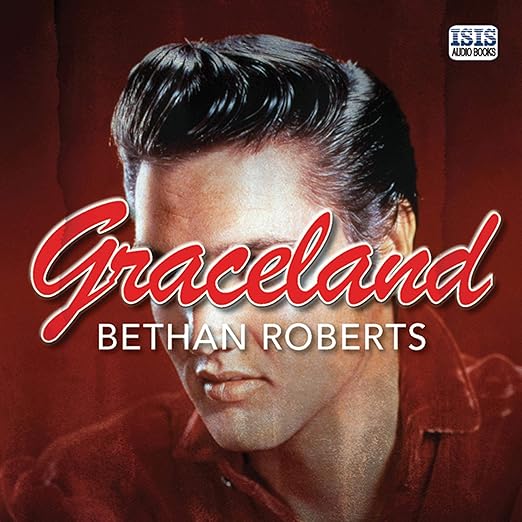
- Performance: Laurel Lefkow gives this fictionalized account of Gladys and Elvis Presley's relationship a quiet, careful quality that honors the book's literary ambitions without overselling its tragedy.
- What it covers: Maternal devotion and its costs, fame as a kind of exile, Southern memory and class aspiration
- Feel: Downbeat and literary, with the heat and music of the American South as constant backdrop
- Our call: A genuinely literary imagining of the Elvis-Gladys relationship that takes the mother seriously as a protagonist, though its emotional austerity may not be for every listener.
I came to this novel not as an Elvis fanatic but as someone who has always been more interested in the people adjacent to fame than in the famous themselves. Graceland, by The Practical Atlas (the pen name for author Bethan Rogers), takes the mother-son relationship between Gladys and Elvis Presley as its real subject, which immediately suggested a more interesting angle than another Presley biography. Fame is the backdrop here. The relationship is the foreground.
The novel is fictionalized, which is important to establish at the outset. Rogers is not reporting facts about Gladys and Vernon Presley's lives so much as imagining the interior texture of those lives. Some readers who came expecting biography were disappointed by that creative liberty. Those who came expecting literary fiction found something more rewarding.
A Closer Look at Graceland
Rogers structures the novel around two interweaving time frames: Elvis's impoverished childhood and his rise to the heights that allowed him to buy Graceland for his family. The contrast is handled skillfully. One reviewer with a literary comparison at hand noted that the early scenes reminded them of Donna Tartt's writing, which is not an idle comparison. Rogers is reaching for that quality of precise, slightly elevated prose that makes poverty and aspiration feel specific rather than sentimental.
The emotional center is Gladys, and it is here that the book does its most original work. The standard Elvis narrative gives Gladys a supporting role: the devoted mother, the one he loved most, the one whose death broke him. Rogers gives her an interior life, an independent perspective on what the wealth and the fame cost her specifically. The drinking, the diet pills, the loneliness inside the mansion, these are not incidental details in this version of the story. They are the story.
What Makes Graceland Worth Hearing
Laurel Lefkow narrates with the measured quality that literary fiction requires: she does not push for emotional effect but lets the prose find its own level. At thirteen hours, this is a sustained commitment, and Lefkow's consistency matters across that span. The American South setting, which Rogers evokes with period detail and an ear for the music that shaped Elvis's voice, comes through in the narration without becoming atmospheric performance.
Reviewers note that Rogers captures how Elvis came to love music through the African American communities of his small town, how his style of singing emerged from an immersion in blues and gospel that was genuine before it became a career. That musical grounding gives the novel a cultural texture that distinguishes it from conventional Presley hagiography.
Things to Know Before Starting Graceland
This is a downbeat book. Multiple reviewers flag its emotional register as sad or downbeat in ways that are not criticisms of the writing but honest descriptions of the experience. One reviewer who described herself as a great Elvis fan found it a trifle boring, and another noted that the poetic licence made them uneasy given how much is known about Presley's actual life. If you want celebration or romance around the Elvis mythology, this is not the right version of the story.
The fictionalized approach also means that events and conversations are invented or imagined, which will sit differently with different readers. Rogers is transparent about working in the mode of literary historical fiction rather than biography, but the Presley family's public history is detailed enough that readers familiar with it will notice where Rogers has made interpretive choices.
Who The Practical Atlas Is Writing For
This is the right audiobook for literary fiction readers interested in the American South, in the interior lives of women in mid-century America, and in the specific emotional cost that fame extracts from the people closest to the famous. Readers who approach Elvis Presley's story through a cultural-studies lens, interested in how his musical roots connected to African American traditions, will find Rogers' treatment thoughtful. Committed Elvis fans who want celebration rather than elegy, or listeners who are uncomfortable with fictionalized biography, will be better served elsewhere.
How much of the novel focuses on Elvis's music career versus his relationship with Gladys?
The relationship with Gladys is the primary subject. The music career and rise to fame are context rather than focus. Rogers is interested in what the success meant to Gladys and what it cost her specifically, using the Graceland mansion as a symbol of aspiration fulfilled and domestic happiness frustrated simultaneously.
Does Laurel Lefkow's narration give the novel an American accent, and does that suit the Southern setting?
Lefkow brings a careful, literary quality to the narration that respects the book's period setting without exaggerating it. The American South atmosphere comes through in the prose rather than in performative accent work, which suits a novel that aims for literary fiction's register rather than regional color.
Is the book accurate about Elvis's musical origins and his relationship with Black musical traditions in the American South?
Reviewers who comment on this element generally find it well-researched and handled with care. Rogers depicts Elvis's early immersion in the blues and gospel of his hometown communities as the genuine foundation of his style rather than as appropriation-myth, which several reviewers identify as one of the novel's stronger contributions to the Presley literature.