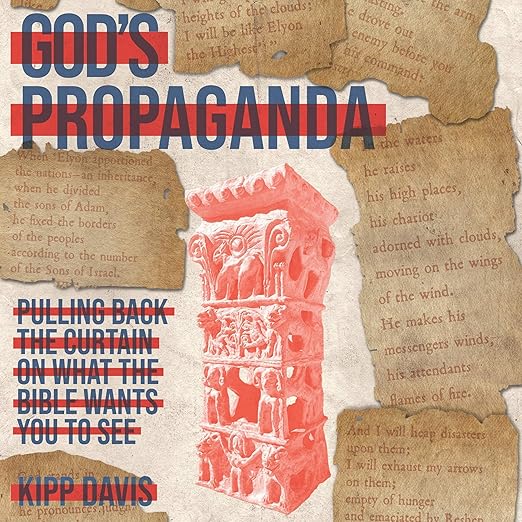
Quick Take
- Narration: Kipp Davis narrates his own work, which gives the 23-hour audiobook an academic seminar quality, authoritative and engaged, though the length demands a committed listener.
- Themes: The Bible as political literature, the Babylonian Exile and its textual legacy, the gap between religious tradition and historical scholarship
- Mood: Intellectually confrontational, not hostile, but willing to say clearly uncomfortable things about a text billions of people hold sacred
- Verdict: Davis brings genuine scholarly depth to a provocative thesis about the Old Testament’s origins as political propaganda, and his self-narration gives the 23 hours an intimacy that pure academic prose rarely achieves.
I have been circling books like God’s Propaganda for a long time. The scholarly study of the Bible’s composition, when its books were written, by whom, for what political purposes, has been developing since the 19th century and has produced some of the most intellectually interesting historiography in existence. But most of that scholarship lives in university press monographs with price tags and vocabulary that keep it from the general reader. Kipp Davis has done something genuinely useful: he has taken that scholarship and made it navigable for a curious non-specialist listener, over the course of nearly twenty-four hours of careful audio.
The central argument is provocative but not new within the scholarly community. The texts of what Christians call the Old Testament and Jews call the Tanakh were not written as timeless spiritual revelation but as political instruments, tools that served the specific needs of specific communities at specific historical moments. The conflicting creation accounts in Genesis, the divine rage at idolatry throughout the Deuteronomistic history, the shape of the covenant theology in Deuteronomy, all of these reflect the crises and ambitions of the kingdoms of Israel and Judah as they navigated their position between Mesopotamian empires. Davis’s contribution is to make this argument comprehensively, accessibly, and with the supporting detail of archaeological evidence and comparative Ancient Near Eastern literature.
Our Take on God’s Propaganda
What Davis does especially well is the contextual archaeology. One reviewer describes the book as adding historical context easily ignored or unknown to those simply reading the Bible, the discoveries and scholarly insights growing since the 1800s that biblical readers rarely encounter. This is precisely right. The material from the Dead Sea Scrolls scholarship, the Ugaritic texts, the Assyrian and Babylonian records that illuminate what the biblical authors were responding to, these are the things that make the argument about political purpose concrete rather than speculative.
The treatment of the Babylonian Exile as the central organizing event of the Old Testament’s final composition is the book’s strongest section. The claim that the Bible as we know it is substantially a product of the exile, that the trauma of conquest and displacement shaped what texts were preserved, amplified, and edited, is well-supported and genuinely illuminating. Davis walks through how apocalypticism emerging from that experience eventually paved the way for both Rabbinic Judaism and early Christianity, which puts the familiar origins story of Western religion in a considerably different light.
Why Listen to God’s Propaganda
Davis narrating his own work across nearly twenty-four hours is an unusual commitment, and it pays off in specific ways. There is an intimacy to self-narration that academic subject matter rarely achieves. Davis explains why he finds this material important, not just what he has found. One reviewer notes that he is easy to read by the non-scholar while explaining deep understanding of the underlying Hebrew, that accessibility without condescension is one of the audiobook’s genuine achievements. The sections on what is happening in the biblical Hebrew that English translations obscure are particularly rewarding.
The length requires intentional engagement. This is not ambient listening content. The theological and historical arguments build on each other, and a listener who checks out for twenty minutes during a chapter on the Deuteronomistic History will find themselves disoriented in the next section. Treat it like an intensive course, short sessions with time to absorb what you’ve heard.
What to Watch For in God’s Propaganda
One reviewer raises a fair concern: there are too many words and too many quotations, and a more focused analysis could be tighter and more powerful. At twenty-four hours, Davis is comprehensive to the point of occasional redundancy. Listeners who want a concentrated version of the argument might find the same scholarly terrain covered in a book half this length would serve them better. The comprehensiveness is also the book’s virtue, but it is worth knowing that you are signing up for an extended course rather than a brisk argument.
The book’s approach will be challenging for listeners who hold the Bible as sacred scripture and are not interested in historical-critical engagement with it. Davis’s title describes the Bible as propaganda, which is accurate to the scholarly argument but which carries a rhetorical charge that is not incidental. This is a book that takes seriously the human political origins of the text, and it does not soften that position.
Who Should Listen to God’s Propaganda
Anyone who has ever read the Bible and found themselves puzzled by its internal contradictions, its shifting portrayals of the divine, or its startlingly political character will find Davis’s framework enormously clarifying. Readers who have engaged with popular accounts of biblical history, Karen Armstrong, Richard Elliott Friedman, or James Kugel’s How to Read the Bible, will find Davis goes deeper into the archaeological and textual evidence and is more comfortable with the provocative conclusions that evidence supports.
This is not for listeners who want their existing relationship with the Bible confirmed and deepened. It is for listeners who want to understand what scholars actually think about when the Bible was written, by whom, and why, and who are prepared to sit with the answer that the text is simultaneously a great work of human civilization and a product of very specific human political anxiety. Those two things are not mutually exclusive, and Davis makes that case with rigor and with genuine appreciation for what he’s examining.
Frequently Asked Questions
Is God’s Propaganda an atheist polemic against the Bible, or a scholarly examination?
Scholarly examination. Davis approaches the Old Testament as a historian and textual scholar, not as an anti-religious polemicist. He uses the language and methods of biblical scholarship, archaeology, and Ancient Near Eastern studies to make his argument about the texts’ political origins.
Do I need prior biblical or theological knowledge to follow the argument?
Basic familiarity with the Old Testament narrative helps significantly, but Davis provides enough context that a thoughtful listener without prior study can follow the main argument. The deeper archaeological and Hebrew linguistic sections will land more fully for listeners with some prior exposure to biblical scholarship.
How does Davis handle the connection between the Babylonian Exile and the emergence of Judaism and Christianity?
It is the book’s central thread. Davis argues that the trauma of the exile substantially shaped which texts were preserved and amplified, and that the apocalypticism emerging from that experience paved the way for both Rabbinic Judaism and early Christianity. He treats this not as speculation but as the most coherent account of the textual evidence.
Is the 23-hour length justified, or does the argument feel padded?
One reviewer raises the fair criticism that the book could be tighter with fewer quotations and more focused analysis. The comprehensiveness is genuine, Davis covers an enormous amount of material, but listeners who want the essential argument without the full scholarly apparatus may find the length demanding relative to their specific interest.