Quick Take
- Narration: Krishna Dharma narrates his own retelling with the authority of someone who has spent decades inside this material, unhurried, devotional in register.
- Themes: Divine incarnation and cosmic rescue, the science of sankhya yoga, the relationship between the eternal self and the absolute
- Mood: Contemplative and elevated, closer to sacred storytelling than academic presentation
- Verdict: For listeners already oriented toward Vaishnava philosophy, this fourth volume of the Brilliant as the Sun series is a valuable entry point into the Srimad Bhagavatam’s third canto; newcomers may need additional context to access the full depth.
I came to Two Avatars as someone with passing familiarity with the Vedic texts but no deep study of the Srimad Bhagavatam specifically, and I think that positioning makes me a reasonable test case for what Dharma has achieved here. The project, retelling the entire Srimad Bhagavatam in the style of a modern novel while adhering closely to the original text, is an ambitious one. The Bhagavatam is vast, layered, and in its Sanskrit form, dense with theological commentary that resists casual reading. Dharma’s stated aim is accessibility, and in this fourth volume he largely achieves it.
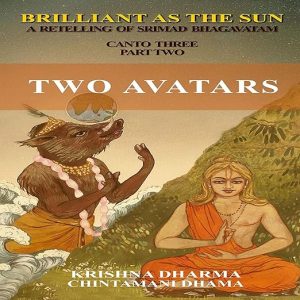
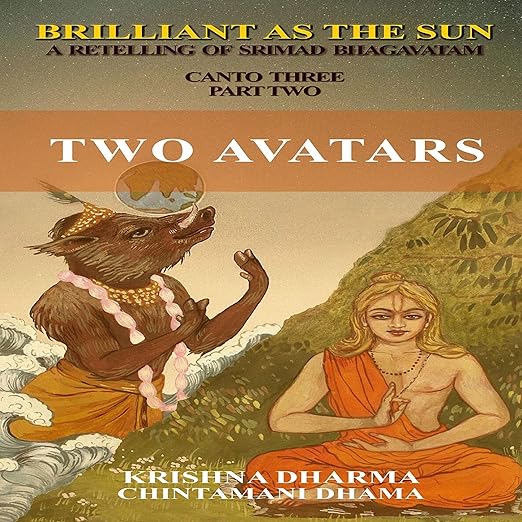
Two Avatars covers two of the Bhagavatam’s most significant narratives from the third canto. The first is the appearance of Lord Varaha, Vishnu’s boar incarnation, who rescues the earth from the demon Hiranyaksha, a story that operates on cosmological scale, the earth literally sinking into the primordial ocean until divinity intervenes. The second moves to a more human register: the sage Kardama, his marriage to Devahuti, and the birth of Lord Kapila, the divine incarnation who descends to teach sankhya yoga. These two stories are quite different in texture, and the volume holds them together without forcing an artificial continuity.
Our Take on Two Avatars
What Dharma does well is exactly what he promises: he makes the flow of the Bhagavatam navigable. The philosophical content, particularly the sections on sankhya yoga and the nature of the eternal self, is handled with care. He doesn’t simplify to the point of distortion, but he also doesn’t assume the listener has read the commentary literature. For someone who has wanted to engage with this text and found the scholarly translations daunting, this series offers a genuine entry point.
The Varaha narrative has a quality of mythological grandeur that Dharma captures in the retelling style. The boar form of Vishnu rescuing the earth is one of those images from the Puranas that carries enormous symbolic weight, the earth as the devotee, rescued by divine love rather than divine power alone. Dharma allows that weight to be present without turning the retelling into an academic exercise.
Why Listen to Two Avatars
Krishna Dharma narrating his own work is the right decision for this material. There is a quality to self-narration of devotional text that differs from a professional performance, a sense that the narrator has inhabited the words for a long time before recording them. Dharma’s pace is unhurried, which suits both the mythological sections and the philosophical teaching sequences. The sankhya yoga teachings attributed to Lord Kapila in particular require a pace that allows ideas to settle. Dharma provides that rhythm naturally.
The single review available at the time of writing describes the retelling as reading beautifully off the original text and commentary from senior Vaishnavas, making for a seamless read into some of the deepest wisdom of the Vedic Puranas. That assessment rings true to my listening experience. Dharma has clearly worked with the Vaishnava commentary tradition rather than against it, which gives the retelling an authority that a more literarily ambitious adaptation might have sacrificed.
What to Watch For in Two Avatars
This is volume four of an ongoing series. While each volume has its own internal coherence, listeners will get considerably more from this entry with prior exposure to at least the framing material from earlier volumes. The cosmic geography, the names of sages and divine figures, and the philosophical vocabulary of the Bhagavatam accumulate across the series. Jumping in at the third canto without that foundation is possible, but some listeners will find the density of proper nouns and theological terms more demanding than expected.
It is also worth noting that the Bhagavatam is religious text, not secular fiction. Dharma has chosen the novel form as a vehicle, but the intent and the content are devotional. Listeners approaching this as historical mythology or philosophical literature will find value here, but they should know that the retelling does not maintain critical distance from the text’s claims. This is Vaishnava devotion rendered accessible, not comparative religion scholarship.
Who Should Listen to Two Avatars
The ideal listener here is someone already oriented toward the Vaishnava tradition or toward the broader landscape of Hindu philosophy who finds the standard Sanskrit translations and their extensive commentary apparatus too demanding for regular listening. This series makes sustained engagement with the Bhagavatam possible in a format that can accompany daily life. It is also genuinely useful for someone who has read the Bhagavad Gita and wants to understand the larger scriptural context from which it emerges.
Listeners looking for secular historical fiction set in ancient India, or for a critical examination of these texts from an outside perspective, will find this too devotionally framed for their purposes. Dharma’s goal is transmission of the teaching, faithfully and beautifully rendered, and that is exactly what he delivers.
Frequently Asked Questions
Do I need to start from volume one of the Brilliant as the Sun series, or can I begin with Two Avatars?
Starting from the beginning is advisable. The cosmic framework, the cast of divine and sage figures, and the philosophical vocabulary of the Bhagavatam build across volumes. Two Avatars has its own coherence, but you will absorb it more fully with the earlier volumes behind you.
Is this a scholarly translation or a creative retelling?
A creative retelling that adheres closely to the original text and Vaishnava commentary. Dharma is not a secular scholar imposing a literary frame, he is a practitioner within the tradition who has chosen the modern novel form to make the Bhagavatam more accessible to contemporary readers.
What is sankhya yoga, and how deeply does the audiobook explain it?
Sankhya yoga is the ancient analytical system of philosophy taught by Lord Kapila in the Bhagavatam, addressing the nature of matter and spirit and the path to liberation. Dharma covers the teachings in the retelling with enough clarity for a non-specialist listener, though deeper study would require engaging with the commentary tradition directly.
Is this audiobook appropriate for listeners with no prior knowledge of Hindu philosophy?
It is possible to begin here, but some prior orientation will help. Even a basic familiarity with the concepts of dharma, karma, and divine incarnation (avatara) will make the listening experience considerably richer. Dharma’s prose is clear, but the theological framework is dense for a complete newcomer.