Quick Take
- Narration: Simon Vance handles the philosophical density of Herbert’s prose with impressive composure. His measured delivery suits Leto II’s millennia-spanning perspective, and he keeps the extended monologues from collapsing into lecture.
- Themes: the weight of prescience, the Golden Path and species survival, tyranny as an act of love
- Mood: Dense and philosophically demanding, with long stretches of dialogue that function more as treatise than plot
- Verdict: The most divisive book in the Dune sequence, and also its most intellectually ambitious. Approach it as an extended philosophical dialogue rather than a plot-driven sequel and it delivers something extraordinary.
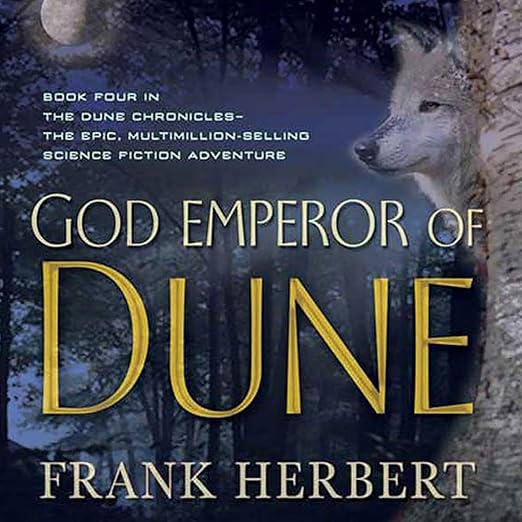
I have read the original Dune trilogy multiple times and waited years before tackling the fourth book. I finally listened to God Emperor of Dune over the course of a week of evening sessions, the kind of slow, deliberate engagement the material demands. Simon Vance’s narration made that week feel like spending time in the company of something genuinely strange and ancient, which is precisely what Herbert intended.
The premise alone signals that this is not a continuation in any ordinary sense. More than three thousand years have passed since Paul Muad’Dib. Arrakis is greening. And Leto II, Paul’s son, has merged with a sandworm to become an immortal hybrid creature, ruling humanity with a grip he calls the Golden Path. He is simultaneously the universe’s most powerful being and its most deliberate prisoner, engineering his own destruction as the only way to ensure human survival beyond stagnation. The novel lives almost entirely inside that paradox.
Our Take on God Emperor of Dune
Herbert shifts register completely here. The political intrigue and ecological wonder of the early Dune books are largely replaced by extended philosophical dialogue. Leto holds court, muses on the nature of power, lectures companions on the necessity of his tyranny, and records his thoughts in journals that function as the novel’s intellectual spine. If you enter expecting the propulsive plotting of the first book, you will be frustrated within the first few hours.
Enter expecting an extended meditation on power, evolution, and what it means to sacrifice individual freedom for species survival, and you will find one of science fiction’s most genuinely audacious achievements. Herbert is arguing something deliberately uncomfortable: that a benevolent dictator who prevents the stagnation of human civilization might be necessary, might even be an act of love. He does not let that argument off easily. Leto’s certainty and his crushing loneliness are both rendered with real force.
One reviewer describes God Emperor as the book where the Dune series becomes something closer to ‘a history-mythology type thing,’ and that shift in genre register is exactly right. The novel is operating closer to Gibbon’s Decline and Fall than to conventional science fiction, using the future as a vantage point to excavate permanent questions about how civilizations grow, calcify, and break.
Why Listen to God Emperor of Dune
Simon Vance is a particularly good fit for this material. The text is dense with interior monologue and philosophical declaration, and a lesser narrator would let it flatten into unbroken lecture. Vance keeps the emotional temperature slightly variable, allowing moments of Leto’s dry sardonic humor, his weariness, his genuine grief at what he has become, to register distinctly from the philosophical passages. At nearly sixteen hours, this is a long investment, but the audio format is actually kinder to the material than silent reading: Vance’s pacing forces you to sit with each idea rather than skimming toward resolution.
One reviewer describes it as ‘an unsettling continuation of the Dune mysteries,’ pointing to how Herbert layers his philosophy with genuine existential unease about where human civilization is headed without intervention. That unease is the book’s emotional engine, running beneath even the most abstract passages.
What to Watch For in God Emperor of Dune
The time jump and near-total replacement of familiar characters means you are essentially starting over with the Dune universe’s furniture. Siona and Moneo, the primary human characters surrounding Leto, are richly developed but operate primarily as interlocutors for his ideas rather than as independent protagonists in the conventional sense. Some readers find that imbalance frustrating. Others find it freeing, precisely because it refuses to let character drama distract from the larger philosophical project.
The sandworm transformation sequences and Leto’s descriptions of his own increasingly alien consciousness are the novel’s most purely science-fictional passages, and they are extraordinary. Herbert is doing something genuinely original: a consciousness that spans millennia while remaining emotionally human in some diminished, aching register.
Who Should Listen to God Emperor of Dune
Essential listening for anyone committed to the full Dune sequence who has made it through the first three books. It will not work as an entry point. Those who loved the political texture of Dune and Children of Dune will find the shift demanding but ultimately rewarding. Those who gave up on Dune Messiah for being too philosophical should not attempt this one. And anyone who tolerates ambiguity well and enjoys fiction that doubles as political philosophy will find it one of the stranger and more rewarding experiences the science fiction canon offers.
Frequently Asked Questions
Is God Emperor of Dune accessible without reading the first three Dune books?
No. The novel presupposes deep familiarity with the events of Dune, Dune Messiah, and Children of Dune. The three-thousand-year time jump means most characters are new, but the philosophical framework only makes sense in the context of what came before.
How does Simon Vance handle the extended philosophical monologues that dominate the book?
Vance navigates the dense interior passages and dialogues with careful pacing, giving the philosophical material room to breathe without allowing it to become monotonous. His voice carries Leto’s combination of ancient weariness and dry wit effectively across nearly sixteen hours.
Why is God Emperor of Dune considered the most divisive book in the Dune series?
It replaces the series’ earlier emphasis on political intrigue and ecological world-building with extended philosophical dialogue about power, evolution, and human destiny. Readers who came primarily for plot find it frustrating; readers who came for ideas find it extraordinary.
What is the Golden Path, and why does it matter to understanding this book?
The Golden Path is Leto’s millennia-spanning plan to ensure human survival by preventing species-wide stagnation and dependence on a single prescient ruler. It requires his personal tyranny and, ultimately, his own destruction. Understanding the Golden Path is essential to understanding every decision Leto makes, including his most disturbing ones.