Quick Take
- Narration: James Marsters delivers his most emotionally interior performance in the series, navigating grief and helplessness with the fluency of twelve books of practice.
- Themes: Death and identity, loss of power, friendship tested by absence
- Mood: Melancholic and strange, with bursts of dark humor
- Verdict: Essential for Dresden Files devotees, though the slower structure and fragmented middle will test readers who preferred the series at full throttle.
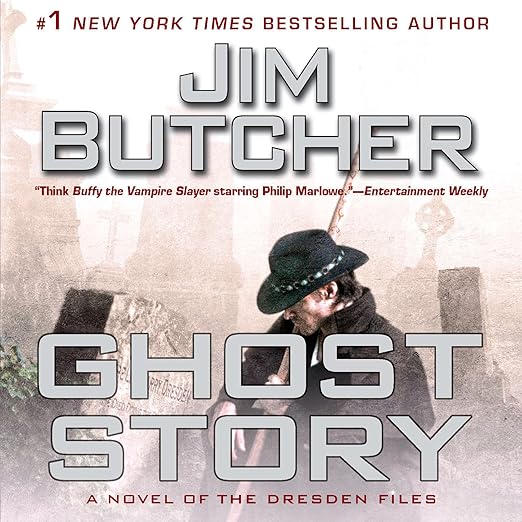
I was somewhere around the halfway mark of this audiobook when James Marsters did something I did not expect: he made me feel genuinely sorry for a dead wizard. That is harder than it sounds. I have been listening to the Dresden Files since the early books, and Ghost Story arrived at a moment in the series where Jim Butcher had effectively dismantled every familiar piece of Harry Dresden’s world. Coming into book thirteen, I was curious whether the story could sustain itself on the sheer strangeness of its premise.
It largely can, though not without stumbling. I finished this one on a Saturday afternoon that started gray and got grayer, which turned out to be the right atmosphere for a ghost story in every literal sense.
Our Take on Ghost Story
Ghost Story is the most formally experimental book Butcher has written in the Dresden Files. Harry is dead – not metaphorically, not temporarily in any comfortable way – and what the book does with that condition is genuinely inventive. The Chicago he wanders as a ghost is a Chicago of echoes and shadows, and Butcher strips his protagonist of every tool he normally relies on: the magic, the coat, the attitude backed by actual firepower. What remains is Harry’s mind and his will, and watching those tested under these conditions is frequently compelling. One reviewer nailed it when they called this “a fascinating new take on the Dresden Files universe.” It is. Whether it is the Dresden Files universe you signed up for is a separate question.
Why Listen to Ghost Story
James Marsters has been narrating this series since the beginning, and his performance here is among his best. The emotional weight of Harry’s situation – the grief, the helplessness, the flashes of dark humor – lands because Marsters has spent twelve books building this character’s voice. He handles the supernatural set pieces with his usual controlled intensity, but what surprised me here was how well he navigated the more introspective passages. A disembodied Harry has a lot of time to think, and Marsters makes that thinking listenable in a way that a different narrator might not have managed. The audio format actually suits the ghostly, half-present quality of the narrative better than the page does.
What to Watch For in Ghost Story
The book has a structural problem that a few reviewers have flagged honestly: the multiple intertwined threads do occasionally blur into each other, and there are stretches in the middle where the momentum slackens. Because Harry cannot simply blast his way through obstacles, some sequences rely heavily on exposition and reflection, which can test patience. Butcher is also doing significant work here setting up what comes next in the series, which means some plot threads feel less resolved than seeded. If you came to Changes expecting a certain kind of catharsis, Ghost Story asks you to defer that. The ending, which several readers specifically praised, does deliver – but you have to earn it.
Who Should Listen to Ghost Story
This is a book for committed Dresden Files readers, full stop. The review that warned “if you’re new to the tales of Harry Dresden, this is not the place to start” is not exaggerating – the emotional impact depends entirely on having watched Harry’s world built up over twelve books. Readers who found Changes electrifying may find this comparatively quiet and strange, and that reaction is valid. For those who are in for the long journey, though, Ghost Story is a necessary and often genuinely moving chapter. The ghost premise is not a gimmick – Butcher uses it to examine what Harry Dresden is actually made of when everything else is taken away. Beyond the question of enjoyment, Ghost Story is also where Butcher begins setting up the second half of the Dresden Files arc, so readers committed to the long game will find it structurally necessary regardless of how they feel about its quieter registers.
Frequently Asked Questions
Do I need to read Changes before Ghost Story?
Absolutely yes. Ghost Story is a direct continuation of Changes and its premise only makes sense if you know what happened at the end of that book. Starting here would spoil a major turning point and eliminate most of the emotional stakes.
Does James Marsters’ performance hold up for a story where Harry cannot use magic?
Yes, and in some ways it is his most nuanced work in the series. Without action set pieces carrying every scene, Marsters has to convey Harry’s psychological state through voice alone, and he does it with surprising depth.
Is Ghost Story slower than the other Dresden Files books?
It is. Several reviewers noted the middle sections lose momentum, and the structure is more fragmented than usual. If you prefer the propulsive pacing of books like Dead Beat or Changes, expect an adjustment.
Does the book resolve the cliffhanger from Changes?
It resolves the immediate situation but opens new questions. Butcher is clearly setting up what follows, so readers who want clean closure may feel unsatisfied. The ending itself is praised, but the road there requires patience.