Quick Take
- Narration: Oliver Wyman handles the dual timeline and Robinette Broadhead’s neurotic interiority with impressive range, making the therapy sessions as compelling as the space sequences.
- Themes: Survivor’s guilt and psychological reckoning, the alien as metaphor for the unknown self, risk and cowardice
- Mood: Claustrophobic, melancholy, and intellectually restless
- Verdict: One of science fiction’s genuinely original structural experiments, and one of the few SF novels where the psychiatrist sessions are as interesting as the space adventure.
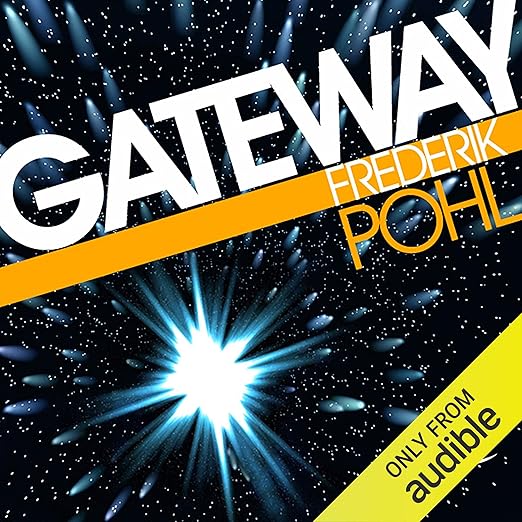
I have a particular fondness for science fiction that earns its reputation across decades rather than just at publication, and Frederik Pohl’s Gateway is one of the canonical examples of that. The novel won the Hugo, Nebula, and John W. Campbell Memorial Award in 1978, which is the science fiction equivalent of a clean sweep, and it has remained in print and in conversation ever since. When the Audible edition landed with Oliver Wyman narrating, I blocked off a weekend for it. I had read the novel years ago, and I was curious how the structural complexity would translate to audio.
The answer, briefly, is: remarkably well. The book alternates between two interlocking timelines. In one, Robinette Broadhead is a prospector on Gateway, the asteroid station where humanity has discovered a cache of Heechee spacecraft that can travel to predetermined destinations across the galaxy. No one knows where any ship will go or how long the journey will take. Some return with wealth and discovery. Some return with dead crews. Some do not return at all. The prospectors climb in and press the button. That is the premise, and it is one of the finest high-concept setups in the genre.
The Psychiatrist in the Machine
The second timeline, set after Broadhead’s final mission, takes place in sessions with Sigfrid, his computer therapist. Broadhead is now famous and permanently rich. He is also, very clearly, destroyed by something that happened on his last voyage. These sessions function as a kind of excavation: we know something terrible occurred; we learn what it was in fragments, through deflection and resistance and the particular way people avoid what they cannot bear to name directly.
Reviewer Lionel S. Taylor identified this dual structure clearly: the two stories intertwine in a way that reveals the same story from different directions. That is exactly right, and it is what separates Gateway from the adventure SF it superficially resembles. Pohl is writing about cowardice and survival guilt and the human capacity for self-deception, and he is using an alien spaceship lottery as the vehicle. Robert J. Sawyer, in the bonus introduction included with this edition, calls it one of science fiction’s all-time greatest novels. That is a defensible claim.
What Pohl Gets Right About Risk
The most disturbing element of Gateway is not the danger but the voluntariness. Prospectors choose to board ships to unknown destinations knowing that some of those ships have never returned. They are paid to take the risk, but the payment is small enough that only desperate or adventurous people accept it. Broadhead is neither particularly brave nor particularly foolish; he is someone trying to escape a life of grinding poverty in the food mines of Wyoming, and the lottery of Gateway seems like his only viable exit.
Reviewer Paul Charran noted that it does not apologize or pull any punches when describing how things can go wrong in the unknown, and that the explorers were not all gung-ho hero types. This is the novel’s great democratic achievement: the prospectors are ordinary people making terrible calculations, and their humanity makes the horror of what can happen to them much more acute. Reviewer W. Weber, who has read the book and its sequels several times over decades, placed it alongside Asimov’s Foundation and Heinlein as a personal touchstone. That kind of sustained attachment is a reasonable indicator of what the novel does at its best.
Oliver Wyman and the Dual Register
This is a demanding narration assignment. Wyman must inhabit Broadhead’s voice at two distinct temporal and psychological points: the damaged, clever, deflecting man in therapy, and the younger, anxious, occasionally reckless man on Gateway. He manages both convincingly. The therapy sessions are the harder material because they require nuance rather than action, and Wyman handles Broadhead’s evasions and the AI therapist’s patient probing with real precision. The space adventure sequences move faster and Wyman shifts register smoothly between them. The bonus introduction by Robert J. Sawyer is an excellent addition that contextualizes the novel’s place in genre history without spoiling its most important revelations.
For Whom Gateway Works Best
This audiobook is the right choice for science fiction readers who are comfortable with interiority and ambiguity alongside their worldbuilding. If you want action-forward space opera, this is not the right match. The pace is deliberate, particularly in the therapy sequences, and the payoff is emotional rather than spectacular. Listeners who loved the introspective science fiction of Ursula Le Guin, or who found themselves drawn to the psychological dimension of Kim Stanley Robinson’s work, will be in familiar territory.
Skip it if you need your SF heroes unambiguously heroic. Broadhead is not that, and Pohl is explicitly interested in that fact. But if you want a novel that uses the outer reaches of space to illuminate something true about the inner architecture of regret, Gateway is fifty years old and has not aged a day.
Frequently Asked Questions
Does Gateway work as a standalone audiobook or do I need to listen to the Heechee Saga sequels?
It is fully complete as a standalone. The sequels extend the universe but the novel’s central emotional and narrative arc is entirely resolved within this book. Many readers consider it the strongest entry in the series.
The synopsis mentions ‘some changes were made to the original text with the permission of the author.’ What does that mean for this edition?
The changes are minor and do not affect the novel’s plot or themes. They primarily involve updating some language to reflect contemporary standards. The core narrative and structure are intact.
How does Oliver Wyman’s narration handle the AI psychiatrist Sigfrid von Shrink, who appears throughout the therapy scenes?
Wyman differentiates Sigfrid’s voice from Broadhead’s clearly and consistently. The sessions work in audio partly because of this distinction; you always know whose perspective you are in, which matters when the alternating timelines are doing such deliberate structural work.
Is Gateway appropriate for listeners new to classic science fiction, or is it more rewarding with genre context?
It works for both. New readers will find it unusual and compelling on its own terms. Readers familiar with the genre will recognize how decisively it departed from the heroic SF conventions of its era, which adds a layer of appreciation. Either way, the emotional core is accessible without prior genre literacy.