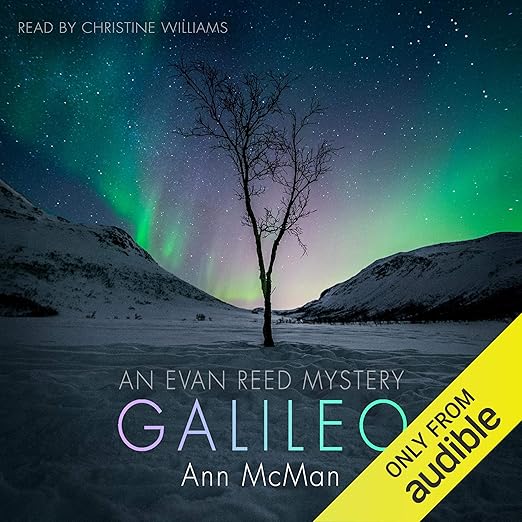
Quick Take
- Narration: Christine Williams handles the sharp pacing and layered character voices of McMan’s political thriller with confident control, keeping the tonal shifts between wit and tension well-managed.
- Themes: Political corruption, LGBTQ+ romance woven into thriller, moral conscience versus institutional power
- Mood: Sharp and propulsive, witty under pressure
- Verdict: Listeners who want an LGBTQ+ thriller with genuine plot architecture and erudite writing will find McMan’s second Evan Reed mystery the stronger entry in what is clearly an underrecognized series.
I started Galileo on a Friday evening with no particular expectations beyond what I knew from Ann McMan’s reputation among readers who want their fiction funny, sharp, and substantively plotted rather than relying on identity alone to carry the weight. By Sunday morning I was annoyed at myself for not having started book one, Dust, first, though multiple reviewers confirm this one stands well enough on its own. The series is called An Evan Reed Mystery, and Evan turns out to be exactly the kind of protagonist I did not know I was missing.
Galileo is book two, and the setup is elegant in the way that good thriller architecture tends to be: Evan Reed, a political operative with high principles and a complicated past, is hired to find compromising material on a corrupt judge being rushed toward a Supreme Court nomination. The judge has survived previous vettings. The situation is, in Evan’s own assessment, not simple. And then the string she pulls leads somewhere much more dangerous than a routine opposition research job.
Our Take on Galileo
What separates McMan from a lot of LGBTQ thriller writers is precisely what one reviewer identified: she does not write fluff with lesbians in it. The plotting here is genuinely constructed, with a cast of characters whose moral compromises accumulate meaningfully rather than existing as props for dramatic moments. Tim Donovan, a Catholic priest carrying a guilt that is not what you would initially assume, and Katherine Donne, a Parisian socialite whose self-respect has taken damage in interesting directions, add texture to what could have been a straightforward political corruption story.
The romance between Evan and Julia Donne, a book publisher with questions about her late father that turn out to connect to the main investigation, is woven into the thriller rather than paused for it. McMan’s specialty, as the synopsis notes, is intertwining hot romance into heart-pounding suspense, and the balance works because the two threads are structurally linked rather than running in parallel tracks that occasionally touch.
Why Listen to Galileo
Christine Williams narrates with the kind of assurance that a book like this needs. The tonal range required is real: McMan’s writing is described by reviewers as funny without being clownish, and navigating that distinction in performance requires a narrator who can land a line without punching it. Williams manages it. The political thriller sequences have the right urgency, and the scenes between Evan and Julia have warmth without softening the overall edge of the story.
At just under eleven hours, this is a comfortable length for the complexity of plot McMan is managing. The story does not outstay its welcome, and the pacing moves briskly enough that the thriller mechanics never feel like they are being explained to you rather than experienced. One reviewer described the characters as larger than life, which is accurate in the best sense: they are drawn with enough specificity that they feel vivid rather than generic, but they operate in a world with higher stakes and sharper edges than everyday life provides.
What to Watch For in Galileo
This is book two of an ongoing series, and there are references to events and relationships from Dust that will make more sense with that context. McMan and the narrative structure do enough to orient new listeners, but the emotional weight of certain character moments, particularly around Evan’s personal history and her dynamic with Father Tim, lands harder if you have the first book in your head. It is worth noting that reviewers consistently report that Galileo is the stronger of the two books, which makes the argument for reading them in order less urgent than it might otherwise be.
The subculture of power and corruption that the synopsis describes as lying beneath the thin veneer of civilization is rendered with enough specificity to feel grounded rather than melodramatic. McMan is not writing a political thriller for readers who want their institutional corruption as background scenery. The world here has texture and consequence.
Who Should Listen to Galileo
Listeners who enjoy the smart political thriller work of writers like Mick Herron or Hank Phillippi Ryan, but want their protagonists drawn from outside the default demographic of the genre, will find this series a productive discovery. McMan writes with erudition and wit, and Christine Williams’s narration serves both qualities well. Start with Dust if you have the patience; dive in here if you want to understand why readers are urgently hoping for a third Evan Reed mystery.
Frequently Asked Questions
Is it necessary to listen to Dust, the first Evan Reed book, before starting Galileo?
The book works as a standalone, and multiple reviewers confirm they read Galileo before Dust without feeling lost. However, character relationships, especially between Evan, Father Tim, and the recurring cast, carry more emotional weight with the context of book one. If you have time, start with Dust.
How does Christine Williams handle the tonal mix of wit and thriller tension that defines McMan’s writing?
Williams is well cast here. McMan’s writing requires a narrator who can land sardonic humor without breaking the thriller atmosphere, and Williams navigates the tonal range with enough control that neither the comedic nor the suspenseful sequences feel out of place.
Is the romance between Evan and Julia central to the plot, or does it run parallel to the thriller storyline?
It is genuinely integrated rather than parallel. Julia Donne’s questions about her late father connect directly to the investigation Evan is pursuing, which means the romantic storyline and the thriller mechanics are structurally linked rather than taking turns. This is one of McMan’s particular strengths as a writer.
How explicit is the content in Galileo? Is it suitable for readers who prefer romance that is suggested rather than detailed?
The romance is substantive but not graphically explicit. McMan’s focus is on character and plot, and the romantic content serves the emotional architecture of the story rather than functioning as set pieces. Readers looking for heavy erotic content will find less than they expect; readers who want romance with real narrative weight will find more.