Quick Take
- Narration: Jennifer Pickens delivers a restrained, interior performance that honors the novel's focus on grief and psychological ambiguity rather than external suspense.
- Themes: Maternal loss, the weight of unresolved grief, sister relationships and divergent survival
- Mood: Claustrophobic and emotionally layered, slow-burn rather than propulsive
- Verdict: A literary mystery that is primarily about what grief does to people over fifteen years, with the investigation as structural scaffolding.
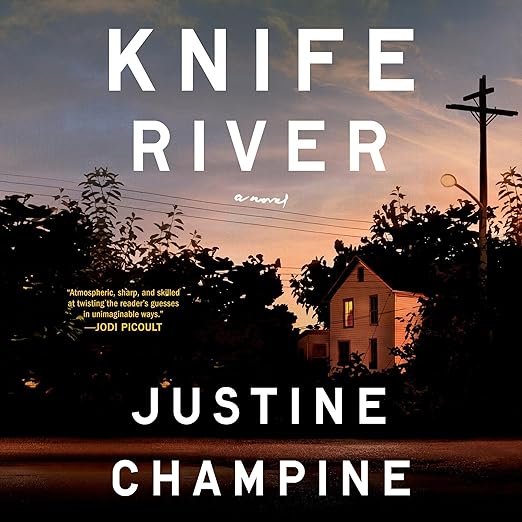
I started Knife River on a quiet Sunday morning and found myself pulled into its particular atmosphere: the small town that Justine Champine makes feel both geographically specific and universally suffocating, and the two sisters whose relationship has been frozen in amber by their mother's disappearance fifteen years earlier. By the time the remains are discovered and Jess returns to the town she fled, the mystery is almost secondary to the question of how grief distorts the people who carry it for a decade and a half without resolution.
Jennifer Pickens narrates the twelve hours with a measured quality that suits the material. This is not a thriller that demands intensity from its narrator; it is a novel that demands precision, and Pickens provides it. Her handling of Jess's voice, which is self-aware about its own evasions and avoidances, is particularly well calibrated.
Our Take on Knife River
Champine's debut has drawn endorsements from Chris Whitaker, Jodi Picoult, and Paula Hawkins, which positions it clearly within the literary mystery tradition. What Champine does particularly well is the portrait of Liz, the older sister who stayed behind and built a life that is really a prolonged vigil. One reviewer described her as stuck in a way that is vividly and authentically rendered. That stasis is not passive: it has its own urgency, its own distorted logic. Jess's return does not simply disrupt Liz's frozen life; it forces both sisters to confront what they chose not to see. The town of Knife River, upstate New York and claustrophobic in the way small towns become when no one can leave, functions as a third presence throughout.
Why Listen to Knife River
The novel's real subject is what might be called the architecture of unresolved grief: how it shapes decisions, friendships, romantic entanglements, and the relationship between sisters who loved each other and also failed each other. Jess's return to her high school girlfriend adds another layer of unfinished business that the novel handles with care rather than melodrama. Reviewers have noted that the ending stays with you, which is a different promise than a thriller typically makes. Champine is not building toward a revelation so much as toward a reckoning, and the distinction matters for how you calibrate your expectations as a listener over twelve hours.
What to Watch For in Knife River
The 3.8 rating reflects a genuinely divided response. Some listeners found the pacing too slow, the mystery resolution unsatisfying, or the characters' self-destructive patterns too much to sustain over the runtime. One reviewer used the word uncomfortable to describe the experience, which is accurate: Champine does not offer easy exits from the emotional situations she constructs. If you approach it as a character study that uses mystery as scaffolding rather than as a thriller that happens to have depth, the experience is more rewarding. The investigation of the mother's death matters less than what the investigation forces the sisters to admit to themselves and to each other.
Who Should Listen to Knife River
Readers who gravitate toward literary mysteries with psychological depth will find this rewarding. Fans of authors like Tana French, whose work similarly uses crime to excavate character and place, will recognize the approach and the pacing. Listeners who want plot-driven suspense with momentum and resolution will likely find the experience frustrating. The twelve-hour runtime is significant for a novel of this emotional density; this is not background listening. Pickens's narration rewards full attention, and the novel rewards listeners willing to sit with ambiguity longer than most genre fiction asks of its audience.
The mother's absence is not simply an unsolved crime in this novel; it is a shaping force that has determined who Liz and Jess each became over fifteen years of not knowing. Champine is careful to show how differently the same loss affects two people who experienced it from the same household: Liz became static, Jess became peripatetic. Both responses are shown as forms of damage rather than coping strategies. That psychological precision is the novel's greatest strength, and Pickens's narration captures it without underlining it for the listener.
Frequently Asked Questions
Is Knife River more of a literary novel or a genre thriller?
Primarily literary, with a mystery structure. The investigation into the mother's death is the narrative framework, but the novel's real interest is in the psychological and relational consequences of grief. Readers expecting thriller pacing will need to adjust expectations.
How central is the LGBTQ content to the story?
Jess's identity and her rekindled relationship with her high school girlfriend are significant parts of her character arc. The novel treats this as simply part of who Jess is rather than as the primary subject. It is woven into the story rather than being its defining feature.
Does the mystery resolve satisfyingly?
Reader opinion is divided. Some reviewers found the resolution emotionally powerful; others wanted more clarity in the traditional mystery sense. The ending emphasizes emotional reckoning over procedural resolution, which suits the novel's literary ambitions but may frustrate genre readers.
How does Jennifer Pickens handle the sister relationship dynamic in her narration?
With careful differentiation. Jess and Liz are very different people shaped by the same trauma, and Pickens makes their distinct voices and emotional patterns audible without overplaying the contrast.