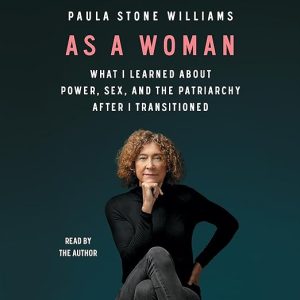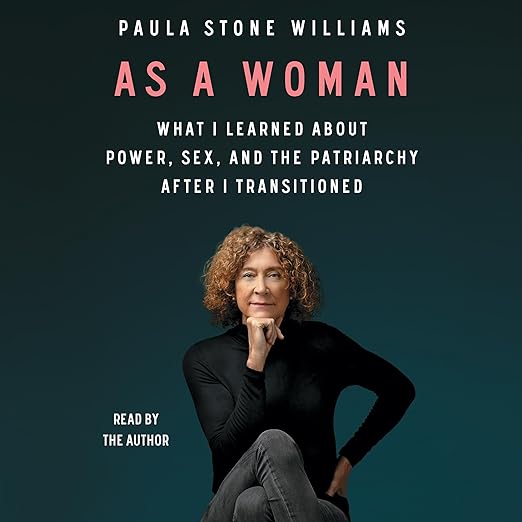
Paula Stone Williams was sixty years old, a father of three, married, and holding several prominent jobs inside American evangelicalism when she transitioned. The audiobook she narrates herself is the account of what happened next, and the fact that she reads it is not a production footnote. The voice that spent decades being heard as a man's now delivers a book about what changed the moment people stopped hearing it that way. Simon and Schuster Audio produced the recording across seven hours and fifty-five minutes.
Williams Narrates Her Own Before and After
A before-and-after far starker than Williams expected forms the memoir's spine. Power and influence in the evangelical world vanished almost immediately. She was expelled from churches she had helped build. Her family had to work through loss and confusion of their own. What she describes finding on the other side gives the book its reach well past a transition narrative: opinions once celebrated and amplified were now sidelined and ignored, and the inequity had been invisible to her for sixty years of being on the winning side of it.
Julia McLaughlin's February 2022 notice, at the top of the scale, observes that the book is read by the author and describes the result as honest, compelling, heartfelt and courageous, framing it as testimony from a woman who has experienced both the benefit and the withdrawal of white male privilege in America. That same response reads the book from inside Christian faith and reports being moved toward greater love and compassion rather than away from belief, which is a useful signal for anyone worried the memoir might be an exit interview from religion.
Structurally the book follows the life rather than an argument, and that is the right call for material this particular. The questions Williams raises arrive where they arrived for her: why women's opinions get discounted in favor of men's, why love and intimacy feel different from the other side, whether a spirituality built in her own image was even available to her after the institutions that formed her had closed their doors.
Validating What Women Meet Every Day
Kathy McAfee, whose August 2021 five-star response signs off with a credit as co-author of Fearless Female Leaders, points straight at the passage of the book with the widest application: its validation of what women meet in workplaces, at home, in church and, in that phrasing, even on airplanes. The everyday-friction material is where Williams is sharpest, because she is describing conditions she can compare directly against a previous life rather than against a theory.
Soraya Chemaly, quoted in the description, identifies the same strength from a different angle, crediting the writing with revealing aspects of gender socialization and culture that usually go unexamined. That is the book's actual thesis, and it is delivered as observation rather than polemic. Williams is not reporting from a study. She is reporting from a natural experiment that ran on one person across sixty years, and the comparison data is unusually clean because the subject and the control are the same human being.
Two audiences are being served at once, which is unusual and mostly successful. Listeners who came for a trans memoir get the transition, the family fallout and the professional exile. Listeners who came from inside evangelical Christianity get something rarer: a leader from their own world describing what the institution did to her, without the score-settling tone that would let them dismiss it. Neither group is written for at the other's expense.
A Three-Year Read From an LGBT Advocate
Substantial dissent does exist on the page, and it is not a pan at all. Michael P. Williams, Esq., who marked it three stars in October 2022, opens by establishing standing: drafting the initial language that added gender identity to Philadelphia's Fair Practices Ordinance in 2002, securing that city's trans community its first legal protections, and lobbying council members as president of an LGBT advocacy group. The headline on that response describes a three-year read. Someone with that history took three years to finish a book they had every reason to want to admire.
Behind five written responses sit 182 ratings, and the 4.4 average runs lower than the visible sample would suggest, since four of those five posts land at four stars or better. Whoever is pulling the number down is not on the page explaining why, which is worth knowing before treating the average as a verdict on the writing rather than on the premise.
Expect a life, not a system. Anyone arriving for a worked-out theology of gender will find episodes, relationships and consequences instead of a framework, and the spiritual material is personal rather than doctrinal. The book also stays firmly inside one experience. It is a memoir of a white American church leader who transitioned late, in comfortable circumstances, and the description makes no claim to survey trans lives more broadly.
Worth noticing too is who the endorsements come from. The description leads with praise from a campaign staffer who directed faith-based outreach, and pairs the book with Redefining Realness for readers looking for a comparison point. The first of those is a political endorsement rather than a literary one, and the second sets up expectations of a very different kind of memoir. Neither is dishonest, but both suggest a book positioned for a movement audience before a general one.
For Anyone Arguing Whether Bias Is Measurable
One four-star notice from April 2023 names a concrete use with no decoration at all: bought for a church library, by a congregation working to be publicly open and affirming, and recommended for adults trying to come out later in life. That is a narrow recommendation and an accurate one. Congregations doing this work have very few first-person accounts written by someone who held the pulpit before transitioning.
Wider still is anyone interested in how differently the same person gets treated when the room reads them as a woman. Managers, human resources professionals and anyone who has argued about whether workplace bias is measurable will find the book's central comparison hard to wave away, because the usual counterargument, that the two people being compared were never equivalent, does not apply. Williams was the control group.
Readers wanting a theological argument rather than a life will find the balance tipped hard toward memoir. Anyone hoping for a survey of trans experience should know this is one account, rooted in evangelical leadership and a marriage of decades. Listeners who would prefer the faith material kept separate from the gender material are not going to get that separation, because the whole point is that Williams could not keep them separate either. Few memoirs get to serve as their own evidence twice over.
Does Paula Stone Williams narrate the As a Woman audiobook herself?
She does. The listing credits her as both author and reader, with Simon and Schuster Audio producing. Given that the book's whole subject is the reception a voice receives once a room reassigns it, having the author deliver the account herself is a good deal more than a casting economy.
Is the audiobook a faith book or a gender book?
Both, inseparably. Williams was a pastor and denominational leader before transitioning and was expelled from the churches she had led afterward. Reconciling faith and identity is the spine rather than a subplot. Anyone wanting only the sociological argument about how women get heard will still find it, but it arrives inside a church story.
Is the material graphic or clinical about transition itself?
Neither. The emphasis stays on the social, professional and family consequences of transitioning at sixty rather than on medical detail. Anyone looking for a clinical account of the process will find it largely absent here, and anyone actively avoiding one can proceed without concern.
How does the audiobook get used inside congregations?
mary bolton, a July 2021 five-star response, describes ordering several copies to share and shelving the book among the spirituality titles used in daily practice. That is the pattern the book seems to follow, moving through congregations by hand, which is also why it carries an LGBTQ+ Studies tag rather than a memoir one.