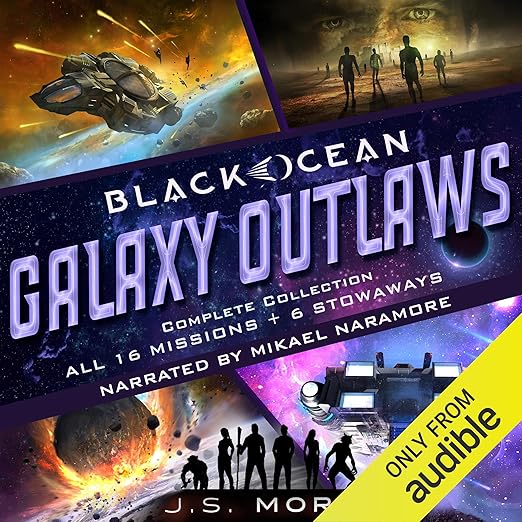
I have been burned before by series boxsets that front-load their quality. So when I saw eighty-five hours of space opera for the price of a single audiobook credit, my first instinct was healthy suspicion. I put on the first Black Ocean mission during a long drive and came back to it voluntarily the next morning, and the morning after that, and kept coming back through multiple missions. J.S. Morin has been writing this universe since 2014, and the consistency of quality across what eventually became a full series is the thing most worth noting about Galaxy Outlaws.
Morin's debt to Firefly is not a secret, he acknowledges it openly, and the premise practically requires the comparison. Carl Ramsey is an ex-Earth Navy fighter pilot turned con man. His ship, Mobius, carries an ex-wife pilot, a four-handed drunkard mechanic, a 120-kilogram predatory alien with the disposition of a very large and dangerous housecat, and the galaxy's most wanted wizard. The wizard is the element that makes this universe genuinely its own, the incompatibility of magic with electronics means that the Convocation of Wizards is as hostile to technology as the criminals Carl tries to avoid, which creates a sustained comic tension throughout the series.
First, the Big Picture
The conscience is the key element the synopsis flags, and it is what separates this from pure space adventure. Carl Ramsey and his crew have an outlaw's skill set but keep making choices that cost them money and endanger them for people they could have left behind. The Firefly parallel holds most closely here, the underlying idealism of the ragtag crew that sabotages their own self-interest is the emotional engine of the series. One reviewer imagined what Firefly could have been if it continued. Another described it as what you would get if the Orville took place on Serenity, or if Star Wars had wizards instead of Jedi, both of which are reasonably accurate genre coordinates.
The sixteen missions and six short stories collected here form a complete narrative arc while also working episodically within individual entries. The series does not require a single binge, it functions well as ongoing listening over days or weeks, with each mission providing sufficient resolution to feel complete while advancing the larger story. That structural design suits the audiobook format particularly well, since eighty-five hours of unbroken narrative commitment would be a significant ask even for devoted listeners.
Why Galaxy Outlaws Works as an Audiobook
Mikael Naramore's narration is the technical achievement that makes this collection work. Keeping a large cast of distinctive characters consistent and recognizable across eighty-five hours is not a small feat. Reviewers do not mention confusion between characters, which in a series with this many recurring crew members and antagonists is the most important possible positive indicator. He also maintains energy across missions without the fatigue that affects long single-narrator performances, the later missions feel as committed as the opening ones.
The value proposition of the complete collection is genuinely unusual. As one reviewer noted, they were hesitant at the price for this much content and were pleasantly surprised that the quality warranted it. Getting sixteen missions and six short stories in one package, re-recorded with a new opening scene for the tenth anniversary, represents a complete entertainment experience at a cost that single-mission purchases couldn't match.
A Few Reservations
The one consistent criticism in the reviews is the wizard problem: when the crew faces a difficult situation, the wizard's powers can resolve it in ways that feel too convenient. One reviewer specifically noted that the fluid moral framework and the ease with which the wizard erases memory or destroys threats can undercut narrative tension. This is a real structural issue in episodic adventure series, the tension between escalating stakes and reliable competent characters. Morin manages it better in some missions than others.
The series is also described by one reviewer as something to listen to during mindless physical tasks, mowing grass, shoveling snow, rather than as demanding literary fiction. That characterization is accurate and not a criticism: this is genre entertainment built for enjoyment rather than analysis, and it delivers on those terms consistently. Listeners expecting the philosophical depth of something like Ursula K. Le Guin's work in the same broad genre will be mismatched to the material.
The Right Listener for Galaxy Outlaws
Natural audience: listeners mourning the cancellation of Firefly who want a prose equivalent that runs to completion rather than cutting off at season one, fans of space opera with found-family dynamics and a comic sensibility, and anyone looking for a high-quality long-form listening commitment that can be parsed episodically. Less suited to listeners who want morally complex slow-burn science fiction or who find fantasy elements in space settings tonally jarring. The wizard is not going away.
Questions Listeners Ask
Is the Firefly comparison accurate, or is it just marketing?
Multiple independent reviewers, not just the publisher's description, use the Firefly comparison. The ragtag crew structure, the conscience-driven anti-heroes, and the episodic mission format are all genuine parallels. Morin has acknowledged the influence directly. The main structural difference is the magic system, Firefly had no equivalent to the galaxy's most wanted wizard.
Does Mikael Naramore's narration hold up across eighty-five hours without the cast getting confusing?
Yes, based on reviewer feedback. Voice consistency across a large cast over this runtime is not flagged as an issue by any reviewer, which is the most important indicator of narration quality for a series this long. His energy is also consistently noted as sustained rather than declining in the later missions.
Do the sixteen missions need to be listened to in order, or can they be sampled?
The individual missions are largely self-contained with internal resolution, so sampling is possible. However, the character development and some ongoing plot threads benefit from sequential listening. The first mission, Salvage Trouble, was re-recorded with a new opening scene for this collection and serves as the natural starting point.
The wizard resolving problems too easily is mentioned as a criticism, how significant is that issue across the series?
It is a real structural concern in episodic adventure series with an overpowered character, and one reviewer found it undermined tension. Multiple other reviewers found it manageable within the series' comic-adventure register. If airtight narrative stakes are important to you, the issue may be significant; if you are watching for it, it appears; if you are in the rhythm of the series, it is generally absorbed into the overall entertainment.