Quick Take
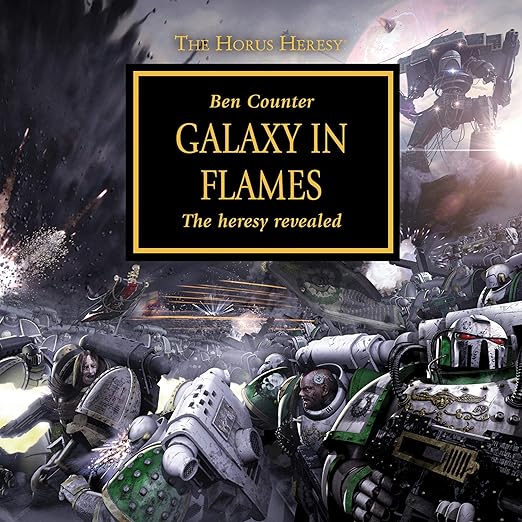
- Narration: Toby Longworth is among the strongest voices in the Black Library catalog, and his performance on Galaxy in Flames carries the weight of the Horus Heresy’s defining betrayal with appropriate gravity.
- Themes: Loyalty shattered by ideology, the mechanics of treachery, brotherhood turned to fratricide
- Mood: Dark and operatic, with the weight of a tragedy whose ending the reader already knows
- Verdict: The third Horus Heresy novel delivers the promise the first two volumes built toward, and Longworth’s narration makes the Isstvan III massacre land with the full emotional force it deserves.
I listened to Galaxy in Flames on an overnight flight, which is the right setting for a novel about betrayal at galactic scale. There is something about the compressed isolation of that listening environment that suited Ben Counter’s narrative, which is itself about a group of people sealed into a situation from which there is no exit and no appeal to reason or mercy. By the time Horus orders Isstvan III virus-bombed and Space Marines turn on their battle brothers, the audiobook had settled into the particular darkness that the Horus Heresy series does better than almost anything else in military science fiction.
Toby Longworth has been narrating Black Library audiobooks for long enough that his voice has become inseparable from how many readers hear this universe. He brings genuine authority to the material, which is essential for a novel where the prose needs to carry events of enormous emotional and cosmological weight without tipping into melodrama.
Our Take on Galaxy in Flames
Counter’s contribution to the Horus Heresy is to make the betrayal feel inevitable rather than dramatic. The virus bombing of Isstvan III is not staged as a shocking twist; it is staged as a revelation of what was already true. Horus’s treachery has been building since the series began, and Galaxy in Flames is the novel where the mask comes off entirely. What Counter does well is keep the human scale of the catastrophe legible within the cosmic scope. Individual Space Marines, with names and histories and specific relationships with each other, are caught on both sides of the divide. One reviewer described the action as death-filled poetry of betrayal after betrayal, which is an accurate account of Counter’s tonal register here: it is not nihilistic, but it is unflinching about what it costs to be on the wrong side of a moment like this, or the right side, since surviving the right side of Isstvan III is its own kind of wound.
Why Listen to Galaxy in Flames
Longworth’s performance is the primary argument for audio over text for this entry specifically. The novel’s structure moves between multiple perspectives and action theaters, and Longworth manages the transitions without losing the listener. The pacing of the audio suits Counter’s propulsive action sequences, and the quieter scenes of characters reckoning with what they are about to do, or what has been done to them, are given appropriate weight. At just under nine hours, Galaxy in Flames is one of the more compact Horus Heresy novels, which reflects Counter’s focus on the event itself rather than extended political or philosophical scaffolding. Longworth keeps the momentum honest throughout. One reviewer who described themselves as a Warhammer newbie called it a must-read, noting they came in great condition from the physical book and intended to read book one first, which is the correct sequence advice.
What to Watch For in Galaxy in Flames
New listeners to the Horus Heresy should not start here. The emotional impact of the Isstvan III massacre depends entirely on the investment built across the first two novels, Horus Rising and False Gods. Without that foundation, the names and loyalties and betrayals will be intelligible but not devastating. Counter writes with the assumption that readers know and care about these characters from prior entries. The occasional criticism that the novel is less well-written than some Horus Heresy entries is a minority view; the majority of the readership finds it among the strongest early entries. The dramatis personae, the extensive cast of Space Marines, can be difficult to track if you have not been keeping mental notes across the series, though the audio format actually helps here since Longworth’s voice work helps distinguish characters that might blur together on the page.
Who Should Listen to Galaxy in Flames
Listeners who have read or listened to Horus Rising and False Gods should come to Galaxy in Flames as soon as they can. This is the payoff for the series’ investment in characters and relationships, and it should not wait. Warhammer 40K fans who have not started the Horus Heresy but want to understand the cosmological foundation of the modern 40K setting will find the trilogy, of which this is the culminating volume, essential context. Listeners new to military science fiction who want something operatic and dark but have not played the tabletop game will find the universe accessible through this series if they start from the beginning rather than parachuting in here.
Frequently Asked Questions
Can Galaxy in Flames be listened to without reading Horus Rising and False Gods first?
Technically yes, but the impact will be significantly reduced. The betrayal at Isstvan III depends on the reader’s investment in the characters and relationships built across the first two novels. Starting here means the emotional architecture of the massacre will not fully land.
How does Toby Longworth handle the large cast of Space Marines across different Legions?
Longworth uses enough vocal variation to keep the major characters distinguishable, which is one of the advantages of the audio format over text for this series. He does not attempt an entirely distinct voice for every named character, but the key figures are clearly differentiated.
Is Galaxy in Flames accessible to listeners unfamiliar with Warhammer 40K?
With the first two Horus Heresy novels as context, yes. The series was written partly to make the 40K universe accessible to readers outside the tabletop game community, and the opening trilogy succeeds at that aim. Listeners who know the 40K setting from the game will have additional contextual richness.
What distinguishes Ben Counter’s contribution to the series compared to the first two novels?
Counter’s focus is the event itself rather than the political and philosophical setup, making Galaxy in Flames the most kinetically driven of the first three novels. Where Horus Rising and False Gods build the conditions for betrayal, Counter executes the betrayal with action-forward prose and emotional precision.