Before You Press Play
- Narration: Self-narrated, so the reader is also the restaurateur, the writer and the kid in the story, with no performance layer sitting in between.
- Themes: Assimilation refused, food as the inheritance that fits, family love braided with violence, belonging found in the margins
- Mood: Loud, profane, funny, unsentimental
- Verdict: Worth your time if you want the memoir rather than the sitcom, and it is a great deal harder than the sitcom.
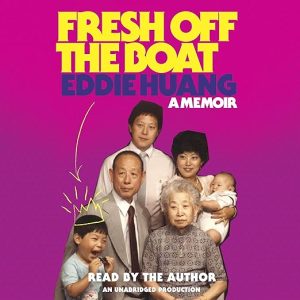
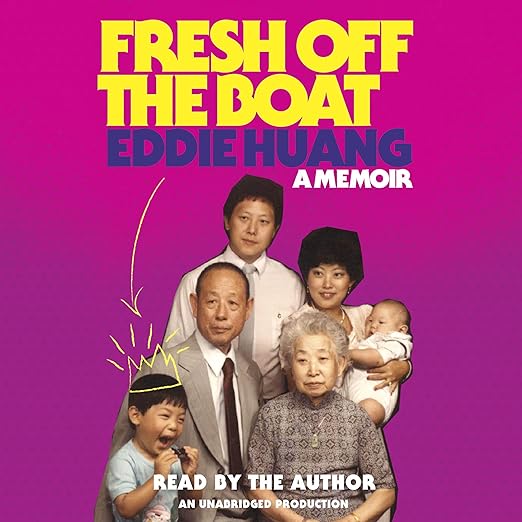
Somebody filed this memoir under home and garden. Eddie Huang's account of growing up a Chinese-American kid in a could-be-anywhere cul-de-sac, fighting, dealing and finding his way to food, sits on this record beside gardening manuals because it carries a Food and Wine tag. The audiobook runs seven hours and fifty-five minutes read by Huang himself, which is the only sensible way to deliver a book written this close to speech. Everything else about the listing is stranger still.
Look at the first line of the description. NOW AN ORIGINAL SERIES ON ABC, followed by a notice calling it possibly the best new comedy of the year, based on restaurateur Eddie Huang's memoir of the same name. Read that carefully: the praise belongs to the television show, and the book is what you are buying. Genuine reviews of the memoir do appear further down, and they are excellent ones. The lead position went to a notice about something else.
What the book covers is harder and funnier than a network comedy could manage. A father described as a cocksure restaurateur with a dark past back in Taiwan. A mother described as a fierce protector and a constant threat inside the same clause. White Jesus and macaroni and cheese tried on and discarded. And a rainbow coalition of lost boys, skate punks, dealers, hip-hop junkies and sneaker freaks, assembled by a kid with nowhere else to belong.
Unpolished is the word a five-star from November 2018 keeps circling, and that response means it as praise. Coming to this straight after Kitchen Confidential, that reader calls it the better of the two books in the same vein, a troubled young person finding meaning in food, while noting plainly that the writing carries a lot of slang and a lot of foul language. Unpolished on a page is a liability. Unpolished in a voice is a style.
Why Fresh Off the Boat Works as an Audiobook
Which is the argument for this recording in a single line. Huang wrote a book that runs on cadence, slang and timing, and the copy's own praise says he does everything with style. Hand that to a hired reader and every third phrase turns into a costume. Hand it back to the person whose speech it transcribes and the register is simply the register. Author-read memoir is often a courtesy; here it comes closer to a requirement.
Food threads through all of it rather than sitting in a chapter of its own, and the Food and Wine tag was reaching for that even as the category around it went wrong. A five-star filed in Spain in September 2013 calls the whole thing a gastronomical experience, funny and interesting, and signs off with a salute to Baohaus. That salute tells you where the road ends up, and it ends up somewhere with a kitchen in it.
Praise gathered further down the copy repays proper reading, because it is unusually precise. Dwight Garner, writing for the New York Times, calls it as much James Baldwin and Jay-Z as Amy Tan, and a book about fitting in by not fitting in at all. Anthony Bourdain calls it merciless and provocative and says Huang is hunting big game. Interview compares the wit to a perfect plate of dan dan noodles. Those are coherent readers describing a coherent book.
Weak Spots in Fresh Off the Boat
Numbers on this record fail to reconcile in either direction. The counter reads two votes, and two whole-star votes can only average a whole number or a half, so 4.3 cannot have come from them. Written responses grade it four, five, five, five and five, an average of 4.8, so the figure did not come from those either. Something on this page is aggregating a population it is not showing you.
Television is the other distortion. A five-star from January 2026 explains that the reading started because of the first season of the show, then reports pleasant surprise at finding the book much more raw and real, and closes by hoping for a reboot on a premium network. That response is honest about its route in, but a listener should expect the memoir to be harsher, filthier and far less resolved than a sitcom version of the same childhood.
Register is the final flag. Fist fights, dealing, sustained profanity and a household where affection and violence share a room are all here, described rather than softened, and the copy's own account of the mother is precisely as double-edged as it sounds. Anyone wanting a warm immigrant-family story told gently will be startled early. The book has no interest in being reassuring, and the format does nothing to blunt it.
Who Should Listen to Fresh Off the Boat
Accidental is how a four-star from March 2015 came to this book, added to an order to reach free shipping. That reader stayed for the recognition: a childhood spent moving around, being odd enough not to fit anywhere, hunting for a peer group through fist fights, family values, work ethic, schooling and drugs. Anyone whose childhood had that shape will find plenty here that lands, whatever country their own family came from.
Pass on it if sustained profanity wears you down, or if you came looking for recipes and restaurant technique, since food runs through this as a thread rather than standing as its subject. Anyone hoping for the sitcom's tone should stay away too. And listeners who need a tidy arc will meet a memoir written by somebody in his thirties who had not finished deciding anything yet, which the copy freely admits.
Category error aside, this is author-read memoir working exactly the way the form should. The writing was always speech. Huang built a book out of a voice that does not moderate itself, and the recording hands that voice back its original medium. Ignore the shelf it landed on, ignore the television notice at the top of the description, and take the thing on its own terms.
Frequently Asked Questions
Does Eddie Huang narrate the Fresh Off the Boat audiobook?
He does. Byline and narrator credit carry the same name, so the person who lived the childhood, wrote the sentences and runs the kitchen is also the one reading them. For a memoir written this close to speech, that removes an interpretation layer the book was never built to survive in the first place.
Is the Fresh Off the Boat audiobook the same story as the ABC series?
Not really. The show was based on the memoir, and the description leads with that link before saying anything about the book itself, while one December 2018 response discusses the ethnicities included in the series rather than in the text. The memoir is rawer and considerably less resolved than a network comedy could be.
Why is this memoir filed under home and garden?
A Food and Wine tag appears to have pulled it there. Food genuinely runs through the book, from a father's restaurant to the author's own passion for it, but the subject is assimilation, family and belonging rather than cooking. Treat the category as a filing error and look for it among memoirs instead.
Does Fresh Off the Boat survive being taken in small pieces?
It does. Seven hours and fifty-five minutes, and the material is anecdotal by nature, moving between a fight, a job, a meal and a scheme, so stopping between chapters costs almost nothing. The profanity and the sheer volume do make it a poor choice for shared listening with children in the car.