Quick Take
- Narration: Alfred Gingold delivers the Chopra Center material with a measured professionalism that keeps the Eastern-Western integration accessible rather than mystifying, a good match for content that might otherwise feel ungrounded.
- Themes: Integrative addiction recovery, mind-body approaches, Eastern wisdom in clinical application
- Mood: Calm and expansive, with practical scaffolding beneath the philosophy
- Verdict: A thoughtful integrative approach to addiction recovery that challenges the disease-as-identity model, six hours of the Chopra Center’s methodology in audio form, best suited to listeners open to mind-body frameworks.
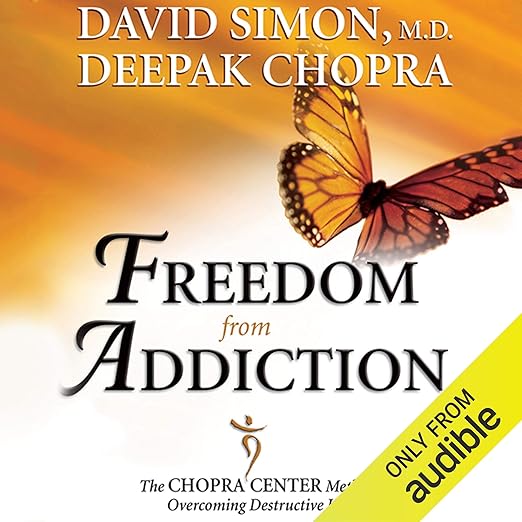
There’s a particular kind of book that arrives when you’re looking for something outside the mainstream recovery framework, not because you distrust the mainstream, but because you’ve been in and out of it and need a different angle. Freedom from Addiction, developed from the Chopra Center’s program by cofounder David Simon and Deepak Chopra, is that book. It came up in a conversation I was having about integrative approaches to habit change, and what struck me about the listener response is how consistently people describe it as providing a “fresh” frame for something they’ve been trying to address for years.
The core argument departs from the standard recovery model in one significant way: Simon and Chopra explicitly challenge the idea that people “are” their addictions, or that they are powerless to control them. This will land differently depending on where you’ve landed in your own relationship to recovery frameworks. For listeners who have found the powerlessness model liberating, this reframe may feel like a challenge to something that is working. For listeners who have found it limiting or who have not connected with 12-Step approaches, it may be exactly the opening they needed. Simon’s medical background lends the physiological sections credibility; Chopra’s Eastern philosophy lens shapes the book’s understanding of why cravings exist and what they are trying to address.
The Integration of East and West
The most distinctive feature of the Chopra Center’s approach is the integration of Ayurvedic medicine, meditation, and Eastern understandings of mind-body connection with Western clinical research on addiction neuroscience. Simon and Chopra are not presenting these as contradictory frameworks but as complementary ones: the Western research explains the biological mechanism of craving and relapse; the Eastern traditions offer tools for addressing the underlying sense of lack that cravings are attempting to fill. The meditation and stress management sections are particularly well-developed, grounded in the center’s clinical practice.
What the Program’s Tools Actually Are
Beyond the philosophical framework, Freedom from Addiction provides concrete guidance: how to identify the triggers behind your specific pattern; how to use foods and supplements to reduce physiological cravings; how to develop a meditation practice that addresses stress without substituting one compulsive behavior for another; and how to distinguish between emotional states that can be sat with and those that require a specific response. This is not vague wellness language, the center has worked with thousands of patients, and the tools reflect that clinical experience. Alfred Gingold’s narration makes these sections feel accessible rather than clinical, which is the appropriate balance for an audio format.
Limitations and the Right Audience
The Chopra Center’s approach is not for everyone, and Freedom from Addiction is honest enough to be evaluated on that basis. Listeners who need the structural community of 12-Step programs, or who find spiritual frameworks for behavioral change unconvincing, will get less from this material than those who are open to the mind-body-spirit integration that the Chopra approach requires. The book is also more explanatory than prescriptive, it offers a comprehensive framework for understanding addiction differently, but the day-to-day recovery work requires more than six hours of audio can deliver. Think of it as the conceptual foundation for a complementary approach to recovery, not a standalone program.
Frequently Asked Questions
Is Freedom from Addiction compatible with 12-Step programs, or does it present itself as an alternative?
The Chopra Center’s approach can function alongside 12-Step work, though its philosophical premise, that you are not your addiction and are not powerless, differs from the 12-Step framework. One reviewer with years in and out of recovery programs describes it as giving a ‘fresh and life-altering approach’ rather than replacing existing work. The two are complementary for some people and philosophically misaligned for others.
What role does meditation play in the Chopra Center’s addiction approach described here?
Meditation is one of the central tools. Simon and Chopra present it specifically as a stress management and craving-interrupt practice, a way of sitting with discomfort rather than reflexively reaching for the addictive substance or behavior. The book provides guidance on establishing a practice rather than assuming the listener already meditates.
Is this audiobook useful for someone trying to support a loved one in addiction, or is it primarily for the person struggling?
Both uses are reflected in the reviews. One reviewer describes purchasing it specifically to better understand a friend’s experience and finding substantial value in that role. The framework for understanding why someone uses, what need the addiction is serving, is useful context for anyone close to the situation.
Does Alfred Gingold’s narration suit the blend of clinical and philosophical content?
Yes. Gingold reads with a measured authority that prevents the Eastern philosophy sections from feeling abstract or untethered, while keeping the clinical sections accessible rather than dry. The content moves between Ayurvedic concepts and neuroscience research, and Gingold’s consistent register holds that range together effectively.