Quick Take
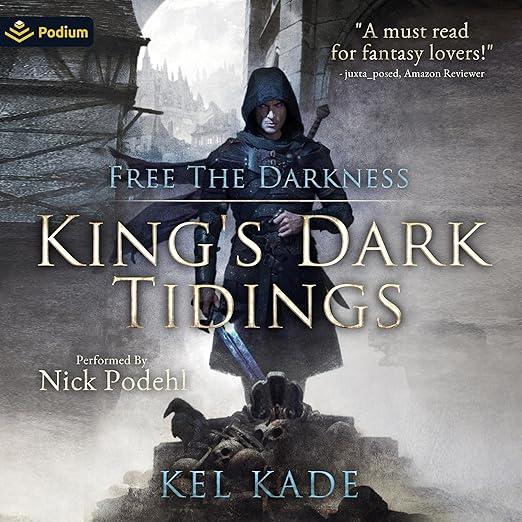
- Narration: Nick Podehl is one of the genre’s best, and he handles Rezkin’s flat affect and the surrounding ensemble with precision, his voice work is a strong reason to choose audio over print for this series opener.
- Themes: Identity and socialization, the ethics of absolute loyalty, found family under duress
- Mood: Propulsive and darkly funny in unexpected moments, with a protagonist unlike most fantasy leads
- Verdict: Free the Darkness introduces one of self-published fantasy’s more genuinely original protagonists, it rewards patience in the middle section with a world and a character that grow more interesting the longer you spend with them.
I listen to a lot of fantasy, and I have grown somewhat resigned to the particular pattern of the chosen-hero origin story. The prodigy, the secret heritage, the mentor figure who appears at the right moment, these elements recombine in familiar configurations, and I do not always mind, but I do notice. Free the Darkness caught my attention because Rezkin, its central figure, is genuinely strange in a way that the fantasy genre does not produce very often. He is trained from childhood into something close to perfect competence, but his social understanding is essentially zero. He knows how to perform human interaction because he was taught the forms. He does not know what any of it means.
That gap, between capability and understanding, is what gives the book its particular texture. The humor that emerges from it is not broad or satirical; it comes from watching an extraordinarily dangerous person navigate situations he has no real framework for, applying the logic of combat and loyalty to contexts where those tools do not quite fit. One reviewer described Rezkin as a truly strange and powerful boy and his life as incredibly tragic but logical, both things are true simultaneously, and Kel Kade maintains that balance with more consistency than you might expect from a debut fantasy novel.
Our Take on Free the Darkness
The book’s premise, elite assassin raised in complete isolation is thrust into a world he does not understand, is not entirely without precedent, but Kade’s execution avoids the most predictable version of that story. Rezkin is not gradually humanized through romantic attachment or a mentor’s wisdom. He extends protection to the people he accumulates around him not because he feels affection but because his orders require it, and watching him work out what protect means in social terms is consistently more interesting than the plot mechanics of the actual quest.
The writing is described by one reviewer as plain, literate prose that prioritizes characterization over imagery, and that is accurate. This is not an atmospherically rich fantasy in the vein of Gene Wolfe or Guy Gavriel Kay. The world is drawn clearly but not luxuriantly. What Kade does well is dialogue, the ensemble of characters Rezkin gathers around him are distinct, and their reactions to Rezkin’s strangeness are a reliable source of both comedy and poignancy.
Why Listen to Free the Darkness
Nick Podehl. He is one of the genuinely first-tier fantasy narrators working today, with a track record that includes the Stormlight Archive and the Kingkiller Chronicle, and his handling of Rezkin is particularly well-calibrated. The character requires a narrator who can deliver competent, socially flat affect without making the character feel robotic or unsympathetic, and Podehl threads that needle. The ensemble is equally well-served, each character in Rezkin’s orbit has a distinct voice, which matters in a dialogue-heavy book where the relationships are the primary engine.
One reviewer made a point worth reiterating: this series should not be read out of order, as key plot points build on each other. If you are considering this audiobook, plan to commit to at least the first two or three installments to get the full benefit of the world-building Kade lays down here.
What to Watch For in Free the Darkness
The overpowered protagonist is a real issue for some readers. A reviewer who had read through book six noted that it is hard to generate genuine tension around a character who has no physical or mental equal, and that every woman who encounters Rezkin falls for him becomes repetitive. These are legitimate criticisms of a pattern that emerges across the series. Book one presents Rezkin’s capabilities as strange and alienating rather than wish-fulfillment, which mitigates the issue somewhat, but readers who find the invincible-hero trope exhausting should factor that in.
Who Should Listen to Free the Darkness
Fantasy listeners who enjoy character-centered world-building and do not mind a protagonist who reads as deeply alien will find the first book in the King’s Dark Tidings series genuinely rewarding. It works particularly well in audio given Podehl’s narration. Readers looking for lush world-building, romantic tension with real uncertainty, or a protagonist who grows quickly through emotional experience may find the book’s strengths are not quite the ones they are looking for. Content note: the book contains graphic violence and is intended for adult readers.
Frequently Asked Questions
Is Free the Darkness truly standalone, or do I need to commit to the full King’s Dark Tidings series?
The first book is structured to introduce Rezkin and his situation, and it has enough resolution to feel complete. However, the world-building and character development pay off significantly across the series, and reviewers who had read multiple entries consistently describe the investment as worthwhile. Plan for at least a two or three book commitment if you find the first engaging.
How does Nick Podehl handle Rezkin’s emotionally flat characterization?
Very effectively. Podehl delivers Rezkin’s socially disconnected perspective without making the character feel cold or uninteresting, a real tonal challenge given that the character’s strangeness is the primary source of both humor and pathos. His work is one of the most consistent reasons reviewers recommend the audio format for this series.
The synopsis mentions graphic violence and adult content, how intense is it?
The book is marketed as intended for adult readers and contains graphic violence and some sexual innuendo, though no explicit sexual content. The violence is present but not gratuitous by the standards of contemporary fantasy. Readers sensitive to violence should be aware it is woven throughout the action sequences.
Does the book lean more into comedy or into serious fantasy worldbuilding?
Both are present, but they operate differently. The humor emerges organically from Rezkin’s social incomprehension rather than from satirical intent, and it sits alongside genuine danger and darkness. One reviewer described it as offering bits of humor and lots of action, which captures the balance reasonably well.