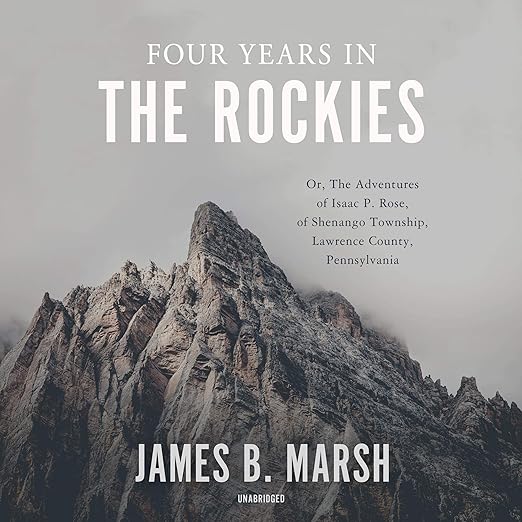
Key Details
- Narration: Traber Burns inherits sentences shaped for a parlor reading rather than for earbuds, and the publisher's sample settles this faster than any description.
- Themes: Trapping in the far west, frontier survival, an American self-invention story told in period terms
- Mood: Weathered and episodic, closer to testimony than to adventure
- Verdict: A worthwhile document for anyone drawn to the century, and a slog for anyone drawn only to the action.
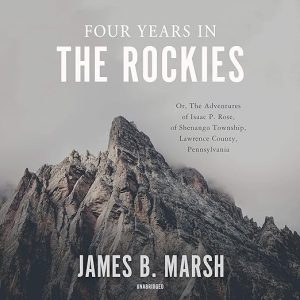
Blackstone Audio released this in June 2019, five hours and thirty-six minutes of it, under a travel and adventure heading that misrepresents what a buyer actually gets. Four Years in the Rockies is not travel writing in any sense a modern browser would recognize. James B. Marsh assembled the life of Isaac P. Rose, a trapper who worked the mountains at the height of the nineteenth-century fur trade, and the audiobook that results is a period biography of a man almost nobody has heard of, doing work nobody does anymore, written in a register nobody writes in anymore. Whether that counts as a recommendation depends entirely on what you want out of five and a half hours.
Marsh follows Rose through weather that should have finished him, animals that nearly did, and a fight that came close to costing him an arm, closing on a return to settled life and an education. The description promises that sequence and the book delivers it in that order, which is more than a lot of frontier titles manage. The copy calls the result essential listening for anyone interested in the fur trade and the men who risked their lives inside it, and on the narrow question of subject matter the claim holds up. Very little survives from inside that trade in a form a general listener can follow for five straight hours. Rose was there, he came back, and somebody wrote it down while he could still tell it.
Opinion splits at sentence level, and three stars from January 2016 state the problem better than any summary could: the writing sits somewhere between a novel and plain prose, stilted in the manner of its century, and finishing it takes determination. That same response still came down on the side of liking the story. Both halves of that verdict belong in your decision. Marsh worked at a moment when narrative nonfiction still borrowed the machinery of fiction, and the borrowing here is unrestrained. Anyone who has read much from the era settles in within twenty minutes. Anyone arriving from contemporary adventure nonfiction spends those same twenty minutes wondering why nobody gets to the point.
The Best Parts of Four Years in the Rockies
Period prose hands a reader a genuinely awkward job, and understanding the job is the fastest way to decide about this file. Traber Burns has to deliver sentences whose rhythm was built for the eye and for reading aloud in a parlor, not for a pair of earbuds on a bus. Two failure modes wait on either side: flatten the archaism into contemporary newsreading and the texture vanishes, or lean into it and the whole thing turns into costume drama. Only the narrow path between them works. One minute of the publisher's sample will tell you which way this recording leans, and on a book whose chief obstacle is its own style, that minute is worth more than any plot summary.
One structural feature deserves more credit than it gets. Five stars from February 2018 single out the chapter summaries, the short precis opening each section that hints at what is coming without spoiling the account itself. That device was ordinary in books of this vintage, and it does unexpectedly specific work in audio. It hands a listener who has drifted a fixed point to re-enter at, and it says in advance whether the next stretch is worth full attention or whether the next twenty minutes can be background. Almost no modern nonfiction audiobook offers anything comparable. On a text this demanding, the summaries function as handholds.
Before You Commit to Four Years in the Rockies
Now the counter, which is where a buyer should slow down. One rating sits at the top of this listing against five written verdicts underneath it, and the single logged grade is a four, a value one vote can legitimately produce. The mismatch matters less than what those five responses actually are. Every one of them describes reading rather than listening. One of them arrives under a handle naming the reading device it was typed on, and that same four-star verdict recommends taking the book in short spurts rather than long sessions, which is advice about eyes and a page. Four of the five predate the 2019 recording outright. The column is real reader response to Marsh's text, and not one word of it responds to this file.
Then the harder thing. Rose worked in country that already had people living in it, and Marsh wrote about those people with the assumptions of the period rather than ours. The description frames the near-loss of an arm as a skirmish with a group of Native Americans and goes no further, while the text behind it is considerably less careful. Nothing on this record indicates any modern apparatus around the material: no editor, no annotator, no introduction and no notes are credited anywhere on the file. A listener who wants that framing supplied will have to supply it personally, and a listener who would rather not hear the period speak in its own voice should choose a modern history of the trade instead.
Should You Listen to Four Years in the Rockies?
Somebody with an existing interest in the Rocky Mountain fur trade, in mountain-man culture, or in how nineteenth-century Americans told stories about themselves will get real value here. Used that way, as a document rather than as entertainment, five and a half hours is a small price for an account from inside a trade that left very few of them. It pairs well with a modern history too, supplying the texture that scholarship compresses into a paragraph: what the cold actually did to a man, how long a wound took to stop mattering, what the work was worth in a season. Teachers and reading groups working on westward expansion will find it usefully specific rather than usefully broad.
Anyone chasing the pace of contemporary adventure nonfiction should keep walking. The unevenness is genuine, with months passing in a paragraph while one animal encounter runs the length of a chapter, and the shelf label promising adventure travel sets up an expectation the book was never built to meet. Sample the opening chapter, decide there whether the voice and the century are tolerable company, and if they are, everything the description advertises does arrive, roughly on the schedule it advertises.
Questions Listeners Ask
Did Isaac Rose write this himself, or is Marsh telling the story?
Marsh is telling it. The description credits Marsh with giving insight into the life of a man who forged his own path in the far west, which is the language of biography rather than of an edited diary. Rose supplies the experience; the sentences, the shaping and the century's attitudes are Marsh's.
Does the audiobook include any historical introduction or explanatory notes?
Nothing on the record suggests it does. The file credits an author, a narrator and a publisher, and no editor, annotator or historical consultant appears anywhere on it. Listeners who want the fur trade placed in context, or the book's period attitudes addressed directly, will need a second source running alongside.
Does the runtime of this audiobook match the scope it promises?
Barely. Four working years in the mountains are squeezed into a single sitting, and it shows: long stretches of ordinary trapping pass in a sentence, while a single confrontation with weather or an animal runs at length. The book moves in episodes rather than argument.
Why is a fur-trade biography filed under travel and tourism?
Because the category system had nowhere better to put it, most likely, but the fit is poor. Marsh wrote a nineteenth-century life, not a destination book, and an adventure travel tag will route people here who expect modern expedition writing. The Rockies function as a workplace in this account, not as scenery.