Quick Take
- Narration: Daniel Wisniewski handles the duet-style narration format with skill, lending the frontier fantasy world distinct vocal registers that suit the litrpg-adjacent tone.
- Themes: Outsider advantage and limitless potential, frontier justice in a world of beastkin and magic, cross-species world-building
- Mood: Propulsive and escapist, with a frontier-western fantasy atmosphere
- Verdict: An ambitious 85-hour complete-series package that delivers immersive beastkin frontier fantasy for readers who want to commit to a fully realized world.
There is a specific kind of reader who, upon seeing 85 hours and 21 minutes in the runtime field, does not feel daunted but rather relieved. For those readers, the complete Four Laws series package represents something genuinely valuable: a fully realized world to disappear into at a scale that actually allows for immersion rather than just a visit. I approached this one knowing it would be a months-long companion rather than a weekend commitment.
David Burke's premise is familiar to readers of portal fantasy and litrpg-adjacent fiction: a man from our world, transplanted into another. But the execution has its own flavor, and the specifics of Rob's situation shape a story that is more interesting than a standard power-fantasy delivery.
Our Take on Four Laws: The Complete Series
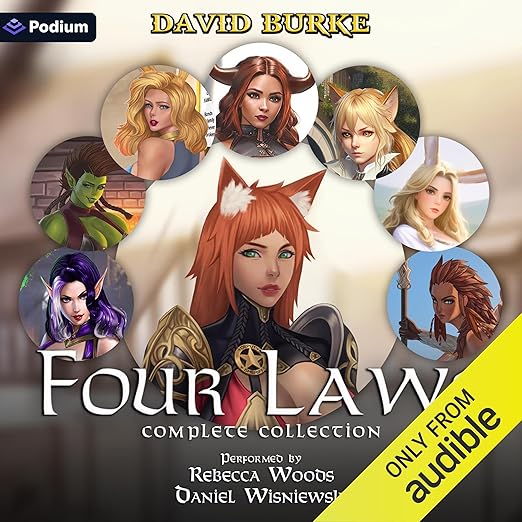
Rob is a California police officer, tired of dealing with the particular frustrations of his jurisdiction, when a goddess offers him a deal: his life ends in six hours in his current world, or he lives out the rest of his days in a universe where time runs differently. He takes the deal. What he arrives into is a frontier town populated by beastkin, elves, and orcs, a world with established races whose stats and abilities operate on fixed systems. Rob's disadvantage is immediate and physical: he is outclassed in strength, speed, durability, and he cannot use the local magic at all.
His single advantage is the one that carries the series: as an outsider, his stats are not capped. Where every other race hits a ceiling, Rob has limitless potential. The story is fundamentally about the labor and cost of that potential, about what it actually means to train from zero when everyone around you has inherent advantages you cannot shortcut.
Why Listen to Four Laws
Daniel Wisniewski navigates the duet-style narration format with skill, giving the broad cast of beastkin, elves, and orcs enough vocal distinction to track across a series of this length. The narration format itself is worth noting: duet style typically means two voices alternating or harmonizing across scenes, which suits a story with multiple significant perspectives and helps break up what could otherwise become an overwhelming single-voice commitment at 85 hours.
Burke's world-building is the primary pleasure. The frontier-town setting, with its mix of fantastical races and the social dynamics of a place where law is still being established, gives the story texture beyond the straightforward progression-fantasy template. Rob's law-enforcement background informs how he approaches conflict and problem-solving in ways that distinguish him from the standard protagonist-from-another-world type.
What to Watch For in Four Laws
This is a newly released complete series, and with only nine reviews available at publication, the reader consensus is still forming. The high average rating suggests strong satisfaction among early adopters, but potential listeners should be aware they are committing to a significant time investment with less community discussion to draw on than a longer-established series. The beautiful monster girls element noted in the synopsis signals that romantic subplots are part of the package, a tone marker for readers calibrating their expectations.
The litrpg-adjacent framework, with its stat ceilings, outsider advantages, and progression mechanics, will feel immediately comfortable to readers of that tradition and potentially unfamiliar to those approaching this as straightforward fantasy. Burke does not spend extensive time explaining the system; he assumes readers will acclimate, which they generally do.
Who Should Listen to Four Laws: The Complete Series
Designed for readers who enjoy portal fantasy and litrpg-adjacent progression stories with a frontier-world flavor. The complete series package is particularly suited to listeners who want to experience a full narrative arc without waiting for installments. Those who enjoyed similar outsider-with-unlimited-potential frameworks in other progression fantasy series will find familiar pleasures here. Readers new to the genre or those who prefer lower runtime commitments should start with individual volumes of other series to test their appetite before committing 85 hours.
Frequently Asked Questions
Is the Four Laws series litrpg, or is it more traditional portal fantasy?
It sits in between, with litrpg-adjacent mechanics such as stat caps, progression systems, and outsider advantages operating within a portal fantasy structure. Rob arrives in a world that has its own established rules and hierarchies, and his limitless stat potential is the series' core mechanical premise. Readers comfortable with progression fantasy conventions will feel at home.
What does ‘narrated in duet style’ mean for the listening experience?
Duet style typically involves two narrators performing the text, often alternating by character perspective or scene. Daniel Wisniewski leads the narration, and the format suits a series this long by providing vocal variety and helping distinguish character viewpoints across the full 85-hour runtime.
Does the complete series resolve its major story arcs, or does it end on ongoing threads?
As a complete series package, the expectation is that major arcs receive resolution. However, with a limited number of reviews available at time of publication, community consensus on how satisfying the conclusion is has not fully formed. The complete-series framing suggests Burke designed this as a finished narrative.
How does Rob’s law-enforcement background actually influence the story, or is it just backstory?
Burke uses it as character texture rather than just setup. Rob's approach to conflict, his instinct for procedure and de-escalation, and his skepticism of violence-first solutions all trace back to his police background. It gives him a distinctive problem-solving register that distinguishes him from the typical warrior-protagonist archetype in progression fantasy.